Another long post, but it tries to capture the all the work and learning so far. Pics of progress are attached.
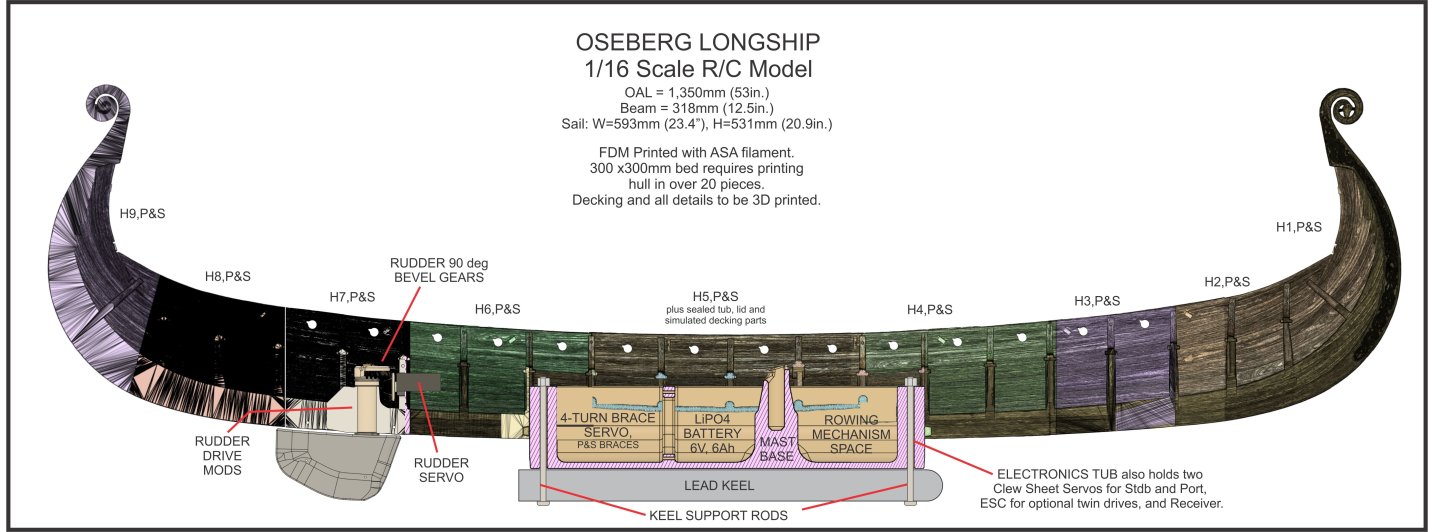
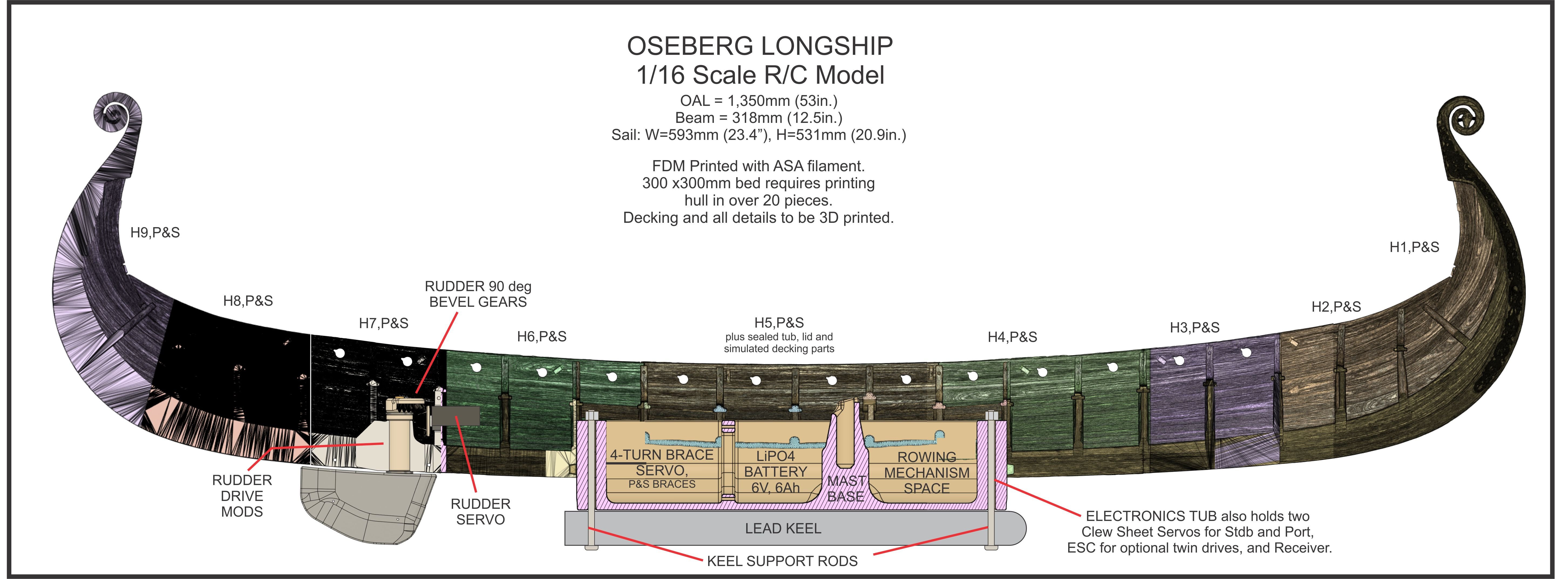
The 1/16th scale R/C build based on the Oseberg longship is a fair way along. The overall length will be 1350mm (53”) and beam 319mm (12.5”).
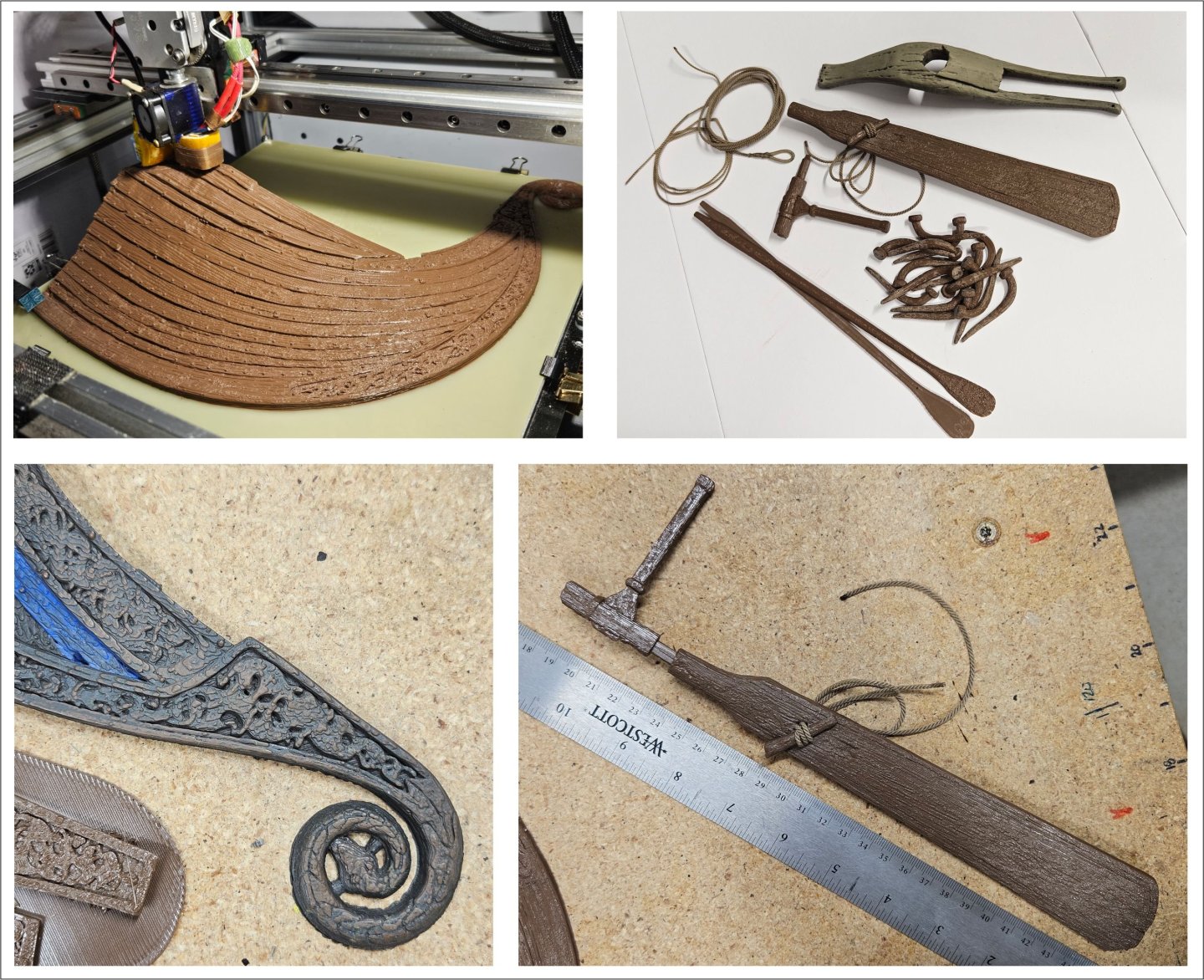
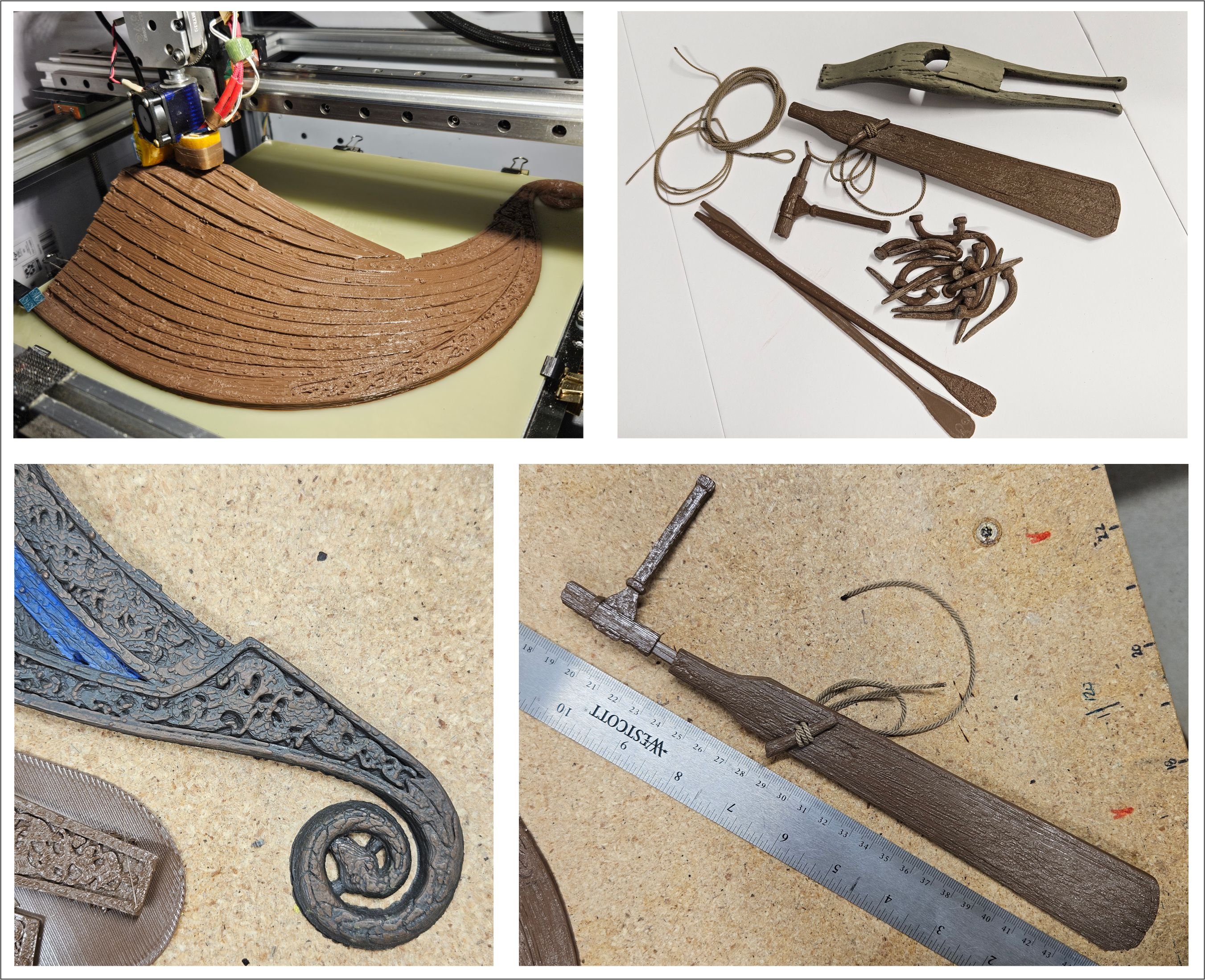
The hull is being 3D printed in ASA, a tough, weather and UV resistant plastic. The STL files for the hull were purchased from Black Forge Models, and compare very closely with the plans published in the Vibeke Bischoff Oseberg dissertation. The files were scaled up by a factor of 2.7 to produce the 1/16 scale size. 3D printed plastic was chosen for the hull because I no longer can build, or figure out how to build, the complex curved lapstrake hull. And having seen so many instances of large wood hulled sailing models exhibiting water damage over time, plastic became the material of choice. Finally, the 3D printer puts in the long build hours, requiring very little of my time or skill.
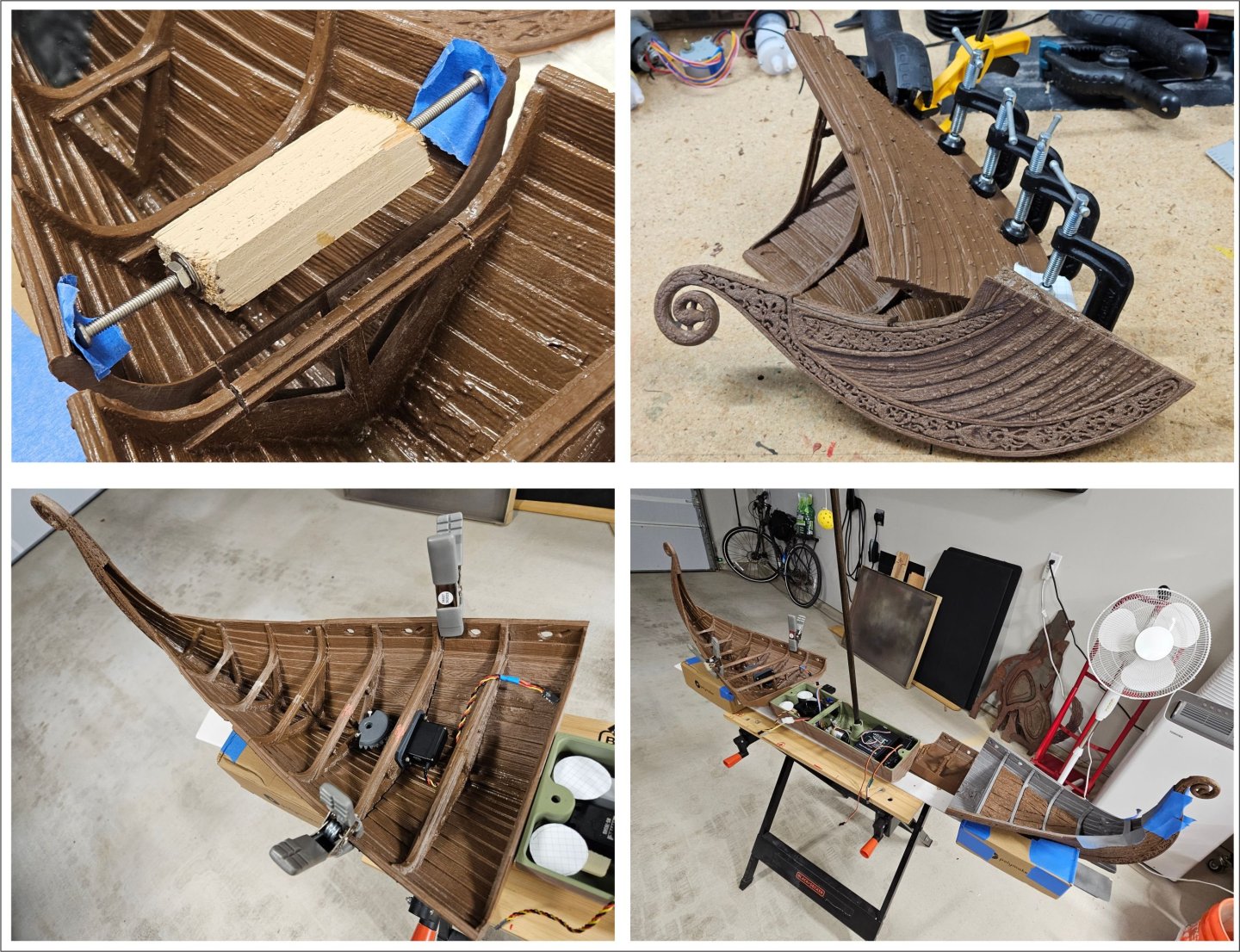
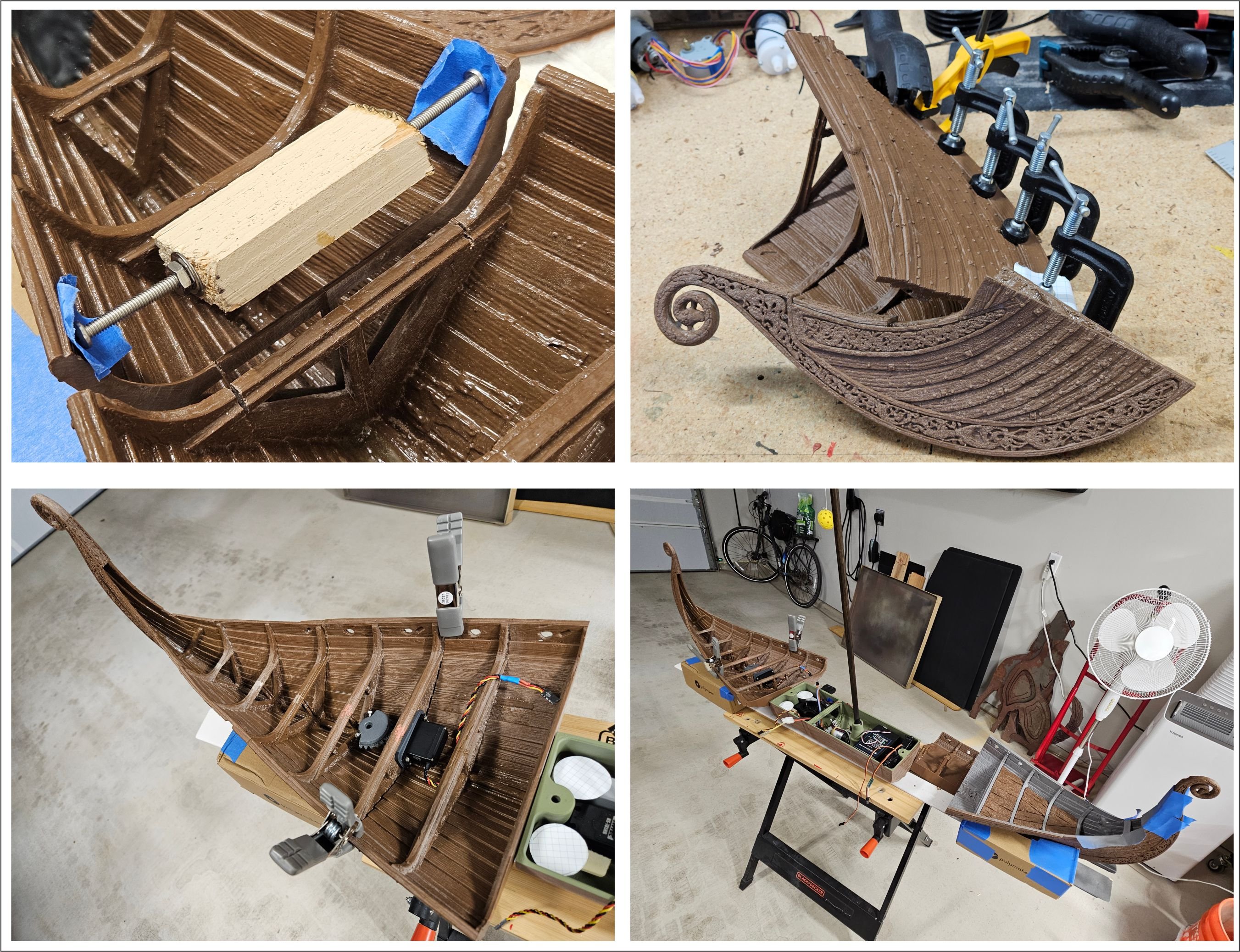
The model is so large that the hull files had to be broken up into 24 separate parts to fit the 300x300mm print bed. Dealing with the extremely large mesh STL files was painfully slow using Autodesk Fusion that typically ate up nearly 32Gig of ram for processing. The separate ASA parts are fused together with a solvent blend of MEK and acetone. Nitrile gloves and organic respirator were used, in addition to ventilation. The separate parts fuse and essentially become one.
The sailing objectives for this model require a yard brace winch servo, two independent sail clew winch servos, a yard lift servo and a functional rudder servo. The use of one servo to control the yard rotation and one independent servo at each of the sail clews is based on testing using a full-scale dummy test rig with a large fan. The independent clew sheets allowed trimming to get the best prototype “look” and control of the large square sail. That testing also allowed exact measurement of the line pull required for each winch servo, needed to calculate the rotation and diameters of the winch drums. HiTec HS-785HB winch servos will be used.
The yard lift servo may or may not be added, but after scores of hours sailing a 2 meter (six-plus foot) R/C brig on open water, I’ve found that the ability to douse the sails is critical when wind gusts whip up or the model runs away. On the brig, the fore and mainmast sails could be opposingly-rotated to stall the model, but with only one large sail on this model, I think the ability to lower the sail remotely will be necessary.
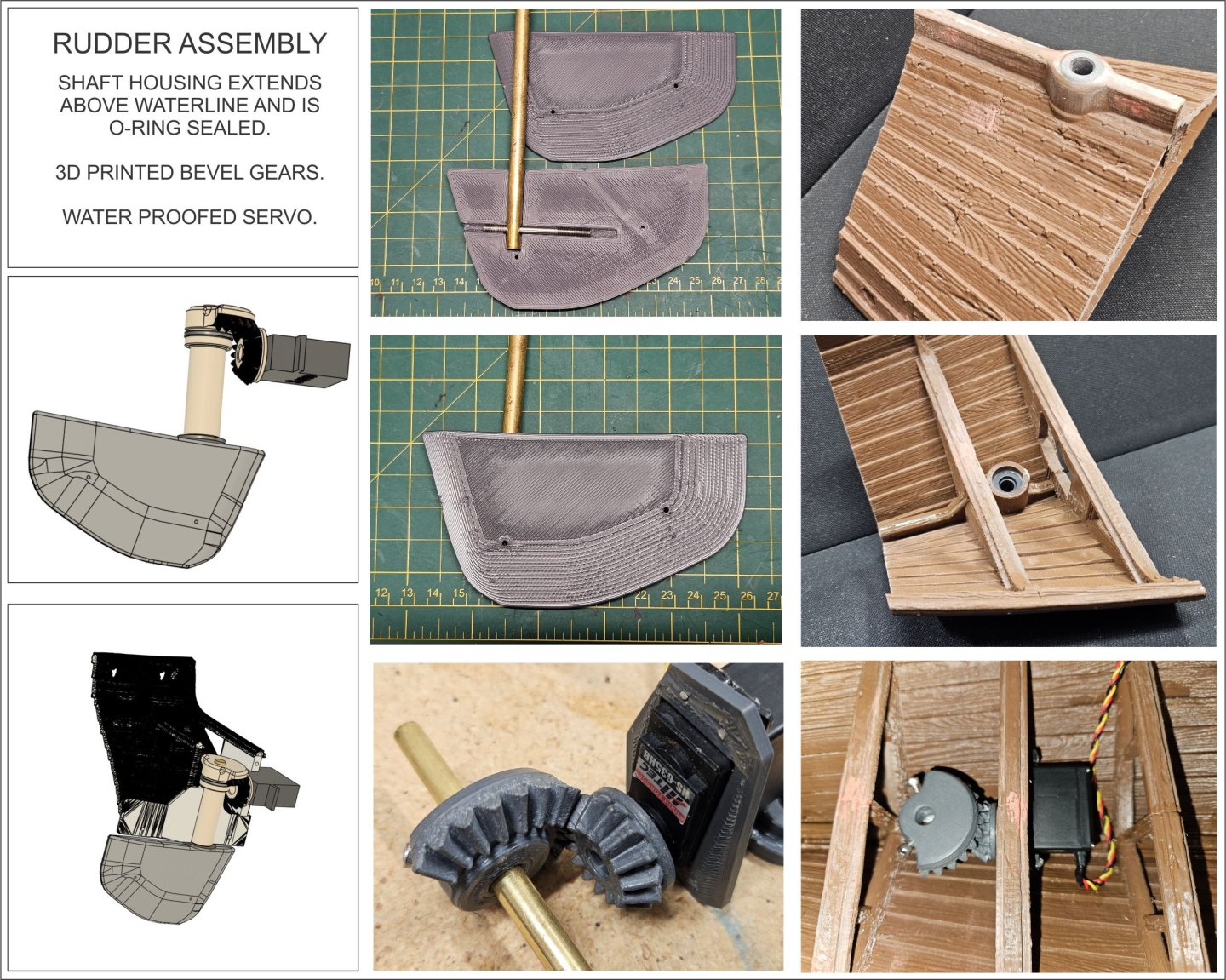
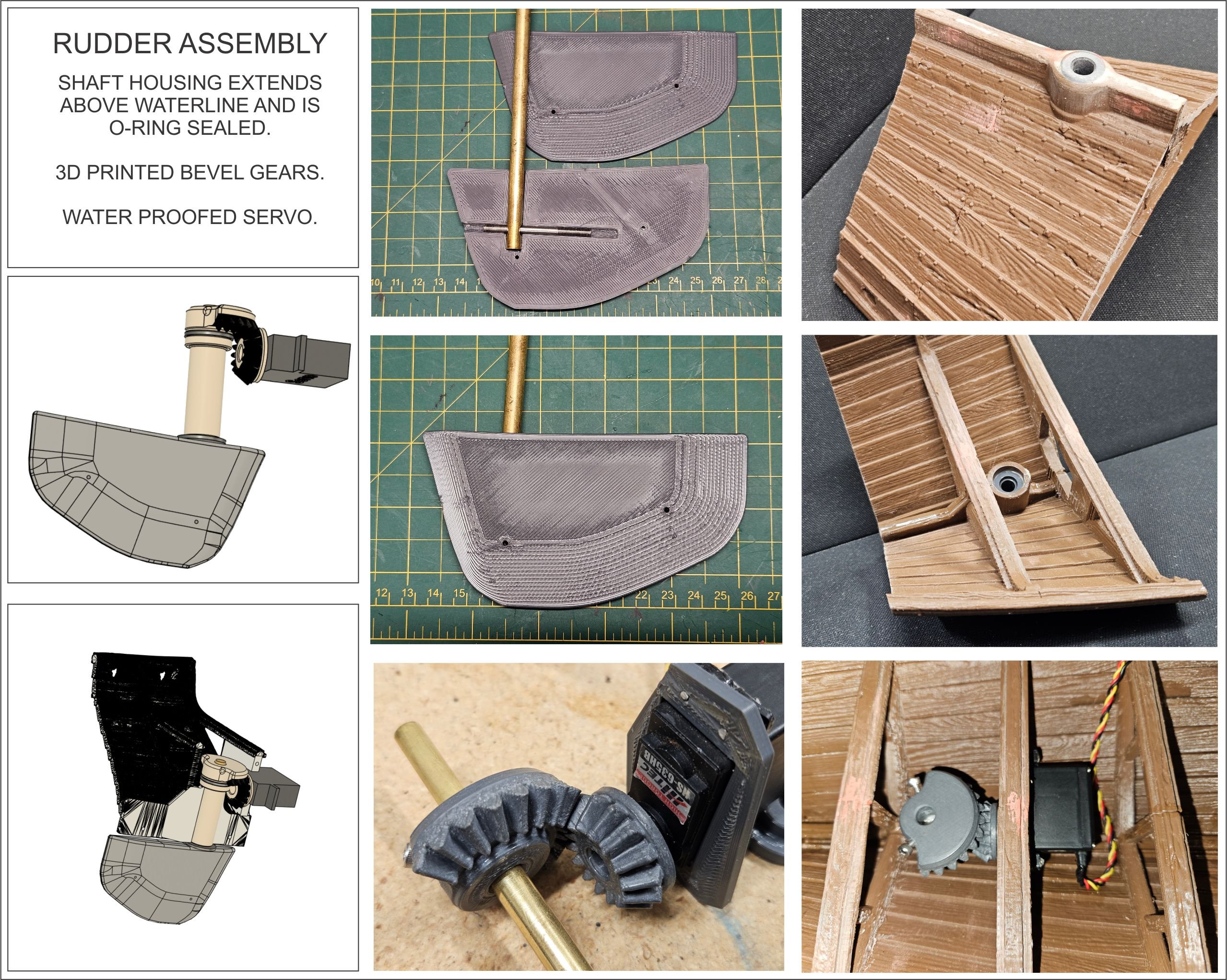
Given the length and mass of this model, the scale prototype rudder would likely not be effective, so an additional functional rudder was added to the hull. The initial shape may need to be changed after testing. The scale rudder will be static.
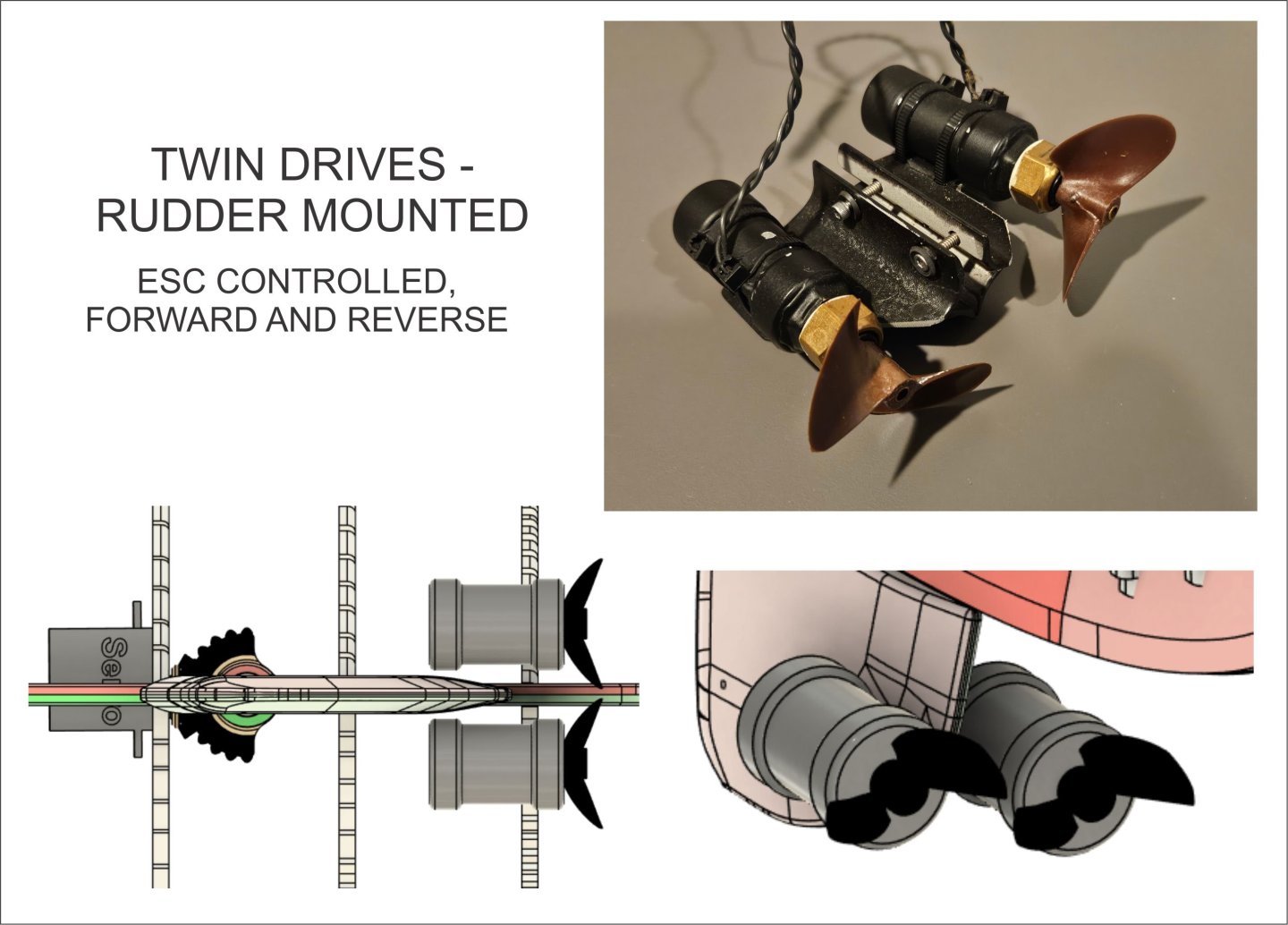
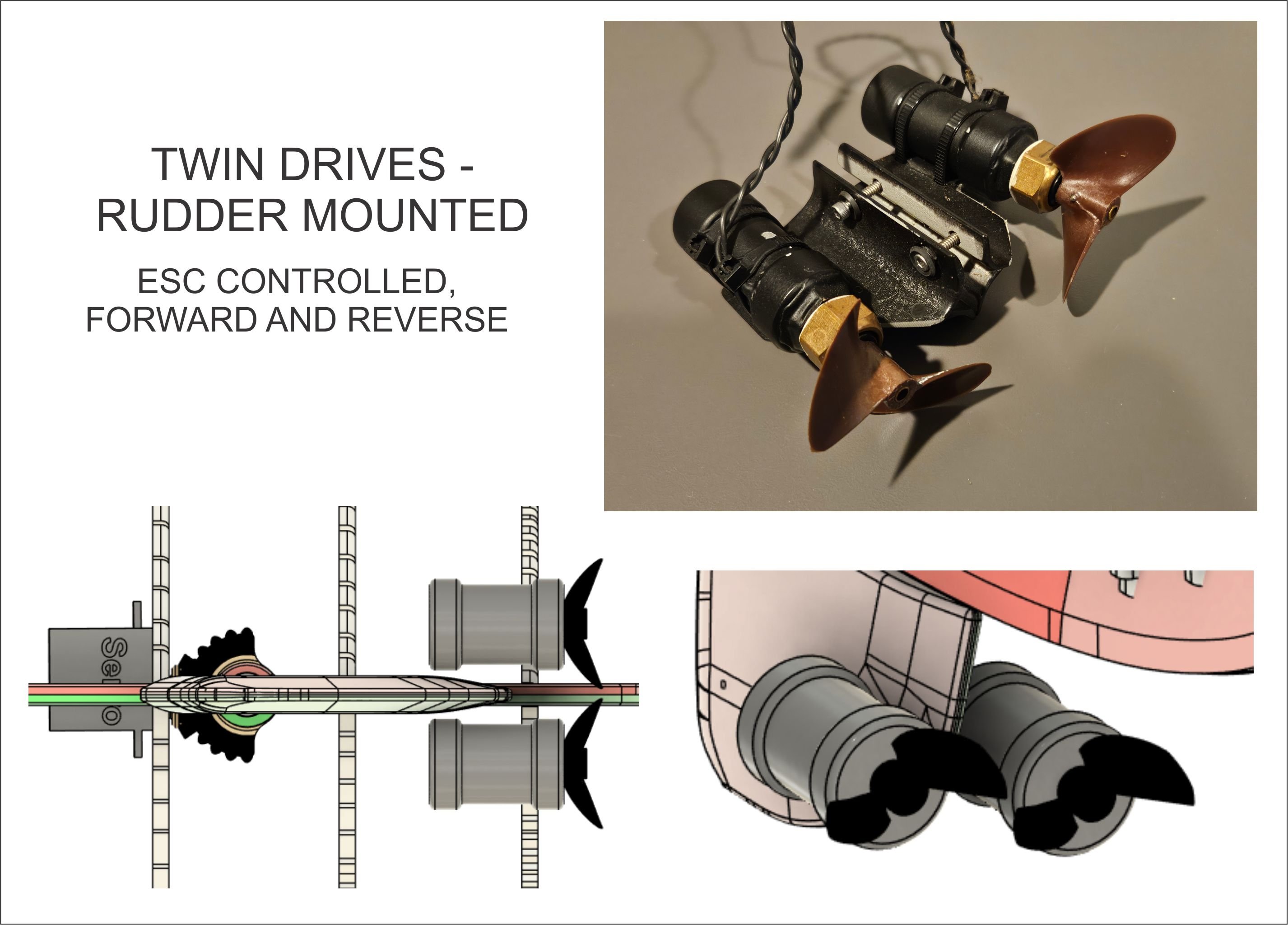
In addition, a twin-motor/prop drive will be mounted on the rudder. In our boat club shows on a small pond with many other boats around, the drives are necessary to maneuver in the limited sea-room and to avoid collisions. The motors also allow sailing past weedy shorelines out to open water.
Eventually, I’d like to add a rowing mechanism with crew. I have a preliminary design, but a lot of testing and development will be needed. And printing and installing over twenty 100mm tall Vikings that will likely weigh almost a kilogram, in addition to the mechanism weight, will be a challenge.
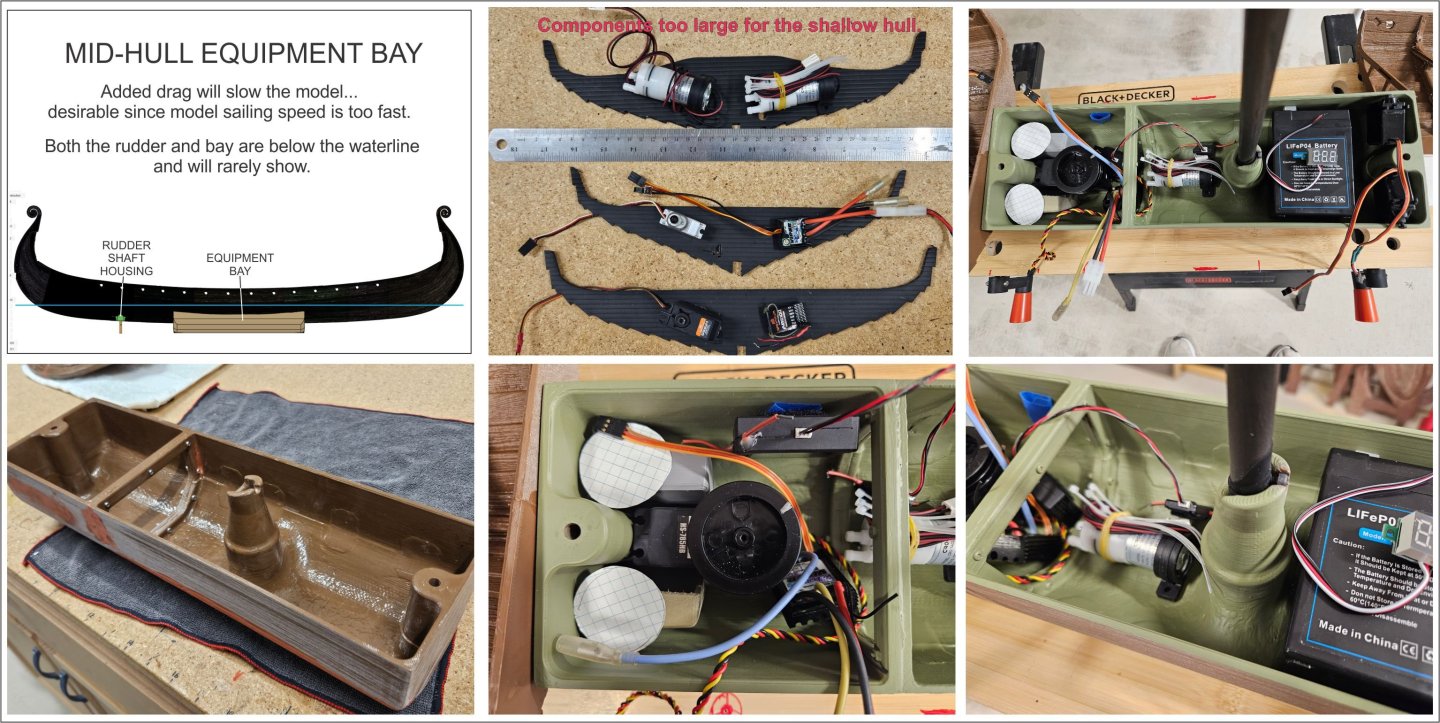
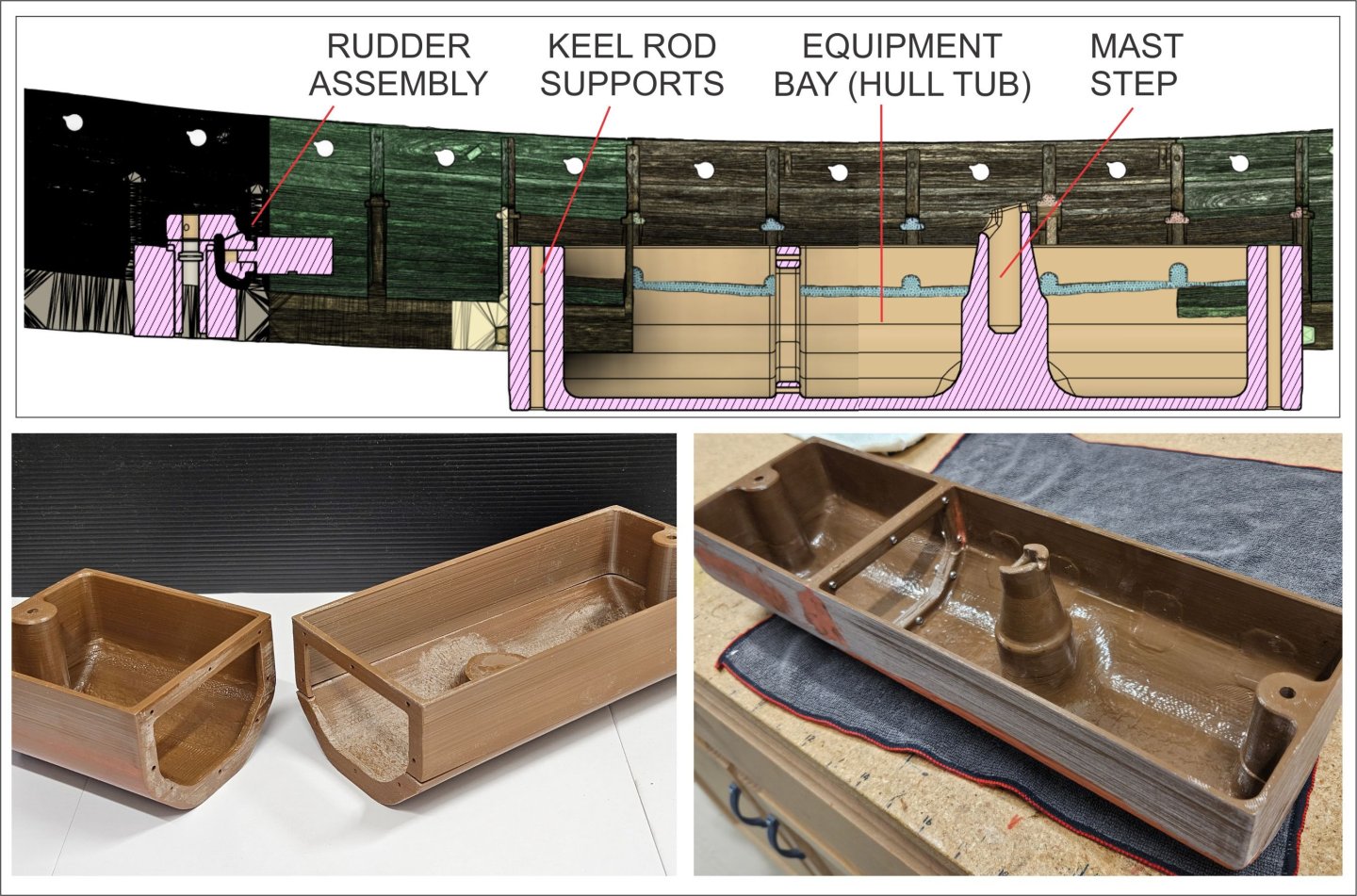
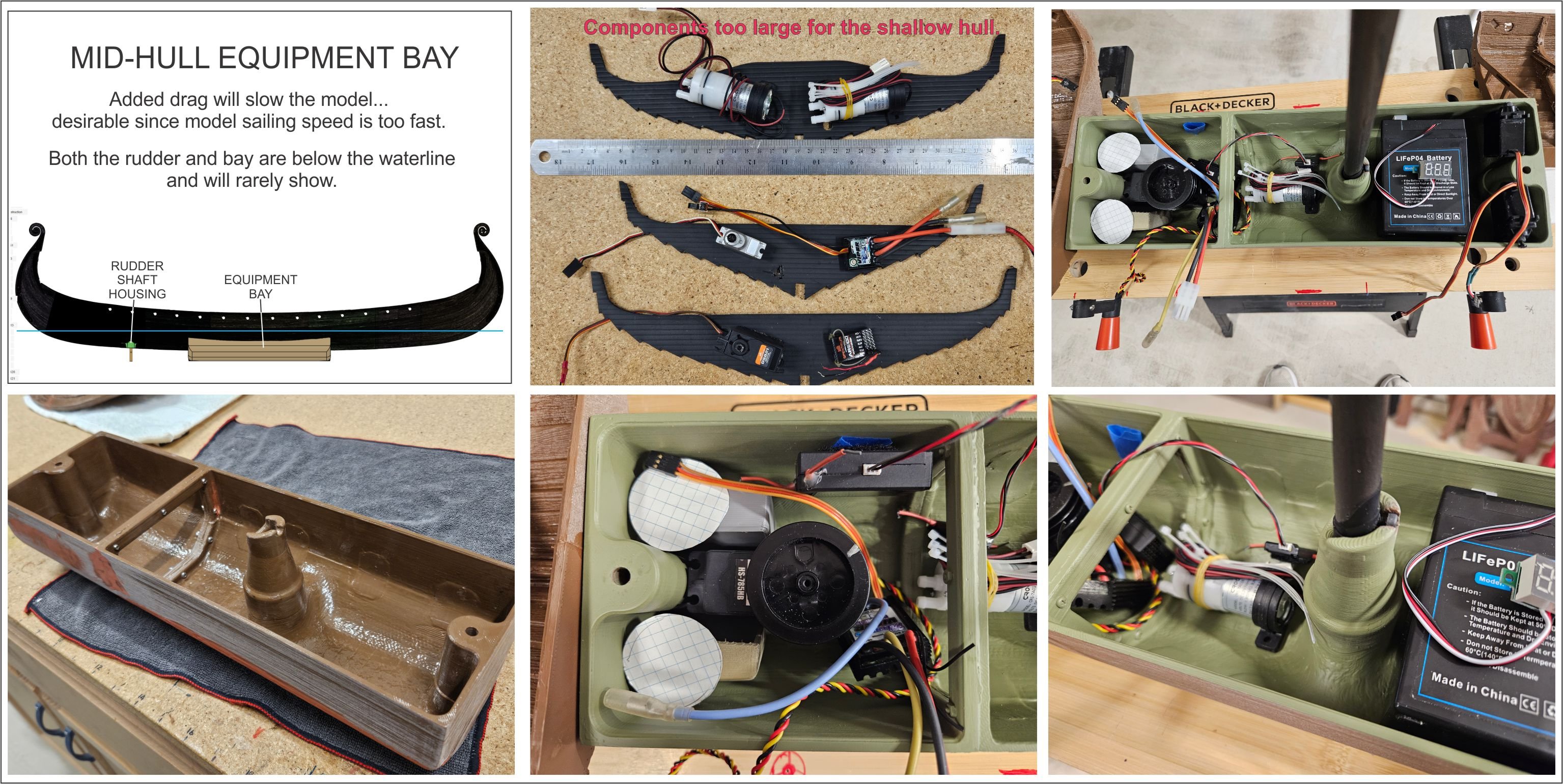
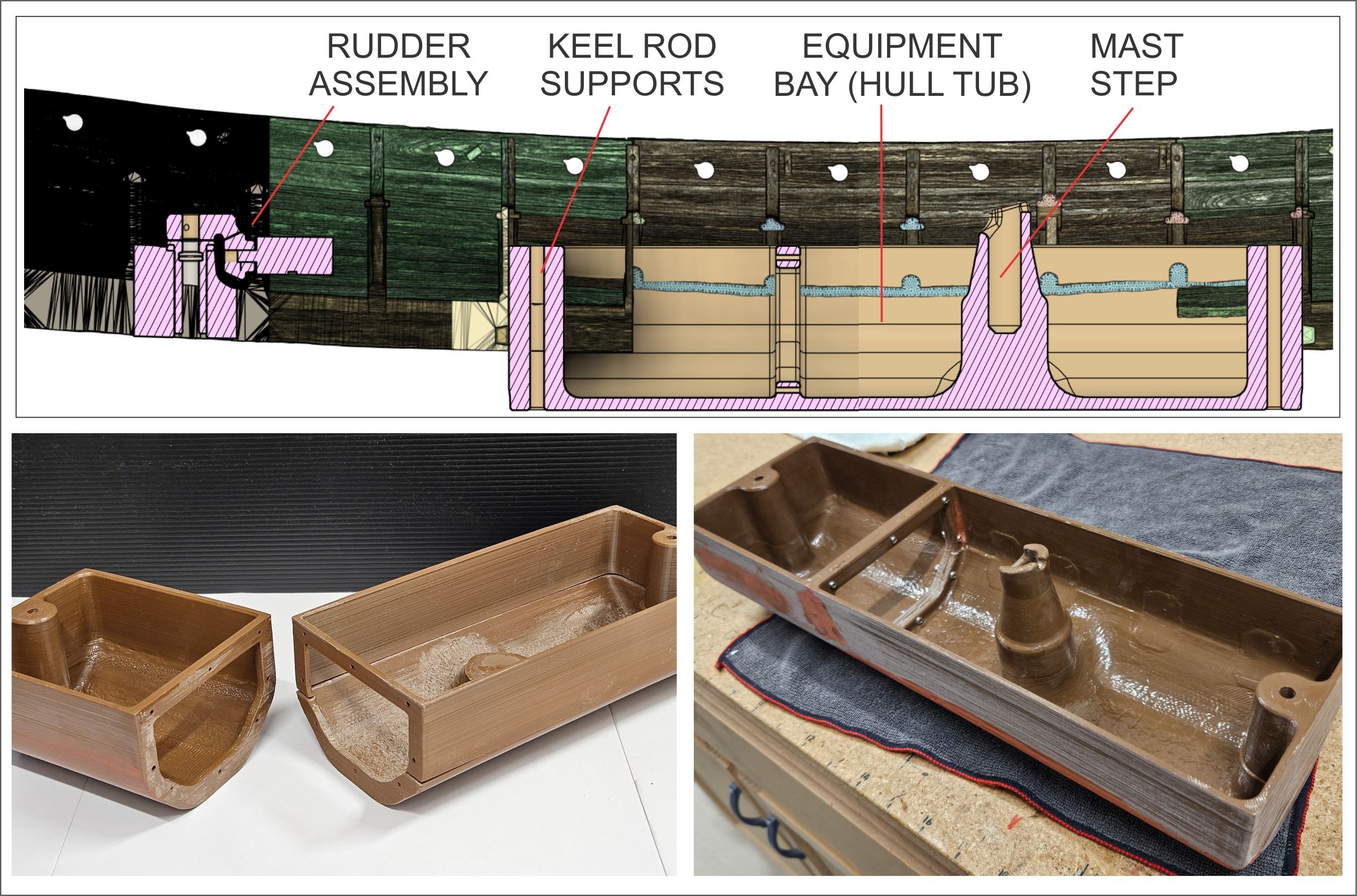
To fit all the above, along with a 6V,6Ah LiFePO4 battery, RX, ESC, rowing mechanism, etc., the very shallow draft hull needed to be modified. A midship equipment bay was added. It does not show above the waterline, and the model can be displayed without the external R/C modifications showing: the rudder can be removed and a stand and name plaque can hide the hull addition.
The two main build challenges so far have been targeting a suitable buoyancy-to-weight ratio with a lightweight hull and secondly, fitting all the R/C equipment:
- Buoyancy: Because of the large, single sail area that can be very close-hauled, the hull weight above water needs to be kept at a minimum to allow keeping the center of gravity well below the center of buoyancy with a heavy and deeply suspended keel. That should help minimize knockdowns in gusty winds.
- R/C equipment fit: Scale frames were printed early on to test fit the R/C gear. It was obvious that with the very shallow hull a deeper equipment bay needed to be added to the hull as shown in the pictures. The equipment bay structure will be under the waterline and should help lower the overall center of gravity.
Rigging function and deck details will be kept prototypical looking, similar to the approach on the Syren build. The line will be made on a ropewalk with 100% polyester at various needed scale diameters. The sail material will be Supplex, a lightweight, UV resistant nylon fabric.
The above covers most of the design considerations. Following is some of the work already completed:
The hull sections take a long time to print – 8 to 13 hours each. They are printed in a 50 deg.C heated chamber to prevent warping. Dimensional shrink has been about 1% and the hull sections have mated very closely, allowing tight fit joints for gluing and appearance. Clamps and a spreader, as shown in the pics, were used to precisely align hull sections for bonding. A fair amount of print support structure cleanup is necessary, with roughly a 70% part:30% support material ratio seen with the use of “column supports” in early print sections. Switching to “tree supports” in a different slicer reduced the print times, waste and cleanup effort significantly in later prints.
The external surfaces of the printed parts are brass-wire brushed to smooth out the print layer lines and other print artifacts. Assembled sections are filled and sanded to blend joint lines where necessary.
The internal structure of the 3D printed parts is porous (at 70% fill), so water intrusion needs to be prevented. Three solid outer walls are used and then the whole part is brushed with solvent to “skin-over” the surface. Multiple paint layers will also help. Krylon spray paint will be used - it has held up extremely well on my heavily sailed brig since about 2009 - 16 years now.
After all the hull sections are printed and assembled, the buoyancy will be tested, hoping for the best. The parts were printed at 70% infill and seem light enough, but if too heavy the whole hull would have to be re-printed at lower fill – a tremendous setback. I should have given this more thought and research before all the printing – hopefully not a significant mistake. The hull equipment bay is designed to support keel suspension rods, so ballast weight will also be determined with a test keel. For the keel, I plan to use a piece of flattened and shaped PVC pipe filled with lead pellets, sized and made after the initial ballast weight determination.
The rudder, servo and gear mechanism has been printed, assembled and tested.
The twin motor drive from my R/C brig, Syren, will be used on this model. It only needs to be fitted to the rudder. The drive mounted on the rudder gives very high maneuverability on a large model, needed in small water bodies, around other models, to get to clear, non-weedy sailing areas and to get to shore if winds die or sail control fails.
The next step will be figuring out the decking and sealing to prevent flooding, yet allow access for the future addition of a rowing mechanism. After that, electrical and mechanical installation, detailing, painting, sailmaking and rigging will be started.
I'm still looking for STL files for figures to be used as Viking oarsman. I have one set, but there are only three different figures and they are in helmets and armor - an unlikely look for working oarsman. Any hints on sourcing a 3D printable crew would be much appreciated.
Any helpful hints or comments are very much appreciated.
Thank you.