

.jpg.6c90d67e7e9071af590f4d4a2a8bc908.jpg)
Waldemar
-
Posts
987 -
Joined
Content Type
Profiles
Forums
Gallery
Events
Everything posted by Waldemar
-
.thumb.jpg.c6343966b029e7941df5b987d129aac6.jpg)
48pdr cannon
Waldemar replied to Thanasis's topic in Discussion for a Ship's Deck Furniture, Guns, boats and other Fittings
... this is much better, surer method than calculations based on the crazy specific densities of substances like iron or stone used in the shot manufacture. -
48pdr cannon
Waldemar replied to Thanasis's topic in Discussion for a Ship's Deck Furniture, Guns, boats and other Fittings
As evoked by Bruce, a simple formula can be used to calculate any bore (or roundshot) diameter, just knowing only one from a given calibre system. There were naturally some small individual variations for different reasons, but it usually works within production tolerances, at least for identification purposes. Diameter1³ Poundage1 ------------------------ = ----------------------- Diameter2³ Poundage2 For example, if you know that the bore diameter of a French 48 pounder is 19.4 cm, and you are looking for a diameter of a (theoretical) French 68 pounder gun, then: 19.4³ 48 (pdr) -------------- = -------------- x³ 68 (pdr) x³ = (19.4³ * 68) / 48 = 10343,63 =====> x = 21.8 cm (bore diameter of a theoretical French 68-pounder) For better results, avoid – if possible – mixing calibres of different systems used in specific countries. -
48pdr cannon
Waldemar replied to Thanasis's topic in Discussion for a Ship's Deck Furniture, Guns, boats and other Fittings
Is it acceptable in this fine project to arm the ship („Terpsichore“) operating already in 1821 with the ordnance specifically designed in 1825 (and delivered in 1826) for „Karteria“? You decide, but if the current preferences are for a modern carronade (or carronade like gun) of exactly 48 pound caliber, you are perhaps left only with Russian or Ottoman ordnance, or maybe a British specimen aimed at the merchant market too. The inventory and weight marks cut on the baserings of bronze cannons in the two pictures above are not much helpful here. -
48pdr cannon
Waldemar replied to Thanasis's topic in Discussion for a Ship's Deck Furniture, Guns, boats and other Fittings
Well, factories can be taken over (captured) too, like cities or fortresses. Never mind... The text reads (ou, already translated by Bruce): "This gun is formed like a carronade except that it is longer and has trunnions resembling those of a long gun". One may also add here: just like in carronades intended for merchant service (in contrast to naval/military service), which had normally trunnions as well. This quasi-carronade concept/project by Hastings could not be modelled after Paixhans system, as this system was not yet fully invented, or at least accepted by the French Navy. See Gerard's posts. It seems, that it is just an invention by Hastings. Maybe actually cast, maybe not. Don't be afraid of the apparently obsolete stone (chambered) guns, as they could be deadly efficient even against large warships. You perhaps know a famous accident, from just a few years before, when a large stone roundshot from an Ottoman gun smashed at the large British ship-of-the-line, making terrible damage and killing some of the crew on the spot. Only range was lacking, just as in carronades. -
48pdr cannon
Waldemar replied to Thanasis's topic in Discussion for a Ship's Deck Furniture, Guns, boats and other Fittings
Just to be on the safe side: no armament factory (gunfoundry) in Greece then? Taking all this into account, and especially the available sources of artillery armament, I would turn into the Ottoman or Venetian ordnance. If Ottoman, it could be half-kantar gun, which may be regarded as an equivalent of the Western carronade of roughly the standard 48-pdr size. This half-kantar gun, in its shape, was not far from the obsolete, medieval stone guns (cannon-periers). And all of these chambered guns were still widely used on board Ottoman ships even in 19th century. Always cast in bronze. For example, in the Russo-Turkish war of 1787-1792, Ottoman 86-gun battleships had four half-kantar guns. Ottomans also cast copies of Venetian and Russian longer unicorns (cannon-howitzers), but these should be easily distinguished by a professional like Hastings from a carronade-like guns with shorter barrels. If not Ottoman, you can take into account Venetian ordnance, with hundreds, if not thousands of specimens lying all around. Many of them, in function and capabilities, were almost perfect equivalent of modern guns. Again, first take a look at what was used locally then... -
48pdr cannon
Waldemar replied to Thanasis's topic in Discussion for a Ship's Deck Furniture, Guns, boats and other Fittings
Well, if you insist on something more modern, quite detailed data is available for the Russian carronades and the so-called unicorns, both naval service, and both also in 48-pdr size, and both in regular service in 18th and 19th centuries. As an aside, Russian unicorns are in practice nothing more than copies of Venetian guns of the New Invention from 1684. You just need to establish such possibility in your sources. And keep in mind that even "Karteria", built abroad few years later than the "Terpsichore", had to wait several months for her modern, state-of-the-art armament. Meanwhile, she got temporary, more or less random guns taken from a fortress. -
48pdr cannon
Waldemar replied to Thanasis's topic in Discussion for a Ship's Deck Furniture, Guns, boats and other Fittings
May I ask you, what is the current state of this research except data you have already put in this thread? Thank you in advance. -
48pdr cannon
Waldemar replied to Thanasis's topic in Discussion for a Ship's Deck Furniture, Guns, boats and other Fittings
There is also another possibility, ie. that of Venetian guns of the so-called "New Invention" from around 1684, being in essence cannon-howitzers, just like the later French Paixhans guns (canon-obusiers). Two models were produced in modest quantities, with calibres of 265 mm and 212 mm (respectively of 200 and 120 „small“ Venetian pounds). The calibre of the smaller version is quite close to the supposed, later „48-pdr carronade“. Two prototypes were cast from iron in England (six calibres long, ~1670 kg). „Normal“ production specimens were cast in bronze at the Venice Arsenal (3500 „large“ Venetian pounds = ~1560 kg). More on these guns in G. Candiani, The race to big calibres during the first war of Morea and Sigismondo Alberghetti’s guns of new inwention, [in:] Ships and Guns. The Sea Ordnance in Venice and Europe between the 15th and 17th Centuries, 2011. Smaller, 120-pdr (212 mm) Gun of the New Invention (cannon-howitzer), with its shell beneath the muzzle: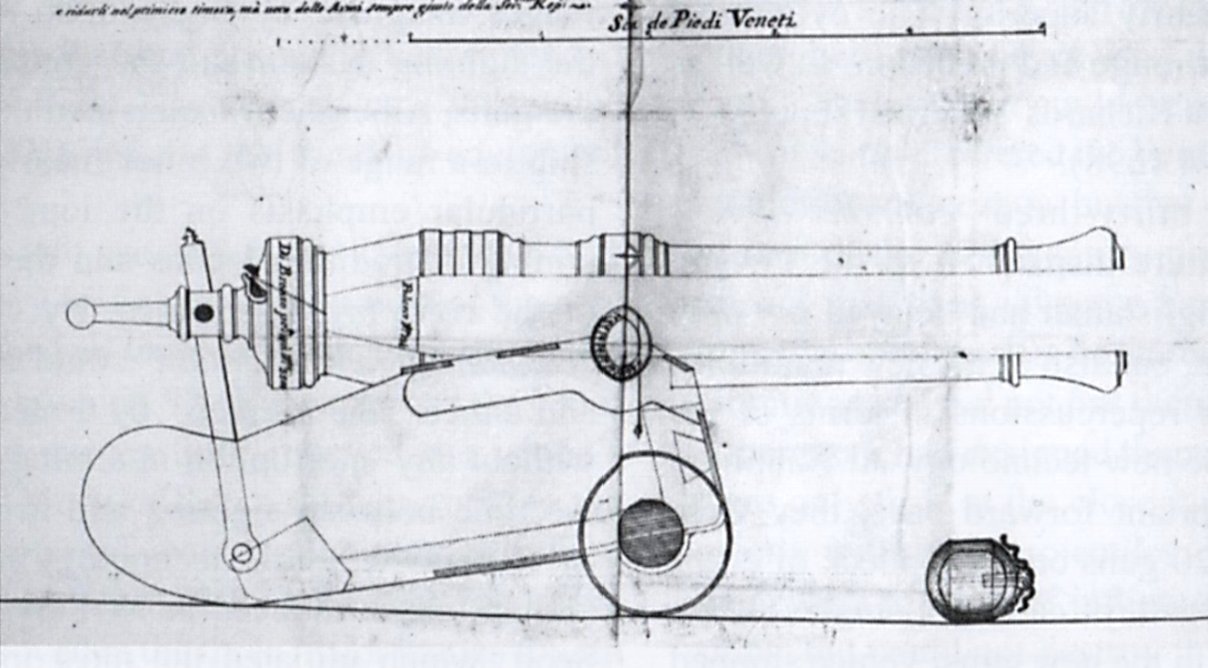
-
48pdr cannon
Waldemar replied to Thanasis's topic in Discussion for a Ship's Deck Furniture, Guns, boats and other Fittings
More details on a matching Venetian „48-pdr carronade“ (from the book by C. Beltrame and M. Morin, I Cannoni di Venezia. Artiglierie della Serenissima in Turchia, Grecia e Dalmazia, 2013). Tipologia: cannone petriero da 90 in bronzo Località di conservazione: Askeri muze ve Kultur Sitesi Komutani Istanbul N° di inventario: 261 Fonditore: Tommaso di Conti Anno di fusione: ante quem 1540 Proprietà: statale Calibro: 19.2 cm Peso pezzo marcato: 1360 (il peso in libbre grosse alla veneziana) = ~610 kg Dimensioni: 190 cm (lungh. tot.), 174 cm (lungh. conv.), 30.7 cm (diam. al foc.), 31.8 cm (diam. agli orecch.), 26 cm (diam. alla gioia), 32 cm (diam. della gioia). Descrizione: pezzo di tipo “camerato”, ossia con canna il cui diametro in corrispondenza della culatta è ridotto. L’arma è dotata di rinforzo centrale mentre la volata, e parte del posteriore, sono più strette. La gioia di bocca presenta una gola molto pronunciata. Sulla parte alta della volata una doppia cordonatura crea una fascia su cui è presente la X del Consiglio dei Dieci. Al di sotto è presente un leone accosciato verso destra soprastante le iniziali T e C tra triangolini, indicanti il fonditore. Al centro dell’anello di culatta è inciso il numero 1360 indicante il peso in libbre grosse alla veneziana. Sul pomo sono incise due linee parallele. Sample stone gun (cannon-perier) intersections:-2.thumb.jpg.6ee5d69d3a9f6a1ea819beb0b0c95250.jpg)
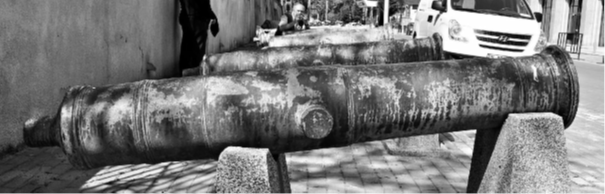
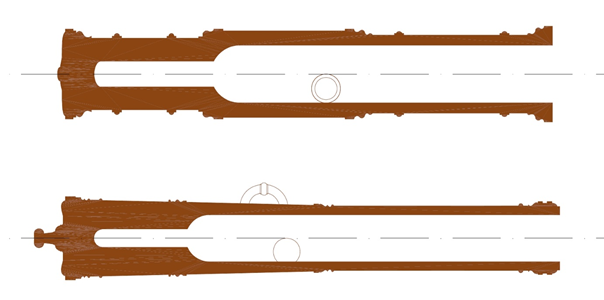
-
48pdr cannon
Waldemar replied to Thanasis's topic in Discussion for a Ship's Deck Furniture, Guns, boats and other Fittings
… and it would be rather a bronze gun, relatively lightweight, up to, say, 700–800 kg. -
48pdr cannon
Waldemar replied to Thanasis's topic in Discussion for a Ship's Deck Furniture, Guns, boats and other Fittings
Thanasis: An obsolete large Venetian stone gun (petriera, cannon-perier) would lovely match the available data on your gun. Such guns could be quite long, sometimes almost like true-bored cannons. Large bore in the range of 18–19 cm diameter would roughly match the closest standard 48-pdr shot. And perhaps best of all, it was a chambered gun, just like the carronade, and essentially it could be used as carronade, hence classed as such by the Philhellenes. -
48pdr cannon
Waldemar replied to Thanasis's topic in Discussion for a Ship's Deck Furniture, Guns, boats and other Fittings
Licentia poetica? My straightforward interpretation (hopefully in line with the intention of both author and translator) is: 48 pounder carronade = carronade of the calibre of 48 = carronade of the calibre of 7 inches Just different descriptions of a new proposed type (class) of ordnance with the French standard 48 pound (or 7 inches) calibre. Gerard, am I right or otherwise? -
48pdr cannon
Waldemar replied to Thanasis's topic in Discussion for a Ship's Deck Furniture, Guns, boats and other Fittings
… logistic issues may be of help too. What was the source of guns for the Greek navy in general (or this cannon in particular)? Russia, Turkey, France, GB, Greece itself, and so on… Without all of this, we can only create pure deus ex machina. Sorry. -
48pdr cannon
Waldemar replied to Thanasis's topic in Discussion for a Ship's Deck Furniture, Guns, boats and other Fittings
Try to establish if this bower shot through the gunport or over the bulwark (required gun barrel length depended on this, ie. longer barrel for a position with a gunport; horizontal angles!). Try to establish also the way in which calibre of chambered guns (like howitzers, carronades, mortars) were measured and referred to in Greece then (for example, according to iron roundshot or stone rounshot for a specific calibre). Try also to establish the actual weight of a pound used in Greek artillery then. You will have more data then to hopefully sort it out… -
48pdr cannon
Waldemar replied to Thanasis's topic in Discussion for a Ship's Deck Furniture, Guns, boats and other Fittings
In short, soldier words: make an educated guess and choose at the most „modest“ 24-pounder for your schooner‘s bow gun. Better don‘t count on general historians sporting national bias who have usually no idea on period or modern artillery (assuming a 48-pounder or a 68-pounder is just their guess, not derived from the sources). Generally speaking, Paixhan work is more on ideas, rather than on actual practice. That's my advice. Thank you. -
48pdr cannon
Waldemar replied to Thanasis's topic in Discussion for a Ship's Deck Furniture, Guns, boats and other Fittings
Sorry to say, but this is not contemporary document, just modern interpretation sporting many, many grave mistakes… Please don't waste your time on this drawing, unless you have some other goals. Sorry again. Waldemar -
A critique of the works of Nicolaes Witsen
Waldemar replied to Philemon1948's topic in Nautical/Naval History
Philemon, From what has been already said (for example – about availability of materials, or unknown shipwrights‘ choices in many detailed aspects), it is quite clear, that all attempts to make a perfect, true reconstruction of any particular 17th-century ship are doomed from the start (with the possible exception of the special case – the „Vasa“ of 1628). Papers by Fred Hocker are perhaps among the most enlightening publications on this issue. Yet, hopefully, your (and other researchers) efforts would allow still better reconstructions, i.e. closer to the reality. Sometimes such efforts give definitive answers, sometimes just warn about various possibilities, and both of these I consider valuable contributions. This is my point of view. Keep on, Waldemar -
A critique of the works of Nicolaes Witsen
Waldemar replied to Philemon1948's topic in Nautical/Naval History
Whatever you have meant (please be more specific), it is hard to imagine a thorough study on Dutch shipbuilding, or even only a reconstruction attempt of a large 17th century Dutch warship, while ignoring one of the most relevant source artefact – Hohenzollern model. Waldemar -
A critique of the works of Nicolaes Witsen
Waldemar replied to Philemon1948's topic in Nautical/Naval History
Jan, You are perhaps too hard on these works. As it is, we are still waiting for a single book – scientific, thorough study on shipbuilding, giving alternative solutions, authoritative, impressive, comparing design principles used in different periods/regions, embracing their influence on the differences in ships construction, with no shortcuts nor any mistakes, be it Dutch or otherwise. Hopefully, someone‘s efforts will produce such an ideal book in the near future. Do you perhaps know of any attempt to produce such a single study? … And I have just compared the plates from the books by Dik and Winter. No visible signs of plagiarism you are suggesting. Greets, Waldemar -
A critique of the works of Nicolaes Witsen
Waldemar replied to Philemon1948's topic in Nautical/Naval History
While I do have reprints of both Dutch shipbuilding treatises in my home library, they are not always the first-choice books to be consulted (Langerveld 1971 edition for van Yk, and van Wijnen 1994 edition for Witsen; but now their digital copies must be available on the internet too). Sometimes other works have a preference, and among them: – A. Hoving, Nicolaes Witsen and Shipbuilding in the Dutch Golden Age, 2012, which may be regarded as the most readable, clearly arranged interpretation of the methods described by Witsen, – L'Art de batir les vaisseaux, 1719 (Omega 1990 reprint), which is – in effect – a shortened, but still useful compilation of the Dutch works, provided one would not need extremely detailed shipbuilding manual (although in French, it is still written from the strictly Dutch point of view), – G. C. Dik, De Zeven Provinciën, van Wijnen 1994, which should be regarded perhaps as a practical, impressive application of the „manual“ by van Yk, rather than its comprehensive interpretation in the Ab Hoving style. Besides, there are many more modern works: by H. Ketting, H. N. Kamer, E. Rieth, to name a few, which possibly should not be excluded from someone‘s research or analysis. For a number of reasons, I would be probably unable to enter discussion each time, or on the very detailed level, but perhaps you may wish to consider the following, taken from l’Art de batir les vaisseaux: 1. Length of ships (refers to your post #6) It is rather shortly explained on page 19, that the usual length/breadth proportion for the warships is 4:1 (or similar) indeed, and for the merchantmen more – as much as 5:1 for many fluits. Even a sample fluit with the ratio of 5,45:1 (120 feet : 22 feet) is mentioned on page 16. Today, one would be tempted to take it as a simple rule to follow – shorter warships and longer merchantmen, and to judge it from the perspective of the true/untrue statements. But should we? Personally, I consider this statement as a reflection of a general trend only, and from this point of view – perfectly valid. Such approach is not even violated by reading a document from 1628, concerning a captured merchantman, which was considered fit for the naval service, but only after lengthening of its hull. 2. Keel’s bend (refers to your post #22) It seems that you consider the intentional bend of the keel (in the newly-built Dutch ships) always in the downward direction. Nevertheless, on page 71 of l’Art de batir…, one can read, that some (Dutch) shipwrights profiled this bend in the upward direction (hoping the keel would later get straight under the cargo weight), and that other shipwrights built their ships with straight keels from the start, arguing it is better for the ships‘ behaviour when sailing (as if they ignored the phenomenon of the longitudinal distortion of the ship’s hull). Cheers, Waldemar -
A critique of the works of Nicolaes Witsen
Waldemar replied to Philemon1948's topic in Nautical/Naval History
Seems very true, and may explain many apparent „anomalies“ found today in the ancient shipwrecks. Somehow this conclusion escapes our minds all too often. It should be perhaps repeated over and over again, clearly, loudly, and in large letters. Cheers, Waldemar -
A critique of the works of Nicolaes Witsen
Waldemar replied to Philemon1948's topic in Nautical/Naval History
Hello, I find your in-depth analysis of both Dutch works on shipbuilding very interesting. Perhaps the most instructive is to see how various parts of the ships are dimensioned, usually taking into account their practical, structural context, rather than using more or less „theoretical“, conceptual approach. Or, in other words, that the ships are seen perhaps more as an assembly of real, structural parts, rather than a body in a geometrical, ie. conceptual sense. P.S. It would be much easier to read if you would remember to insert empty lines between paragraphs. Cheers, Waldemar -
Help from German speaking readers needed…
Waldemar replied to Waldemar's topic in Nautical/Naval History
Druxey, I am pretty sure you would succeed. Motivation only is needed... ... except consultation on the Model Ship World forum of course. 🙂 -
Help from German speaking readers needed…
Waldemar replied to Waldemar's topic in Nautical/Naval History
Wefalck, many thanks for your entry and interesting explanations. While the translation itself, with the invaluable help of Uwe, Druxey and Cirdan, is already done, you may have just given a possible clue to the author's identity of this document, which is so far unknown. Supposed Swedish linguistic influence in this script may point to the only non-German member of the Naval Commission (a body administering the fleet) – a Swede, Gabriel Pose. This is perhaps a path to explore, although there are so many other possibilities... Deciphering a hand-written document in gothic script was really a challenging, almost traumatic experience. Happily, this document is mostly an easy-to-grasp listing with not-too-many different words, only frequently repeated. But, somewhat troublesome, notoriously differently spelled. The ship's name, "Arca Noë", is a good example. In one place it is written as "Arhnahe" (or "Arhnohe"), and in the other – "Archÿ Nohe", as you can see below (Daß Schüff Archÿ Nohe genandt). Typically, cast-iron barrels would burst into many extremely dangerous fragments (just like the hand grenade would), in contrast to bronze ordnance, which would only open (split) in one spot, while still remaining in one piece (provided there was not much tin in the alloy, as in bells). This is why gunners usually preferred bronze guns. Cheers, Waldemar
-
Help from German speaking readers needed…
Waldemar replied to Waldemar's topic in Nautical/Naval History
🙂

-2.jpg.b1528772f9dd763acd19d2b6c7740b91.jpg)

Our Emblem ®
