


rcweir
-
Posts
185 -
Joined
-
Last visited
Content Type
Profiles
Forums
Gallery
Events
Everything posted by rcweir
-
 I compiled a Table of Contents for the book and have posted it here. Kurt Van Dahm has incorporated it into the NRG's PDF version of the book and I believe it will be included in all future distributions of "Progressive Scratch-Building in Ship Modeling" that the NRG sends out. There was an unexpected complication in this: there are three different versions of the book now - all essentially identical in content but each with different page numberings. They are: The printed version of the book, copyright 2006. The TOC for it is the attached download named "TOC for Ship Modeling by Feldman (printed version).pdf". The former PDF version of the book, copyright 2003, which has been distributed by the NRG. The TOC for it is the attached download named "TOC for Ship Modeling by Feldman (orig PDF version).pdf". The current PDF version of the book, also copyright 2003, which no one has yet but is what you'll get from the NRG in the future. No download is needed because its TOC will be integral to the document. I hope this is not too confusing - in content all of these versions of the book are the same - it's only the page numbers which differ. This was both a tedious and enjoyable exercise for me; enjoyable because through it I had several pleasant conversations with Kurt. TOC for Ship Modeling by Feldman (printed version).pdf TOC for Ship Modeling by Feldman (orig PDF version).pdf
 -
Thanks, Kurt. Then I will try to get ambitious and do something myself. If what I come up with looks useful I'll post it here. Bob
-
Does anyone know if an index has been compiled for Clay Feldman's "Progressive Scratch-Building in Ship Modeling"? I've just obtained Seaways Publishing's bound collection (2006) of articles by Dr. Feldman. It's packed with information, but there's barely a Table of Contents and no sign of an index that I can see for the whole volume nor for any of the individual articles.
-
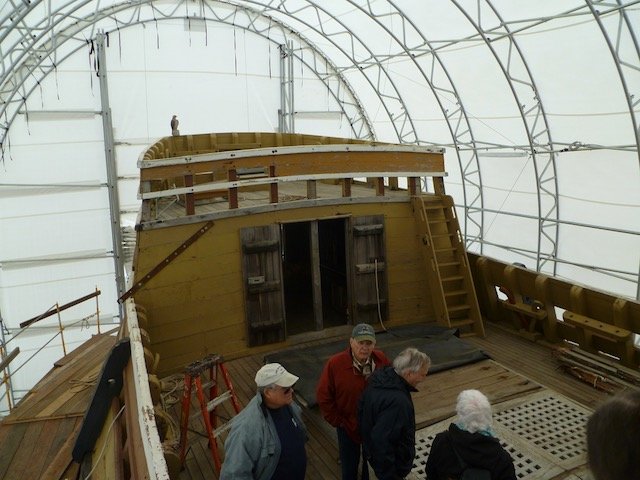
Steve, Have you noticed that the planking around the forecastle deck on the Model Shipways kit is different from the Mayflower II and Baker's plans? In the kit there is a planked strip that starts about 1/8" above the aft end of the deck, then 1/8" gap, and then 3/16" of railing and planking above. So the space is roughly in thirds with the middle third open. On Mayflower II, however, the space is divided in half and the lower half is open. I'll attach a photo of the ship as it was in 2017 and which is consistent with Baker's plans from 1957. For a real vessel, the Baker plan would drain much better. I'm not sure which way I'm going to go on this myself but I wish I had seen it earlier.
-
Painting a BB-63 Missouri
rcweir replied to Rubi's topic in Painting, finishing and weathering products and techniques
The Floating Drydock's Plan Book for USS Missouri says that during her shakedown in 1944 the ship was Measure 32, Design 22D. In January 1945, on her way to the Pacific, all vertical surfaces were repainted to Haze Gray (5-H), with a Navy Blue (5-N) band on the hull parallel to the waterline from the lowest point of the sheer down [to the boot topping]. All horizontal surfaces were Deck Blue (20-B). And they say she finished the war with that pattern. Later they say that some attempt was made before the surrender ceremony to strip the paint off the decks. Below the waterline was "Dark Anti-fouling Paint" with a 4 foot wide black boot topping. Finally, the Floating Drydock's book says that in early 1946 the ship was painted Haze Gray on vertical surfaces and Deck Blue on the horizontals. Paul Stillwell, in "Battleship Missouri, An Illustrated History", mostly agrees with the above except that he is quite clear that the deck in the area of the signing was freshly painted with a dark blue paint "like the other decks". Later he has a picture *after* the signing, on the way back to Pearl Harbor, of paint being stripped from the decks. -
A great reference is "The Floating Drydock's Plan Book Gato & Balao Class Submarines". I think this (and other Plan Books - they're all worth having) is still available as a pdf from http://www.floatingdrydock.com. On p. 95 there is an article on camouflage which basically agrees with black for Gatos at least up to mid 1944. Everything visible from the air had to be black and below the waterline black anti-fouling paint was to be used. Sheen isn't mentioned but I think it should be matte. Late in the war more complicated schemes that involved various shades of gray were introduced but (the article goes on to say) some boats were black throughout the war. Bob
-
Thanks, that's the direction I'm leaning, too: Wasa's deadeyes and the other Swedish example Baker referred to provide solid (literally) support for the choice.
-
I am working on building Model Shipway's "Mayflower" and have lately been obsessing about the correct shape for her deadeyes. William A. Baker, writing in 1958, says in "The New Mayflower" (pp. 110-111) that they have "a slight melon-seed shape, flat sides, and are quite thin". He bases this on period deadeyes recovered in Sweden and his description matches what I see in photos of Wasa. In contrast to Baker, Brian Lavery says in the AOS "The Colonial Merchantman Susan Constant 1605" that "the deadeye itself should presumably be round, as heart shaped deadeyes had gone out of use by that time." He goes on to say that the face was "quite rounded". He does not cite a specific authority at that point in the book but earlier he lists R.C. Anderson's "The Rigging of Ships in the Days of the Spritsail Topmast" as a reference and Anderson supports the round deadeye (p. 93 of his 1st edition). Anderson also talks about Dutch deadeyes of the same period and I don't see anywhere that he says they differed from English design. (I'm interested in the answer to this question for 17th Century Dutch ships, too.) So, is there a settled opinion now on what's right for Mayflower and for the first 1/2 of the 17th century in general? I searched on MSW to see if this was a topic that had previously been thrashed out but didn't find that it had been. Bob
-
Thanks for all the photos. I have my own build of Mayflower going, somewhat behind yours, so you are helping me quite a bit. I've taken some photos of Mayflower II over the past 3 years during its overhaul at Mystic Seaport. I doubt that they'll help you - mostly they show framing and planking - but I've got some closeups of the main top and masthead before the mast was stepped along with other odds and ends of things. I can send them to you or post them in the appropriate place on MSW if there's any interest. Bob
-
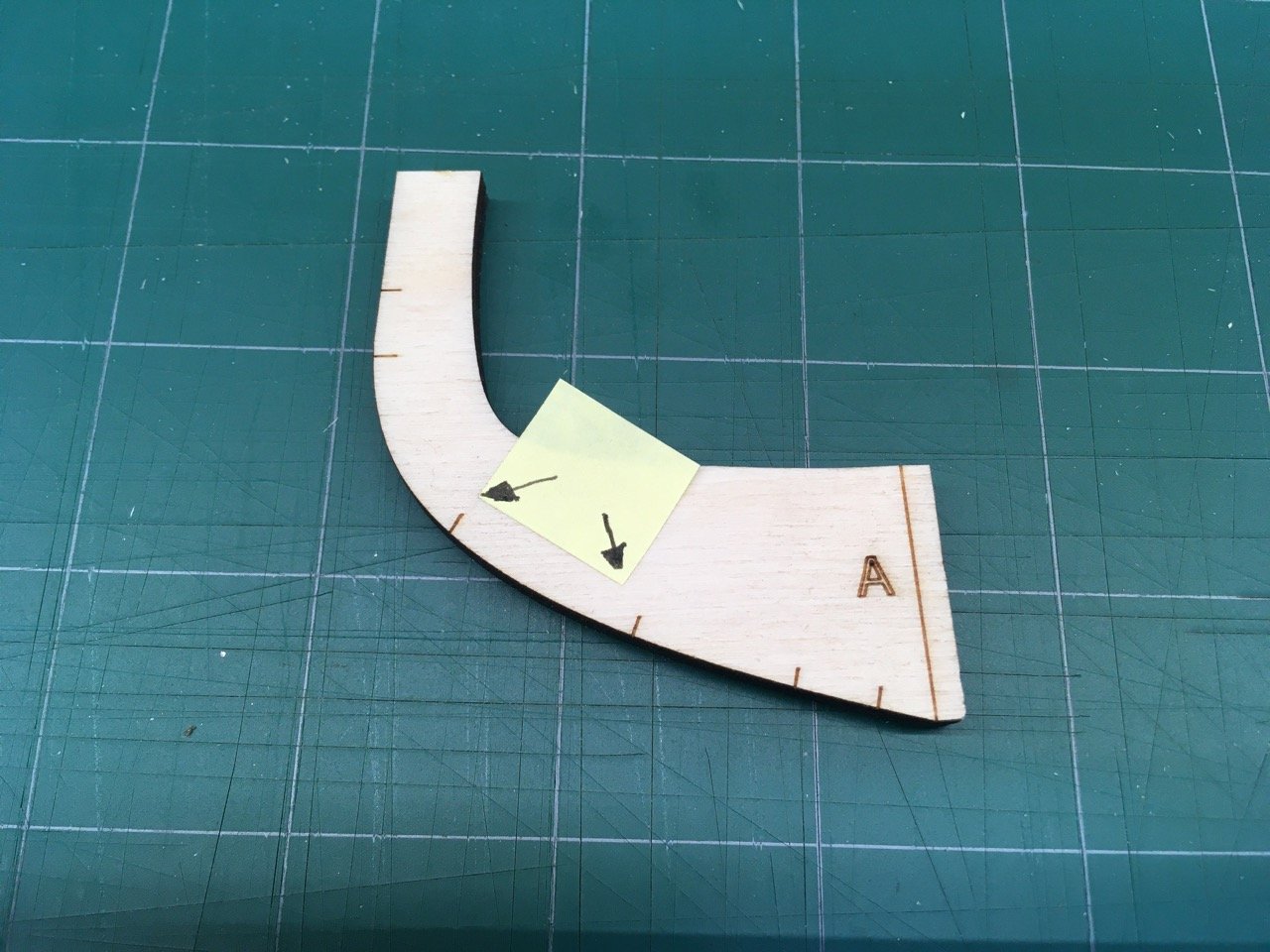
Toni, the frames in the kit have etched marks along the edge but you don't mention them in your writeup. Should we ignore them? I've attached one example of what I'm talking about. Bob
-
It will be fun to watch this build proceed. I noticed one small boo-boo in the printed plans - the ship is SS Robert E. Peary (not "USS") as it wasn't operated by the US Navy. The Navy did have two different Pearys of its own during WWII, though when this one was built in late '42 it had none.
- 45 replies
-
- 2
-

-
- robert e peary
- deans marine
- (and 2 more)
-
I admit that I haven't looked specifically at this, but books published by the US Naval Insittute in the US are frequently co-published by a different publisher in the UK. In those cases the difference is mostly in the dustjacket. Odds are that that's what you are seeing. (If somebody out there has more specifics on the relationships between those publishers, I'd be interested in knowing.) Bob
-
Anyone able to order off Byrnes website?
rcweir replied to bigcreekdad's topic in Modeling tools and Workshop Equipment
I ordered from them a couple of weeks ago with no problem. If I had your problem the first thing I would do is to try a different browser. Firefox and (Google) chrome can be installed on most operating systems.

Our Emblem ®
