


AON
-
Posts
2,880 -
Joined
-
Last visited
Content Type
Profiles
Forums
Gallery
Events
Everything posted by AON
-
 On my plans some are aligned with those above and others are not. I've not looked at pillars... something worth keeping an eye out for as I'm thumbing through stuff for the next few weeks.... unless your "friend" notices it first.
 -
Good morning (evening) I find what you've done to the figurehead to be amazing! Very nice job. It is too bad they didn't provide something representative of the original figurehead with the kit as it must have been very impressive as described (Bellerophon mounted on Pegasus with his Javelin). The size of the 3D printed gun barrels poking out the gun ports look much better also. I am so glad you are back.
- 126 replies
-
- 1
-

-
- victory models
- amati
- (and 2 more)
-
Welcome back Mitsuaki-san! I had found your last build quite a few years ago and found it to be very educational. I look forward to following your future posts.
- 126 replies
-
- 1
-
-
- victory models
- amati
- (and 2 more)
-
You rare absolutely correct about the physical size difference at reduced scale. I'm thinking there might simply be small, medium and large. What they will be has yet to be decided. I'm tallying up all the sizes today to see what there is.
-
I noted that a word in my post above was replaced with **** the word is the actual term used to describe the bottom or tail end of the block in my opinion it is not vulgar or inappropriate for this forum. Much better than what a back splice was AKA, or a seaman's duffle bag was AKA. so the word is a r s e was that so bad?
-
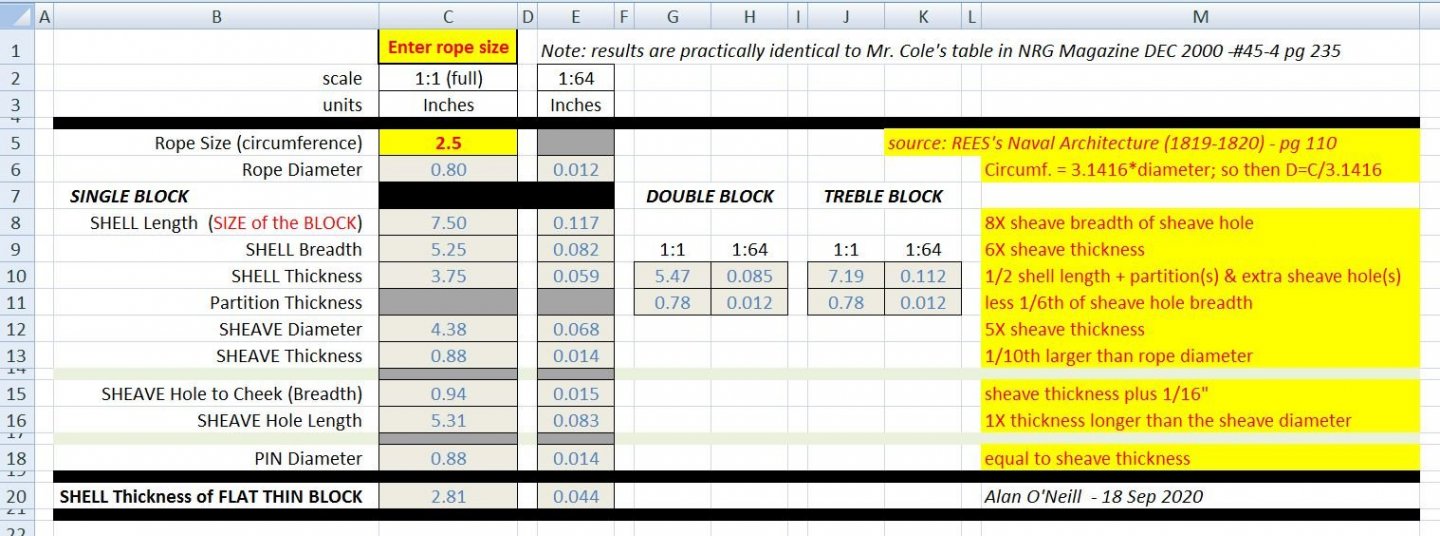
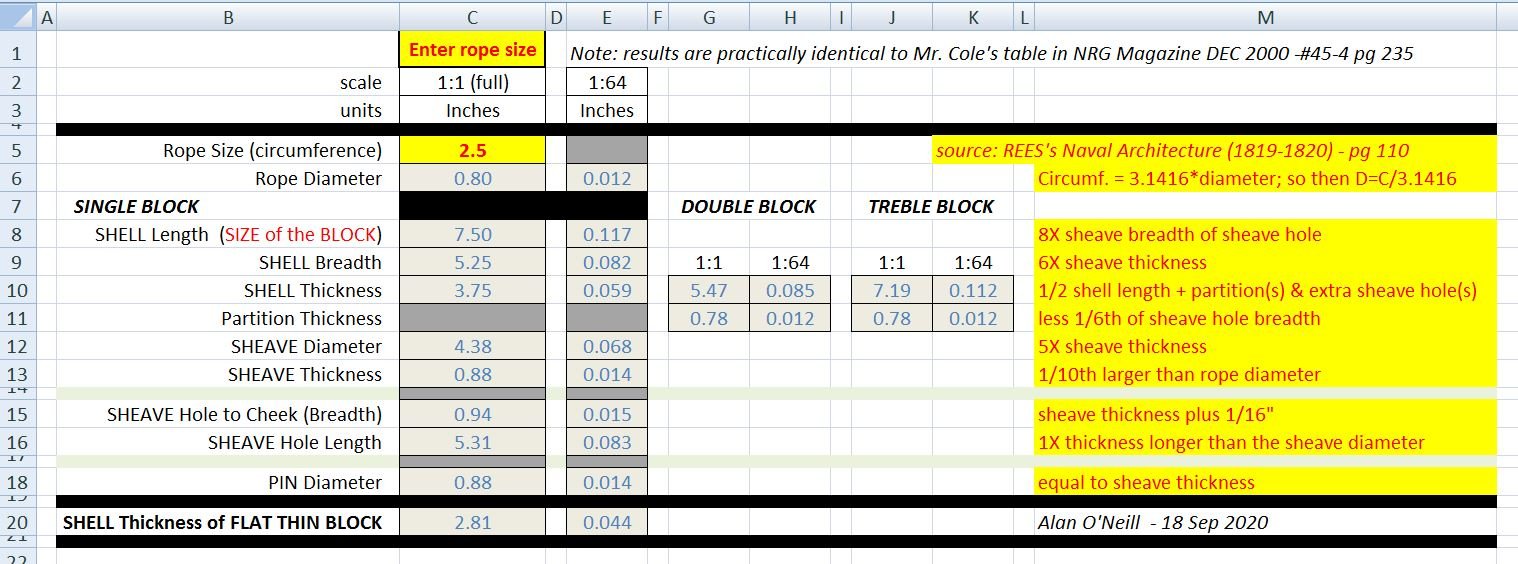
Rope blocks are said to be sized for the size of the rope. The size of the rope specified in Steel's / Rees's tables is the circumference and must be divided by the mathematical constant PI or π (3.1416). So a 2-1/2" rope is actually closer to 3/4" diameter. But, rope block sizes as listed is actually the length of the cheek (side) of the block from the head (top) to the **** (bottom). So a 10 inch block would measure nearest 10 inches tall. Steels (and Rees) provide ratio rule of thumb guide to calculating the dimensions of the various size of block shell and shiver (sheave) as determined by the size of rope (see my spreadsheet mentioned in the post above) While working with my spreadsheet I'd noticed a discrepancy between the ratio rule of thumb and the rigging tables, and have been trying to understand why they differ. The tables specify 10" and 9" blocks for 2-1/2" rope whereas the ratio suggests the length of the block should be 7-1/2" ( of rounded up to 8"). I've noted this same thing happening for other size blocks throughout the rigging tables. I should also point out I am not the first to mention this, Mark, SJSloane mentioned this in his build of HMS Bellona. After a day of searching and postulating I've noted the physical difference between 2-1/2" and 3" rope is quite minimal at about 0.8" and 0.9" diameter. 3-1/2" rope is 1.1" diameter.. So what might be called for via the "rule of thumb" for the carpenters to make blocks would not necessarily be what the Navy preferred. Which is pretty well what Druxey suggested. Then again, a rule of thumb is exactly that. So, when the time comes, I will be using sizes as specified in the rigging tables, with dimensions meant to match the block size, not the rope size.
-
while I wait for the other eye to be done I decided to look at rope blocks. I made an excel spreadsheet based on Steels' (and Rees') rule of thumb ratio. It is below to download if you are interested. The worksheet is "protected" meaning you can only enter the rope size (circumference) in the one yellow highlighted cell. All others are locked. If you want to fool around with the locked cells right pick on the labelled sheet tab (at the bottom) and a pop up menu will appear. Pick UNPROTECT SHEET and it is ready. Steel + Rees - block size calculator - rule of thumb ratio.xlsx
-
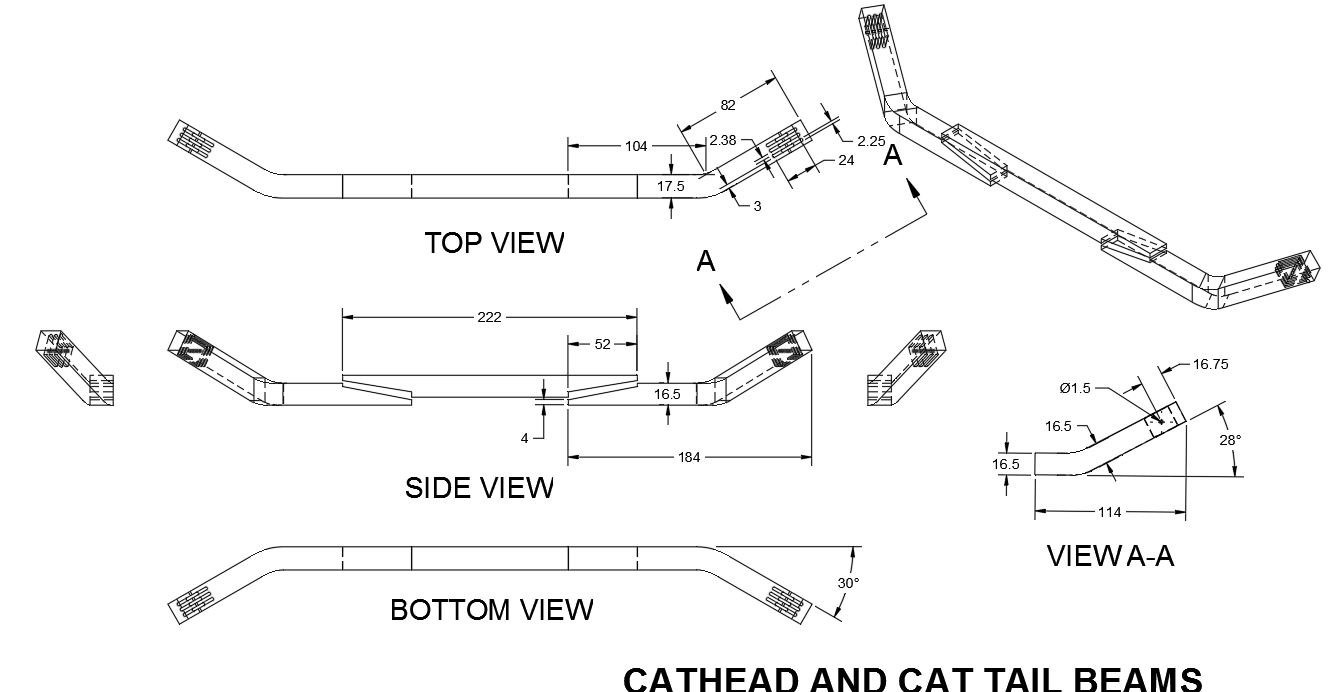
i SHOULD BE AS PICKY ALSO! I will never forget helm port. It is up there with capsize (at 12 years old while just having joined sea cadets, one fellow answered 6-7/8" to the question : what does capsize mean) I've one last drawing for now. The cat head and cat tail. The contract gives some dimensions for the pieces. Rees's plates offer some views of the items and shiver (sheave) size guide based on rope size. So does Falconer. Steele's tables offers info on the rope size. One table suggests 5-1/2" (circumference) and another 6". I've learned that at 1:64 scale the differences do not matter much.
-
As soon as Druxey corrected me I was brought back in my mind to grade school and the teacher assigning us homework to print the new words in our lesson book 50 times and she would check that it was in fact done the next morning. I think I'm gonna need a bigger pencil.
-
helm port, Helm Port, Helm Port, HELM port, HELM PORT, helm port, Helm Port, Helm Port, HELM port, HELM PORT, helm port, Helm Port, Helm Port, HELM port, HELM PORT, helm port, Helm Port, Helm Port, HELM port, HELM PORT ( = rudder hole)
-
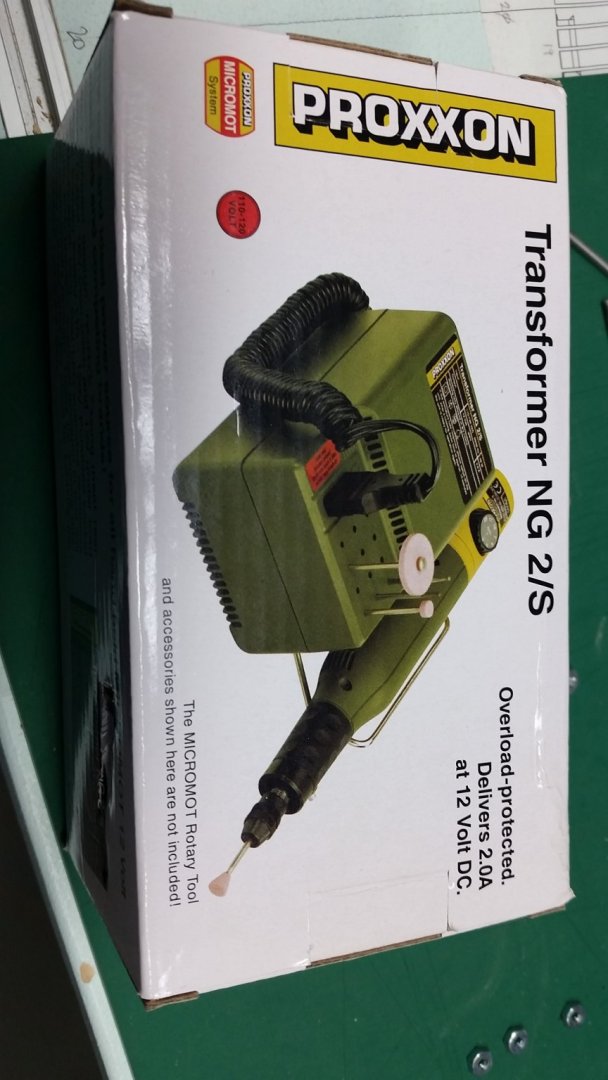
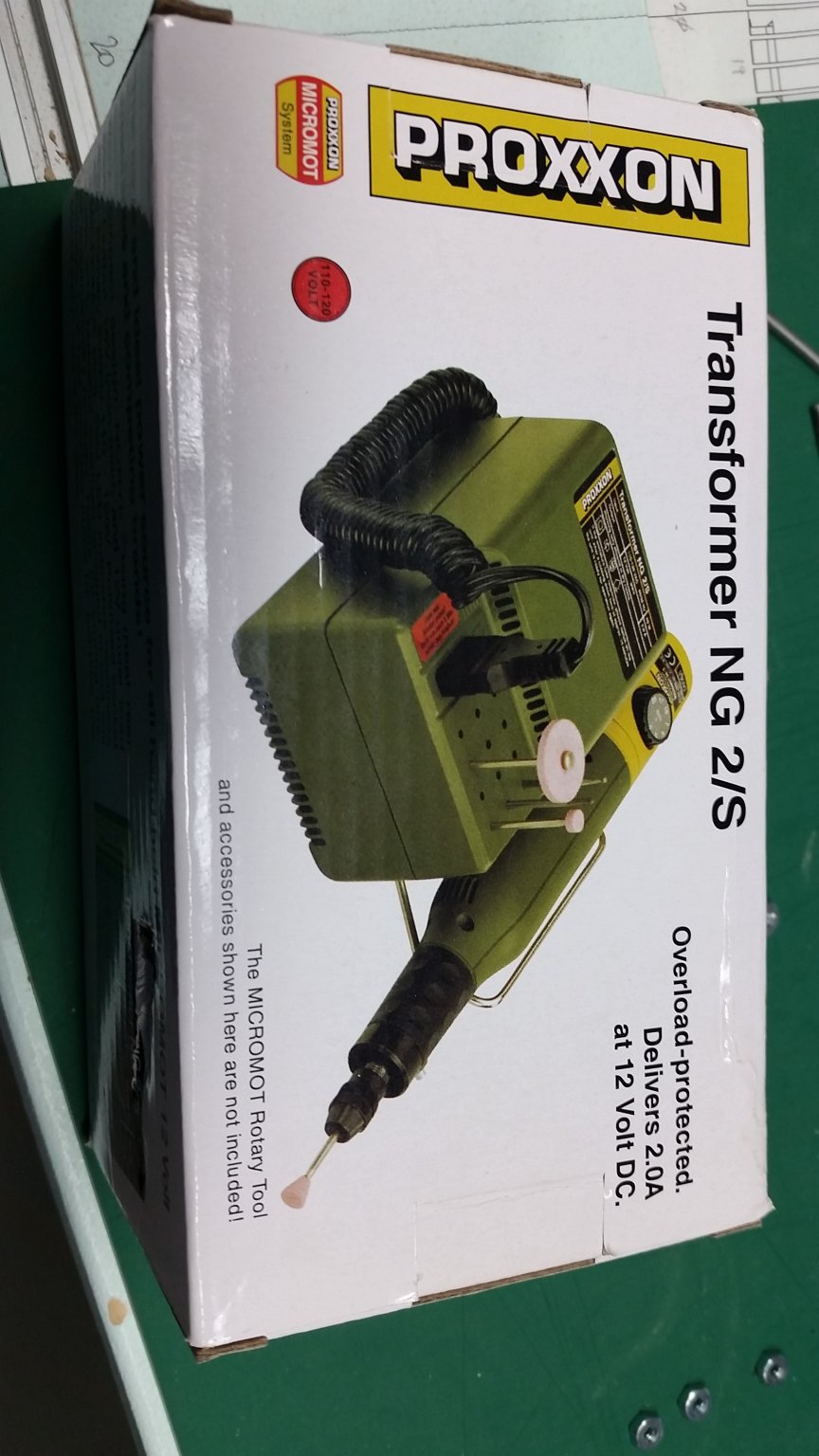
Paul I hope the pipe insulation idea works for you. It is cheap option if you've got the item laying around the house. I have since purchased a Proxon electric sander and transformer... but that is a considerable expense for one small well.
- 87 replies
-
- 2
-
-
- bluejacket shipcrafters
- red baron
- (and 3 more)
-
Good evening Paul, I detest sanding. I mean, I start with all the best intentions, with real honest ambitious resolve.... but sometimes it just never seems to end. It just goes on, and on, and... I find you just have to stick with it and tune into a radio station with some good music you can get lost in. I also experiment with all kinds of different backers for sand paper, including a small cut off length of pipe insulation foam tube. It is similar to those noodles kids use in the swimming pool. I stick the paper into the slot, wrap it around the round pipe insulation and grip it as best as I can... then get back to work. It will form to quite a few odd shapes and is forgiving to the grip. Alan
- 87 replies
-
- 3
-
-
- bluejacket shipcrafters
- red baron
- (and 3 more)
-
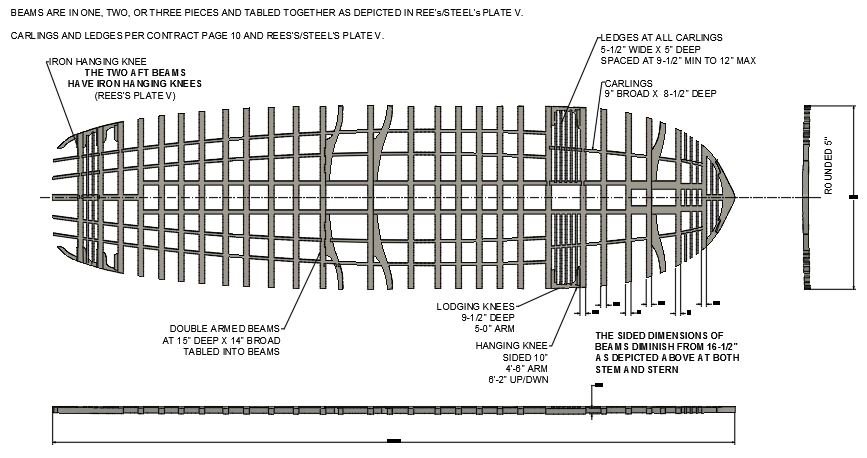
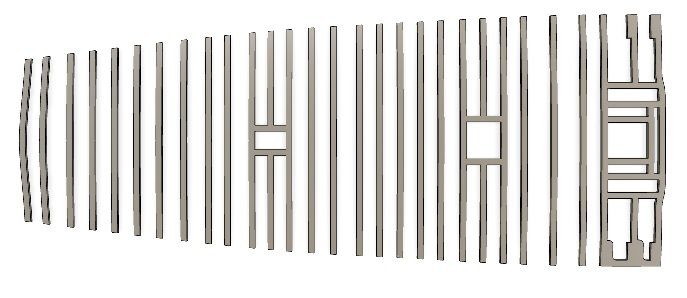
Updated the image of the Upper Deck Beams in post #1096 dated September 5. Below is the Gun Deck Beam image. I will not be doing the Orlop deck as it will not be seen very well. The five beams at the Waist will be made insitu following the Quarter Deck rounding at 8-1/2" (0.133" at 1:64 build scale). Mark: FYI - my upper deck NMM plan shaped tiller hole allows 30° of travel in each direction
-
That energy has to go somewhere as no one has yet repealed Newton's third law: for every action (force) in nature there is an equal and opposite reaction
-
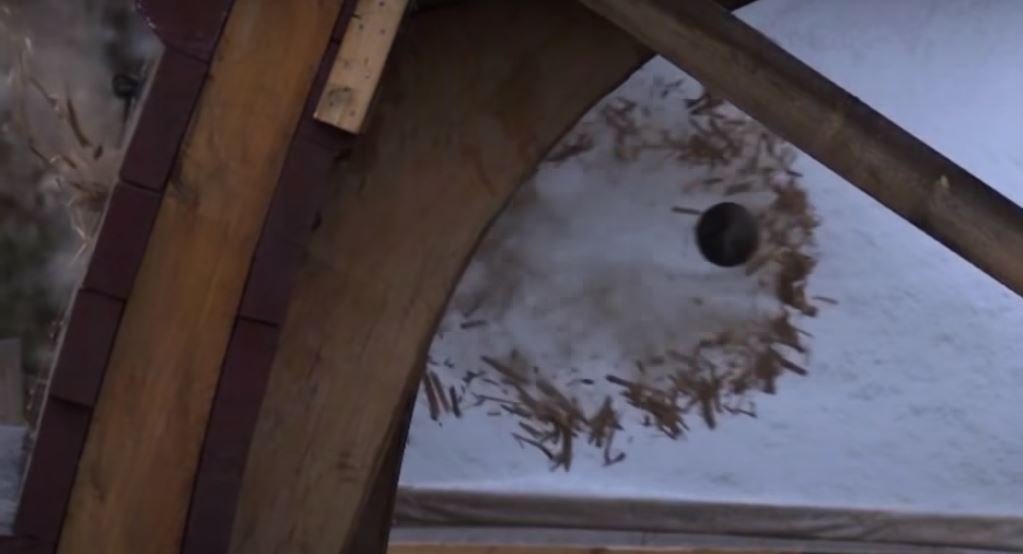
OMG Thank you for the video link Matle to the Vasa Gun Project. The most dramatic part was the ball smashing through the ship's hull... and all the deadly splinters!
-
Dan Gary reminded me about old magazine articles and the short story is that while reviewing my collection of those this morning I discovered something you might be interested in. I sent you a PM regarding building an 18th century made mast! Alan
-
happy your back!
-
First let me make it clear that I am a beginner at ship modelling and every day is a new and steep learning curve for me. Yes I have chosen to dive into the deep end. I am very grateful for all the help I get on the forum (yes, you and you and ...), from members of my local club (Model Shipwrights of Niagara), and from various collections of magazines I've been lucky enough to acquire for a short period before gifting them to someone else in our club, including the older NR Journals I've been given and those I've collected since becoming a member. I feel that must be the luckiest guy in the world! The book I mentioned was "Anatomy of the Ship - The 74-gun Ship Bellona" by Brian Lavery published by Conway Maritime Press Ltd, ISBN 0 85177 368 0. My error when I suggested it was Conway's book... it is Brian Lavery's. Although it is said to have errors I find it a great reference to understanding and identifying items. I just need other sources to verify what he shows me. The NMM plan No. J2938 of HMS Elephant shows nothing in the way of carlings, ledgers and knees. I have the contracts of both Bellerophon (No. ADT 0009) and Elephant (No. ADT 0030) which are identical except for some notations in the margins. I completely transcribed (typed out) the contract with my explanations, definitions, and references to my library books and pages/images/descriptions so I can find them again down the road. Having done that, I find I've forgotten most of what I had learnt so thank goodness I noted where to find it again. I have REES's Naval Architecture (1819-20) book with plates, and I have copies of Steel's Plates which seem identical that I reference. I've study a number of other plans on the NMM website and builds here on this forum of which Mark's Bellona and Gary's (your) Alfred are my go to builds at the moment. You are correct regarding the carlings under the furnace. They are specified at being 12 inches broad and 12 inches deep. I've drawn them at 12 " broad, and the depth of which 2" are to project above the upper deck beams, which I did not model as I will be referring to the contract when building and installing these. The same Idea for the coming carlings ... but at 1:64 scale who will notice a sliver of difference. I will re-read the contract carling location descriptions for the upper deck. Thank you
-
Thank you for the beam plan Mark. I've copied it to my reference library... now I just have to remember it is there. I had seen some of the different features in some other plans. This is different than what Conway drew in his book. I am not surprised as there have been a few other items noted. The thing that really throws me is that I specifically bought the Elephant deck plans (a sister ship) from the NMM and they don't fit the ship for length! Having spent 40 years in engineering I am puzzled as to why that major inconsistency should confuse me!
-
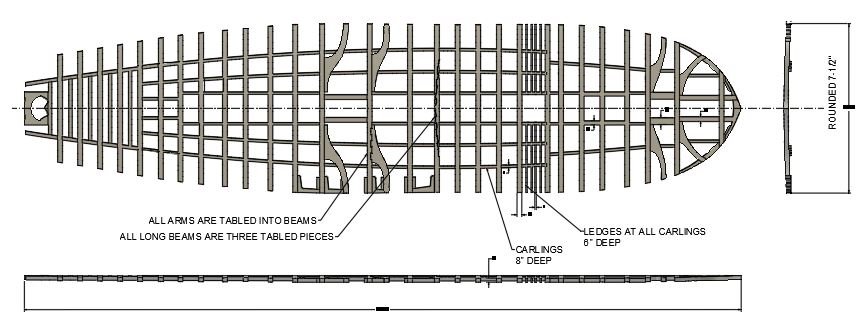
Getting near the end of the Upper Deck Beam Layout. Looking at various references that don't agree with each other plus my NMM deck plan drawing of HMS Elephant is too long for that ship. I've yet to add the Knees... and then check it again. Here is what I have so far... (image updated 13 SEP 2020)
-
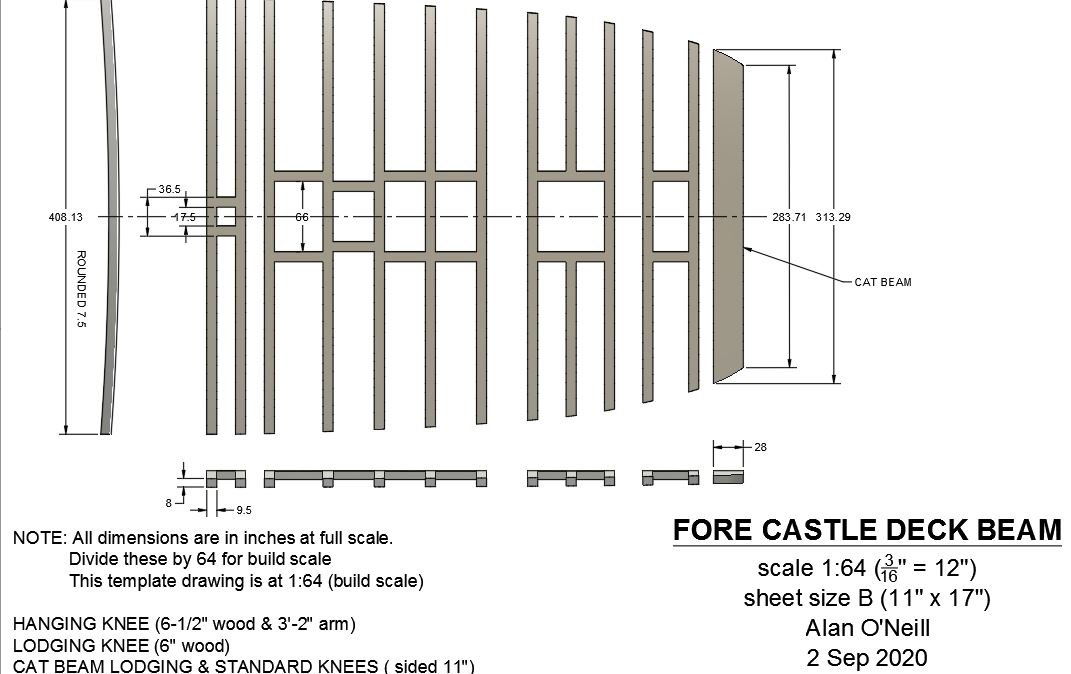
The Forecastle deck beam layout gave me a small headache. First the rounding or camber was said to be 7-1/2" on page 2 of the contract, and then it is 6-1/2" on page 17. I focused far too much on this... once I came to my senses and realized my scale of 1:64 scale build difference was 0.015" I just picked the larger number. Next I didn't understand what the cat beam was. It is said to be 2'-4" broad (wide or sided) and 10" deep. I discovered it is directly below the cat tail (the part of the cathead that crosses the deck athwart ships at the head. I found it in Rees's Plate IV, and also in The Anatomy of Nelson's Ship's page 79, figure 44. As it is a mere 2" (0.03" to build scale) thicker than the forecastle deck beams (8" moulded) I decided to ignore the 10" as no one will see or notice it. I started aft and worked forward with my layout. When I got to the mast I realized the roughly measured beam spacing did not fit the space on the model. I closed up the first three beams aft from 36" to 24" and things lined up at the mast. That is two feet missing from the plan. Just beyond or forward of the mast is a stairwell. The space (a large gap) between the beam forward of the stairwell and the cat beam was not there. I measured the deck plan and then the model and there was a five foot difference. My model deck length is 43'-4" and the contract specifies 42'-9", a mere 7" difference or 0.11" at my build scale. The museum plan deck measures roughly 48'-4" long.... the missing 5 feet! The plan clearly shows carlings (fore/aft joining beams) in only two locations: 1) at mast, and 2) under the belfry. I added them at the gratings, stove pipe and stairwell openings. So this is what I have. (02 Sept 2020 replaced image and dwg with updated version)
-
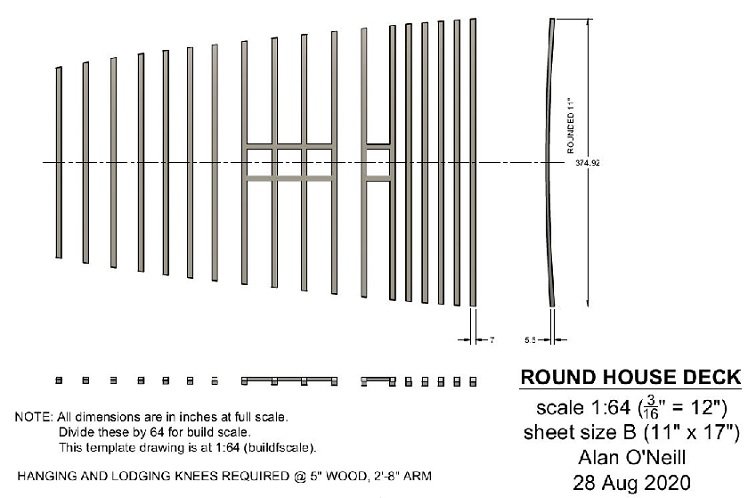
Round House Deck template
-
Played with it some this morning and this is the best I can get. Still has some lines that should not be there. Also I know the knee legs are tapered with rounded ends. I can do this when they are built. screen capture and downloadable PDF below. Moving on to the Round House deck.
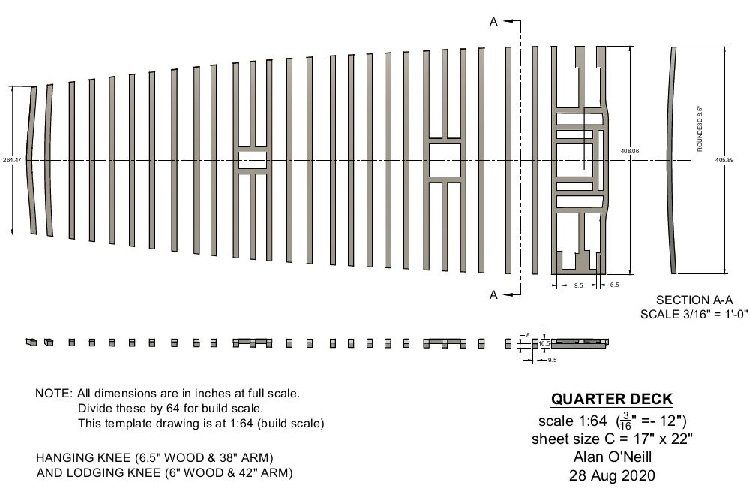
-
Generated the dwg ...but the program jumbled a couple of lines to the right at the main mast location. I've no idea why. If I cannot get it to work properly I can sketch them in with a pencil.
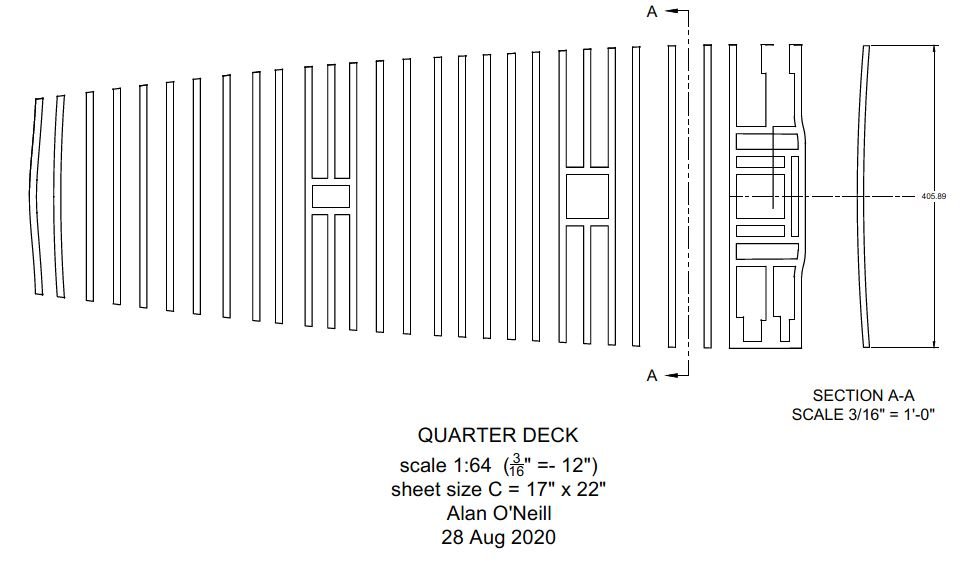
-
I got the model done. Just need to import it to a sheet at 1:64 scale for the template. three pics below 1- a layout with a mess of dimensions 2- same but cleaner looking layout with the dimensions hidden. You can see the shaded areas that will be cut away. 3 - the end result. I roughed in the hanging and lodging knee as blocks in the bottom right corner and just the hanging knees in the top right corner. I'll get the drawing template made than do the roundhouse deck beams.
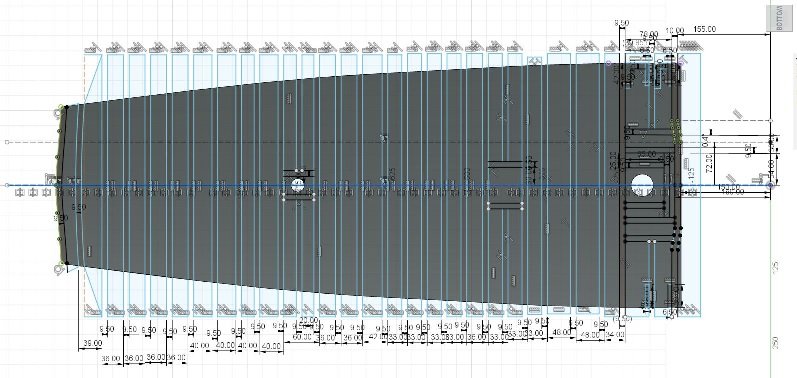
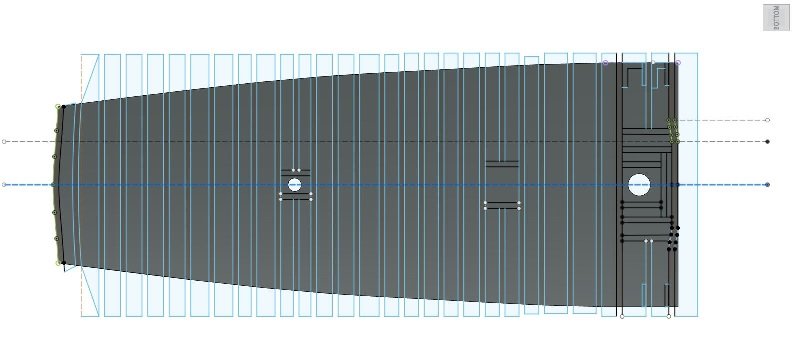
Our Emblem ®
