DONATION DRIVE - SUPPORT MSW - DO YOUR PART TO KEEP THIS GREAT FORUM GOING!
×


Chapman
-
Posts
272 -
Joined
-
Last visited
1 Follower

Recent Profile Visitors
2,470 profile views





-
 The Bitter End reacted to a post in a topic:
Constitution "Mystery Skylight"
The Bitter End reacted to a post in a topic:
Constitution "Mystery Skylight"
-
Hubac's Historian reacted to a post in a topic:
Soleil Royal by EricWiberg - Heller - 1/100 - PLASTIC - started 45 years ago
-
GrandpaPhil reacted to a post in a topic:
Soleil Royal by EricWiberg - Heller - 1/100 - PLASTIC - started 45 years ago
-
 I drilled one larger hole in the center and several smaller ones on the four sides of the gunport, then used a No. 11 scalpel to cut from the center outwards to the sides. That was relatively easy. However, Heller's Phenix hull is relatively thin compared to the Soleil Royal.
- 408 replies
-
- 2
-
-
- soleil royal
- Heller
- (and 1 more)
-
Chapman reacted to a post in a topic:
Soleil Royal by EricWiberg - Heller - 1/100 - PLASTIC - started 45 years ago
-
I found the passage using the right search term. It was the Washington Navy Yard, and a few years earlier than I remembered. It was 1809. The source was an internet post from a few years ago. And: definitely after 1809. It's possible the information came from the author of the book "The Washington Navy Yard".
- 16 replies
-
- 1
-
-
- USS Constitution
- Old Ironsides
- (and 2 more)
-
Hubac's Historian reacted to a post in a topic:
Soleil Royal by EricWiberg - Heller - 1/100 - PLASTIC - started 45 years ago
-
Marcus, I've already read something about that. For the US: the earliest ones I know of are from the War of 1813, which were mentioned in connection with a US shipyard's history. Apparently, the first copies were in stock there and were immediately requested by one of the US Navy captains. Other captains were apparently out of luck for the time being. I still have the text somewhere, but I haven't found it yet. That's the problem with all the bits of information scattered across multiple hard drives. Someone really needs to compile it all.
-
EricWiberg reacted to a post in a topic:
Soleil Royal by EricWiberg - Heller - 1/100 - PLASTIC - started 45 years ago
-
I once rearranged all the gun ports on a Heller Phenix, and it was anything but pleasant. I managed it, but now I think a completely rebuilt wooden hull would have been more effective. You seem to enjoy working with plastic, so I wish you continued success.
- 408 replies
-
- 2
-
-
- soleil royal
- Heller
- (and 1 more)
-
Chapman reacted to a post in a topic:
Sovereign of the Seas by 72Nova - Airfix - PLASTIC
-
Chapman reacted to a post in a topic:
Sovereign of the Seas by 72Nova - Airfix - PLASTIC
-
Chapman reacted to a post in a topic:
Sovereign of the Seas by 72Nova - Airfix - PLASTIC
-
Chapman reacted to a post in a topic:
Sovereign of the Seas by 72Nova - Airfix - PLASTIC
-
Chapman reacted to a post in a topic:
Sovereign of the Seas by 72Nova - Airfix - PLASTIC
-
Chapman reacted to a post in a topic:
Sovereign of the Seas by 72Nova - Airfix - PLASTIC
-
Chapman reacted to a post in a topic:
Sovereign of the Seas by 72Nova - Airfix - PLASTIC
-
Chapman reacted to a post in a topic:
Sovereign of the Seas by 72Nova - Airfix - PLASTIC
-
Chapman reacted to a post in a topic:
Sovereign of the Seas by 72Nova - Airfix - PLASTIC
-
Attached is a link to a lengthy but successful conversion to the destroyer Z14 Friedrich Ihn, following some early wartime modifications. Z 14 Friedrich Conversion from Z17 kit
-
The only 1:350 scale kit that comes close to the Destroyer Type 1934a is the one from Zvezda/Revell, and that's a Type 1936. This means a lot of modifications, especially to the superstructure. It's possible, but involves a lot of research and work.
-
Marcus.K. reacted to a post in a topic:
What did an early 18th-century pinnace look like?
-
Marcus.K. reacted to a post in a topic:
What did an early 18th-century pinnace look like?
-
Marcus.K. reacted to a post in a topic:
What did an early 18th-century pinnace look like?
-
Suitable examples can be found in contemporary paintings, drawings, and models to illustrate the differences to boats from later periods. A friendly inquiry to Mr. Endsor about this topic, via his website, might also be a good idea. I found him to be a very friendly person to talk to. Edit: At this point, I would like to take the opportunity to mention his new book, which is scheduled for publication next year. The Lost Ships of Charles II's Navy: Understanding the Seventeenth-Century Warship by Richard Endsor
-
Restoration Warships by Mr. Endsor contains beautiful drawings with frame plans for the 31ft longboat 30ft pinnace 23ft yawl of HMS Lenox. The Master Shipwright's Secrets for the longboat and pinnace of HMS Tyger, based on a boats contract and contemporary models. They don't look strikingly different from boats from the 18th century. But the details make all the difference. Finding suitable ones for the scale of the Airfix Prince is a challenge in the first place.
-
Richard Endsor's books, with titles like *The Restoration Warship* or *The Master Shipwright's Secrets*, depict boats from that era. I can't say offhand how complete the drawings are; I'd have to look through the books for that. Which is always a pleasure.
-
Royal navy conversion of captured ships
Chapman replied to Aldaris's topic in Nautical/Naval History
Hi Aldaris Some basic information about the armament. https://threedecks.org/index.php?display_type=show_ship&id=4754 The NMM Museum might also have plans for the Holsteen/Nassau. -
Moin, Hi! Those are fantastic guns! And that's for that scale and material. Have you ever considered putting figures on board for a size comparison to the ship?
-
I can agree with that. However, the reproduction of the plans in my edition is rather poor to very poor.
-
Graf Spee colors
Chapman replied to scraig's topic in Painting, finishing and weathering products and techniques
If you want to use paints you already have that weren't specifically developed for DKM ships, you can simply check the model manufacturer's specifications to see if they would match the color of your desired model. Scalemates.com offers the option to compare paints across manufacturers. Experience has shown that the color on the screen looks different than the color in the can. And the contents of the paint cans vary slightly in color from batch to batch. In addition, some model builders wonder whether to use slightly lighter colors than the original to achieve the scale effect. Life can be so hard -
A look at one of her original plans (as captured) clearly shows that she had entire lids that opened upwards.

-
Review Le Coureur 1776 - Shipyard 1:72-scale Laser-Cut Card Model Kit
Chapman replied to catopower's topic in REVIEWS: Model kits
Regarding the Shipyard cardboard model of the Coureur in 1:96 scale. I wanted to modify the model according to the English plans as taken. However, I noticed a problem with the dimensions. I printed the English deck plan in length and width according to the known English specifications and placed it on the model. The length fits the model, but not the width, as you can see!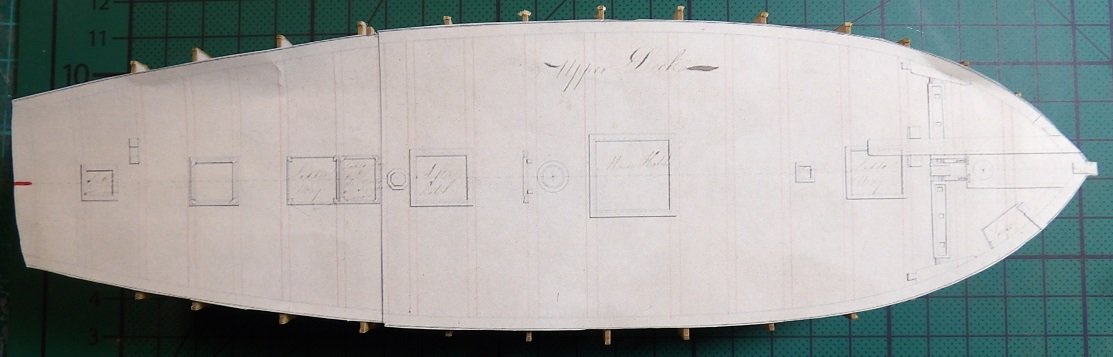
Our Emblem ®