HOLIDAY DONATION DRIVE - SUPPORT MSW - DO YOUR PART TO KEEP THIS GREAT FORUM GOING! (Only 72 donations so far out of 49,000 members - Can we at least get 100? C'mon guys!)
×


Mark P
-
Posts
1,773 -
Joined
-
Last visited
Content Type
Profiles
Forums
Gallery
Events
Everything posted by Mark P
-

Mathew Baker's early concept of ship hull design, ca. 1570
Mark P replied to Waldemar's topic in Nautical/Naval History
Good Evening Waldemar; Nice to see someone taking a fresh interest in this fascinating work. The original is in the Pepys Library, at Magdalen College, Cambridge. It was written firstly by Baker, and then later, after his death, further pages were added by a second hand, believed to be Wells, the storekeeper at Deptford, although he was much more than this in fact. The second part uses logarithms, which only appeared around 1618, some years after Baker's death in 1613. I have been lucky enough to be able to study this work in the original, although not for as long as I would have liked. It is a fascinating, beautifully illustrated book, which is actually much larger than one might expect, with over a hundred pages. There was an attempt started many years ago to produce a proper commentary on it, something which should have been done long ago. The Pepys Library allowed photographs of the work to be taken to aid in this project (normally almost impossible to do) which was to be a combined effort by two well known specialists. Unfortunately, this has never been completed, with work stalled long ago, and is unlikely to ever be re-started. All the best, Mark P -
Good Evening Michael; My previous answer referred only to the eye-bolts; the plates serve a different function. Without denying their support function, and without being certain of what I am about to say, it is likely that these solid plates were made with an eye in their upper end, to which the lower block of the tackle which ended the shifting backstays could be hooked. These backstays were rigged as additional support for the upper masts when under sail, and would be shifted as the yards were braced further away from the central position. They would only be hauled taut/rigged on the windward side of the mast at any one time. All the best, Mark P
-
Good Morning Michael; These are for use in emergencies, when the chain plates or channels have been carried away by battle or storm damage, and were to enable the attachment of jury rigging for the shrouds. All the best, Mark P
-
Good Morning Wayne; Many thanks for this. I will see if I can find out anything about it from the Library. All the best, Mark P
- 17 replies
-
- 1
-

-
- Book
- great britain
- (and 1 more)
-
Good Evening Wayne; Thank you for your comment re Browns University; I was not aware of this one. Would you mind sending me a copy of their collection listing for this. The Keltridge draughts are available as prints from the RMG. They are not as large as 18th century draughts, and are therefore not as expensive to purchase. They do indeed show a lot of detail, but most are not identified with any particular vessel, and may be an exercise in drawing rather than an actual vessel. I stand to be corrected in this, of course. The RMG Keltridge book has some unfinished pages, and whilst greatly detailed, does have some gaps, regrettably. Perhaps the Browns version has these pages completed. All the best, Mark P
- 17 replies
-
- 4
-
-
- Book
- great britain
- (and 1 more)
-
Good Evening Wayne; Thanks for this. Battine was, if I remember correctly, clerk of the cheque at Portsmouth dockyard. He produced one of these books every year, and dedicated each of them to potential/actual patrons who could help with advancing or safeguarding his position. I am sure that at least a dozen different copies survive in various archives and collections. William Keltridge, a shipwright/ship's carpenter produced a similar book, in a similar size, which is more detailed, but of which I know of only one copy, and possibly one other. Keltridge knew his stuff, certainly, as he ended his career as the carpenter of the Royal Sovereign in the 1690s, the highest possible position for a ship's carpenter. I presume that he either died or was pensioned off shortly before the Sovereign burned, as he was not her carpenter by that date, and I have not seen any record of his appointment as an assistant master shipwright in a dockyard, which was the next step in a ship's carpenter's career. His work is not available as a pdf. The various copies of Battine's book seem to be written in different hands, interestingly, with some very neat, and others noticeably less so. Such books came into existence due to the need to educate ships' commanders who had not grown up at sea, and consequently were lacking in all but the most basic knowledge of ships. The competition for an appointment to the command of a warship was eagerly sought by many who considered it their birthright due to their rank in society; and their appointments were hotly contested by those who held themselves more suitable due to their hard-won experience of extensive sea-service. The debate and competition over which source provided the better commanders occupied a large part of the 17th century. All the best, Mark P
- 17 replies
-
- 5
-
-
- Book
- great britain
- (and 1 more)
-
Oops! Apologies to Allan; I seem to have misunderstood the purpose of the question. It relates to the timber structure, not the metalwork on it. All the best, Mark P
-
Good Evening Allan; I think that you will find that the longer of the metal fittings shown close together is a crutch for the main lower studding sail boom to rest in when it is not rigged out for use. Similarly, at the fore end of the channel, the longer metal fitting is an eye for the hook on on inboard end of the studding sail boom to swivel in. All the best, Mark P
-
Swivel guns
Mark P replied to tlevine's topic in Discussion for a Ship's Deck Furniture, Guns, boats and other Fittings
Good Afternoon Toni; As a backup check, I have looked at the height of the swivel-gun stocks on the Admiralty draught of Fly, a sloop of 14 guns. This very detailed draught, dated 1778, shows the swivel stocks ending at a height of 2'9" above the highest point of the quarterdeck planking. One must then add to this for the rounding of the deck beams, and for the metal fork in which the swivel-gun was mounted. All the best, Mark P -
Good Morning BM; Following on from replies above, I have looked through my pictures of models from the NMM and the Science Museum, all of which I have photographed out of their cases, and with few exceptions they have inside bulwarks and bitts etc painted with red ochre. A series of contemporary paintings in the Kriegstein Collection, showing models of many different types of ship, all show the same thing. One of the ships depicted is the 74 gun Valiant of 1759. The exceptions in my models photographed, which number only three in total, are either unpainted, or have the fittings painted black, and the bulwarks red. There are two painted views of the 'Valiant' of 1790 in the NMM collection, but I have been unable to find images of them (the new website is simply awful to try and use) They are undoubtedly there somewhere, though, so you may be able to find them. They are shown, in black and white, in Brian Lavery's book 'Building the Wooden Walls', which describes the building of the 'Valiant'. All the best, Mark P
-
PIllars
Mark P replied to allanyed's topic in Building, Framing, Planking and plating a ships hull and deck
Good Morning Allan; A 32 gun contract from 1778 states that the pillars under the upper deck are to be 6 5/8" at the base, and 6 3/8" at the top, turned; but it does not state if these are to be single or double rows. However, the lack of this detail does seem to suggest that it was a standard arrangement, meaning that if you can find information on a different sized ship, it probably applied to yours also. All the best, Mark P -
Good Morning Alan; The archives at Kew also contain extensive records which came via the War Office, and are prefixed WO. These are all accessible via the search engine at Kew. WO 55/1830, 31 & 32 all contain lists of ships with particulars of ordnance, dating from 1793-1799. How thorough they are I do not know, but by this date normally quite a lot of info was recorded. All the best, Mark
-
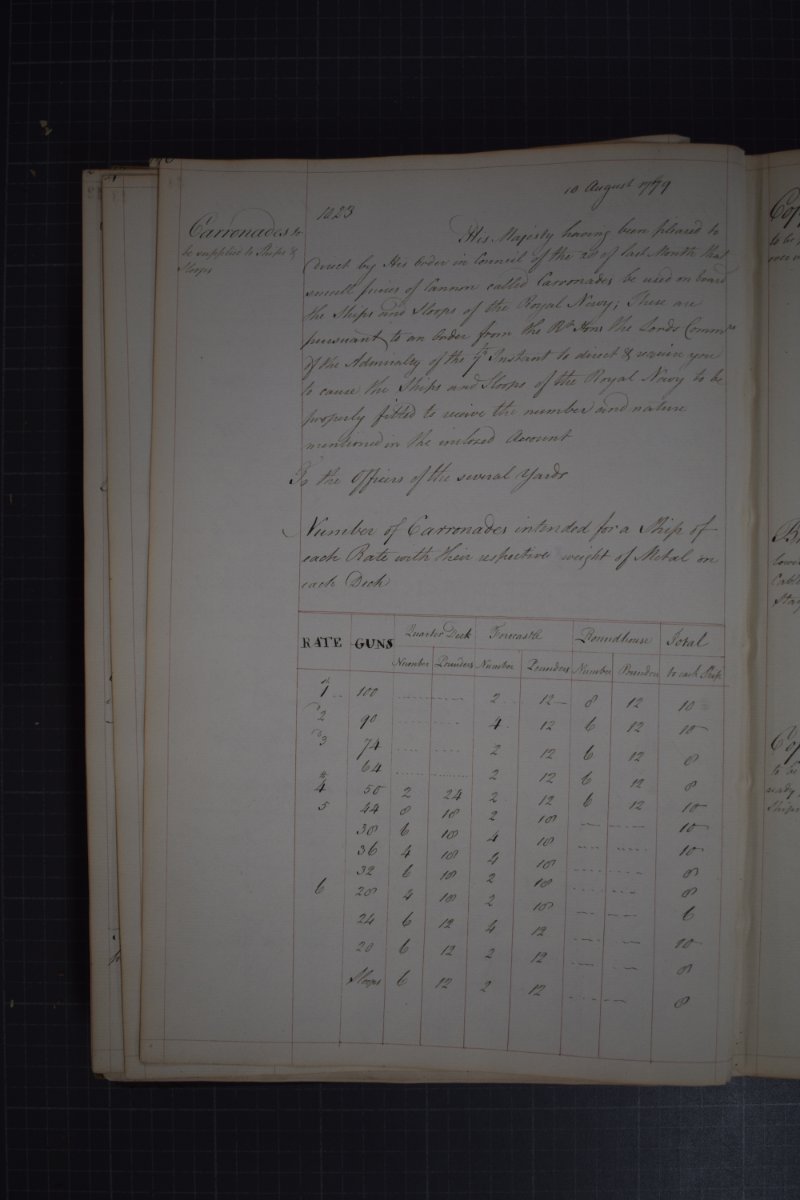
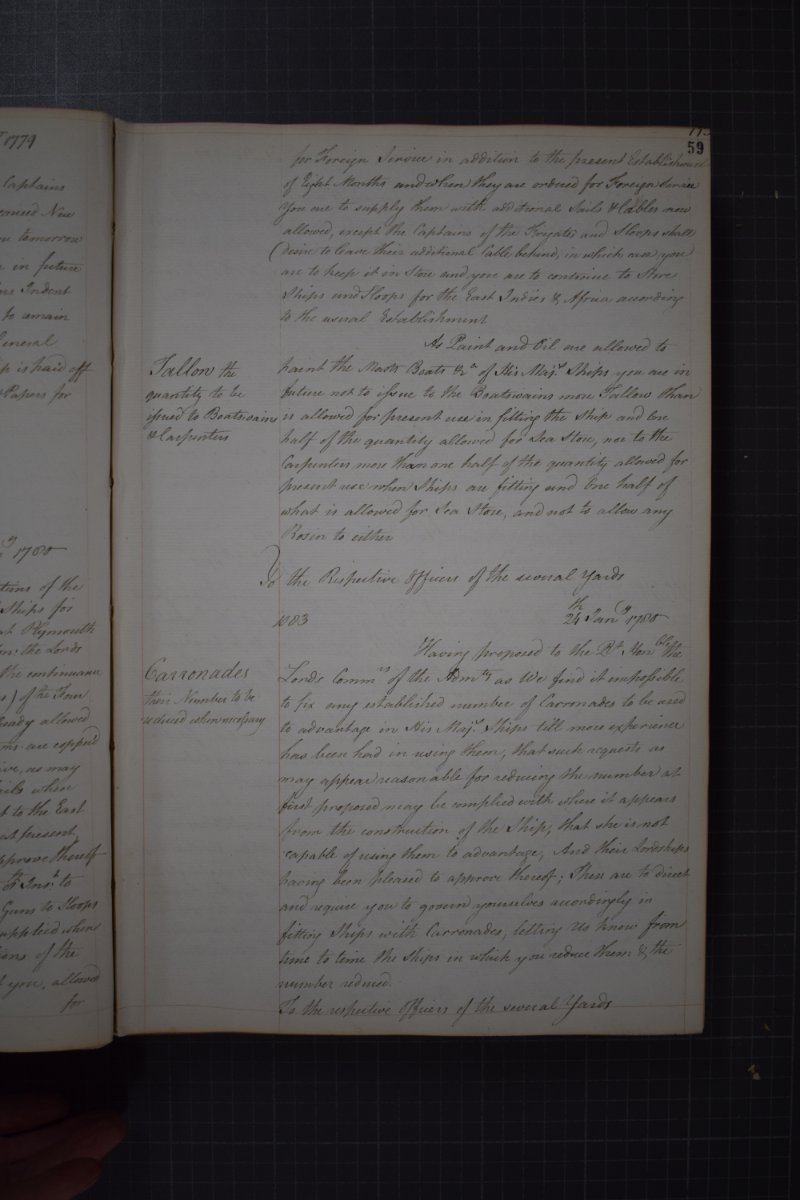
Good Afternoon Allan; The 1788 document gives the dockyards discretion to issue carronades as best suits the ship's qualities. So after this date (and presumably sometimes before) the arrangement could have been non-standard, as your sources indicate. I have a further letter on the matter, dated 1782, which instructs the Navy Board to see that ships capable of bearing the weight of them are to have 68 pdr carronades on the forecastle, with lesser vessels having either 42 or 32 pdrs on the forecastle. The same letter states that the intention is for these to annoy the enemies' rigging, so they would probably be mounted in a position to bear more on the broadside than as a bow-chaser, where the longer barrelled cannon were used. If you would like the pages as images you can see better let me know, and I'll send them over. All the best, Mark P
-
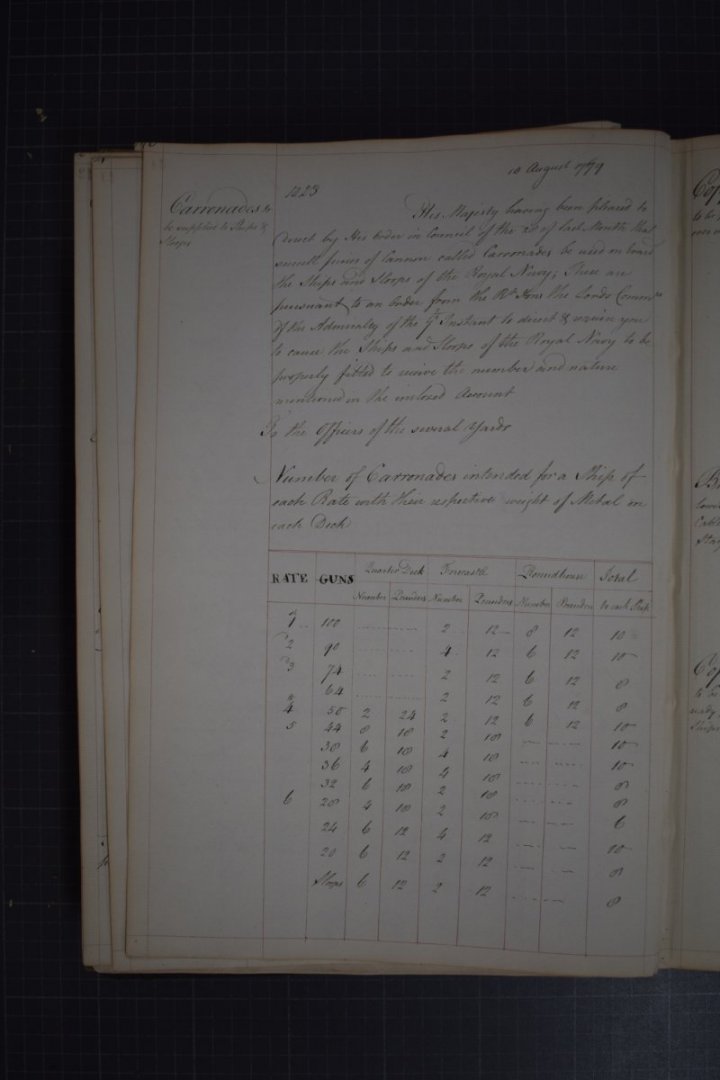
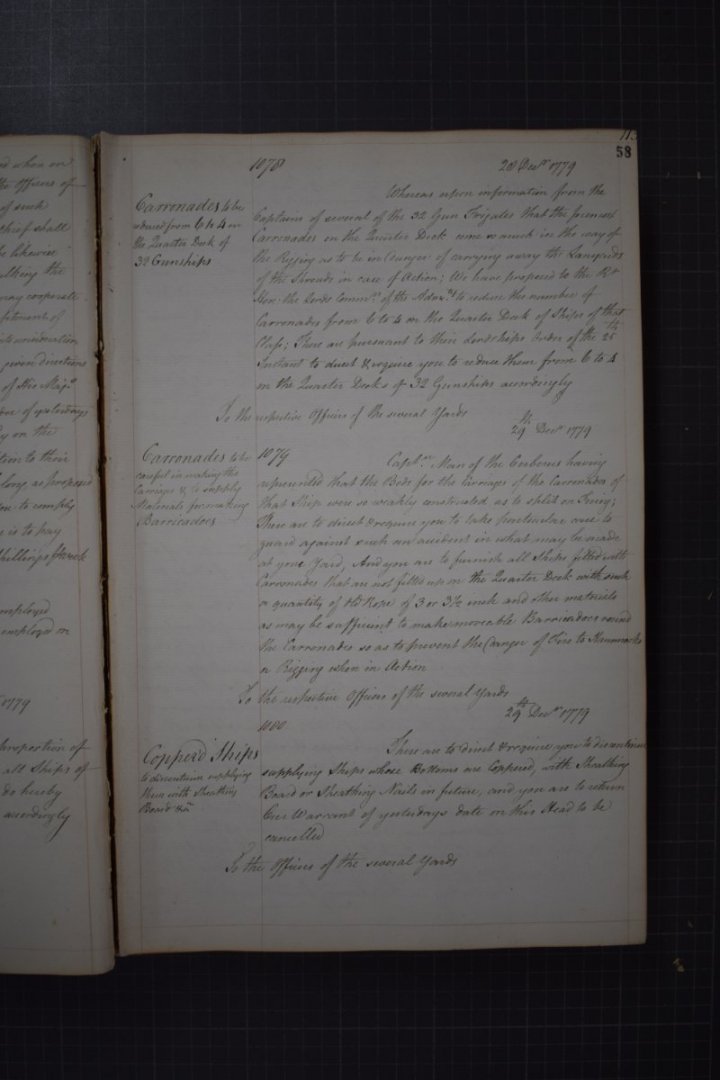
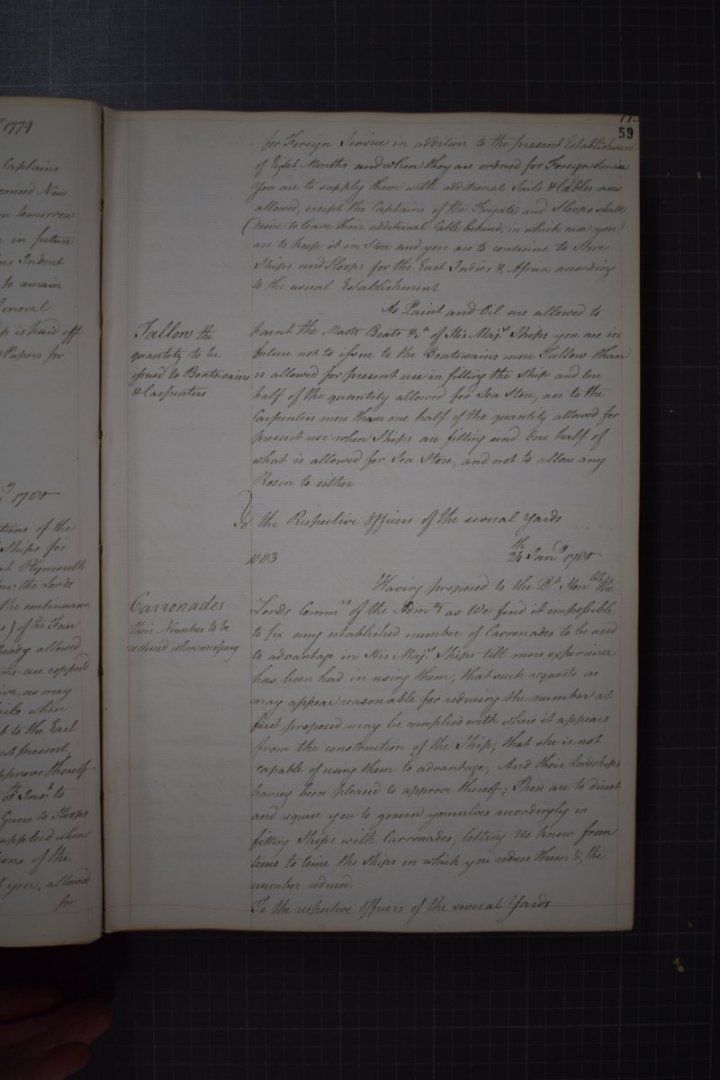
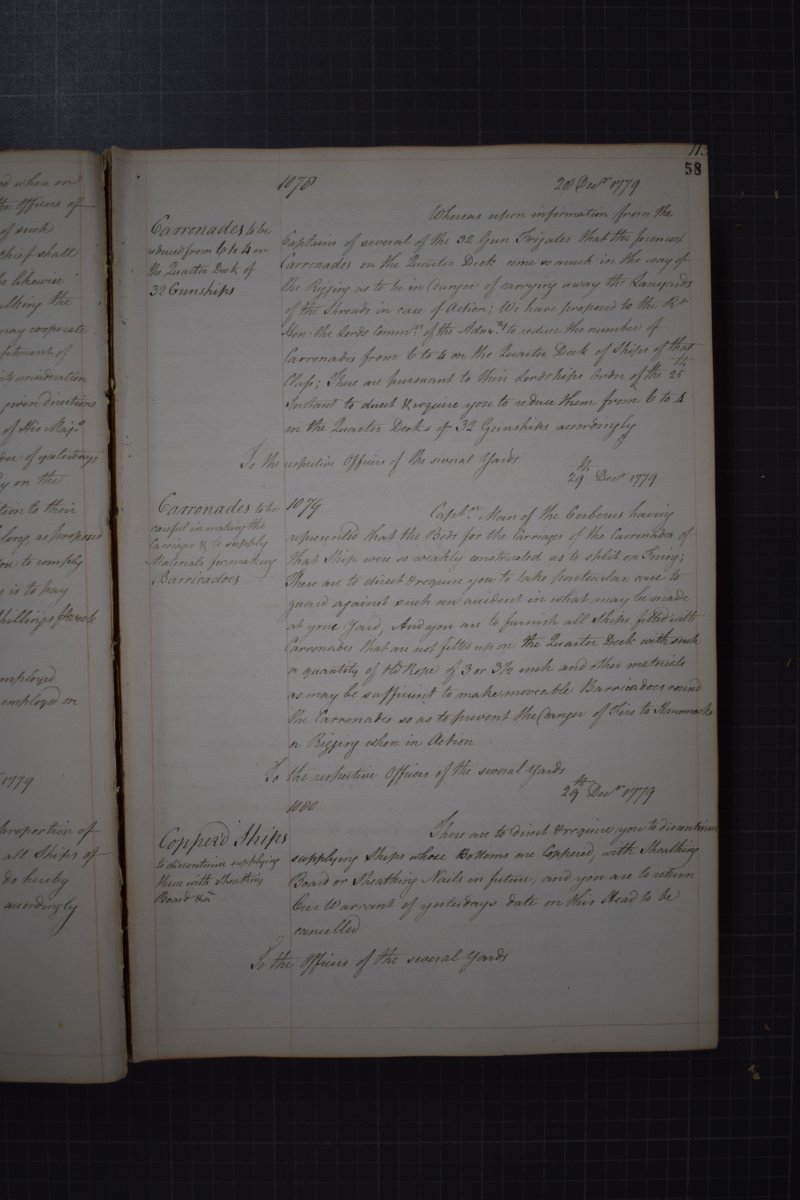
Good Evening Allan; When carronades were first introduced, they were (if I recall correctly; might be wrong!) only issued to a ship at the captain's request. It was also his decision (and presumably the gunner's) as to where they were to be sited. See below pictures of contemporary letters on the subject, from 1779 & 1788 All the best, Mark P
-
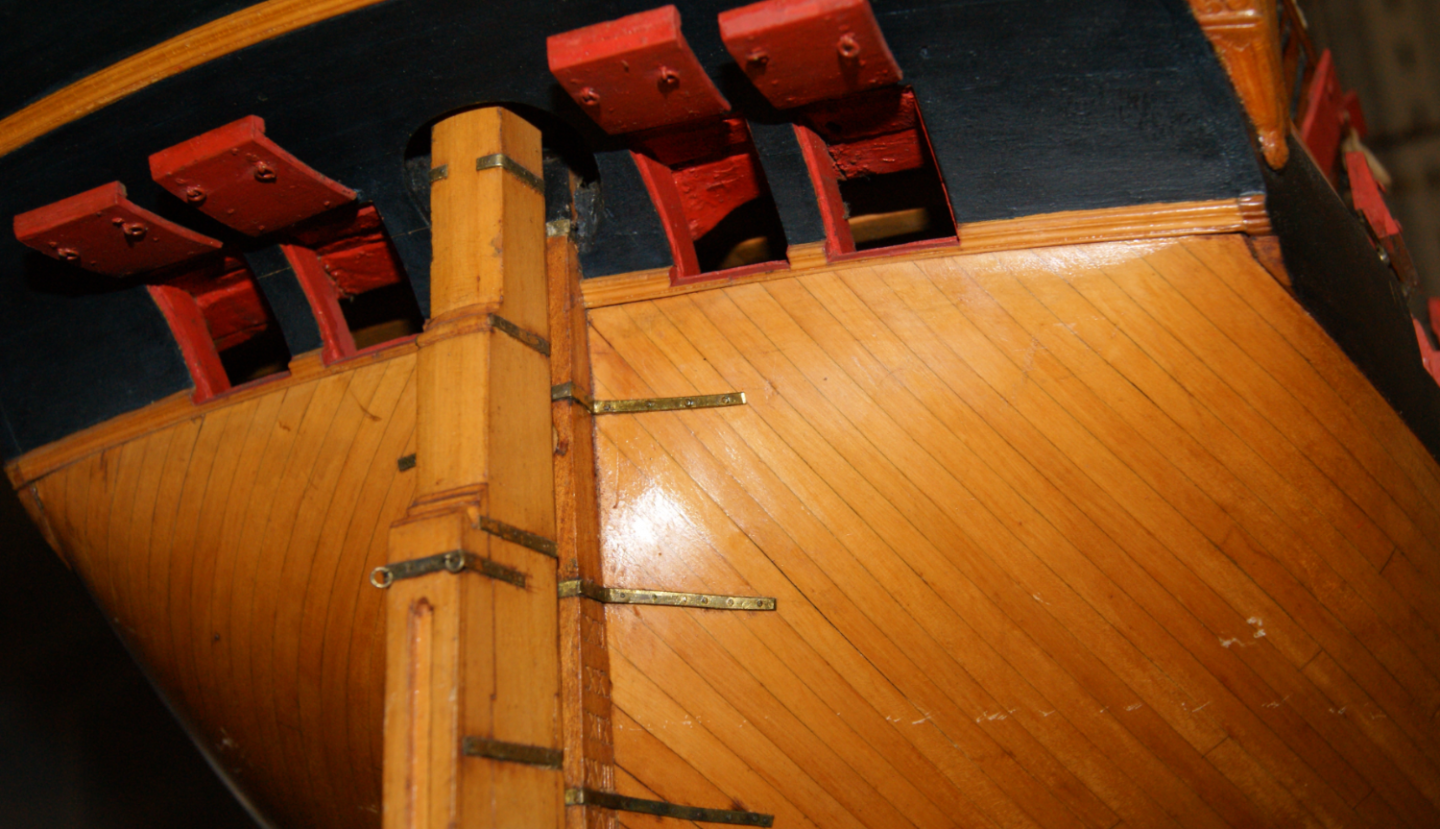
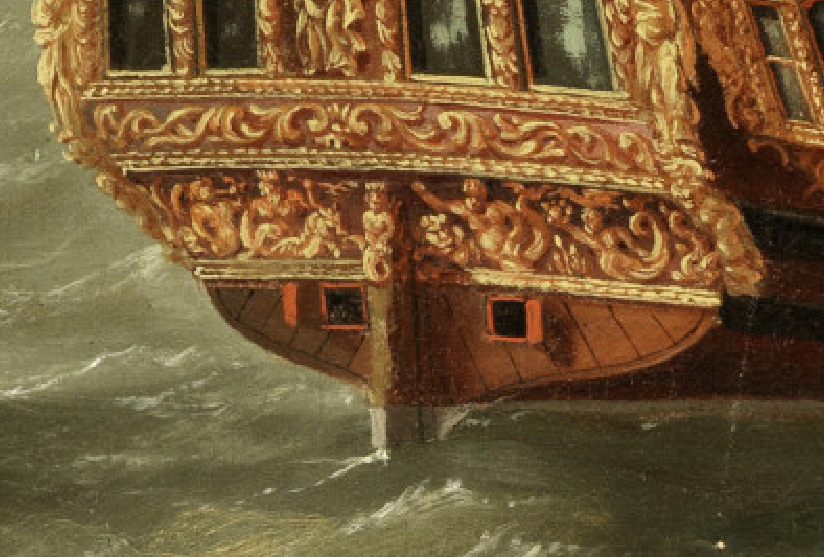
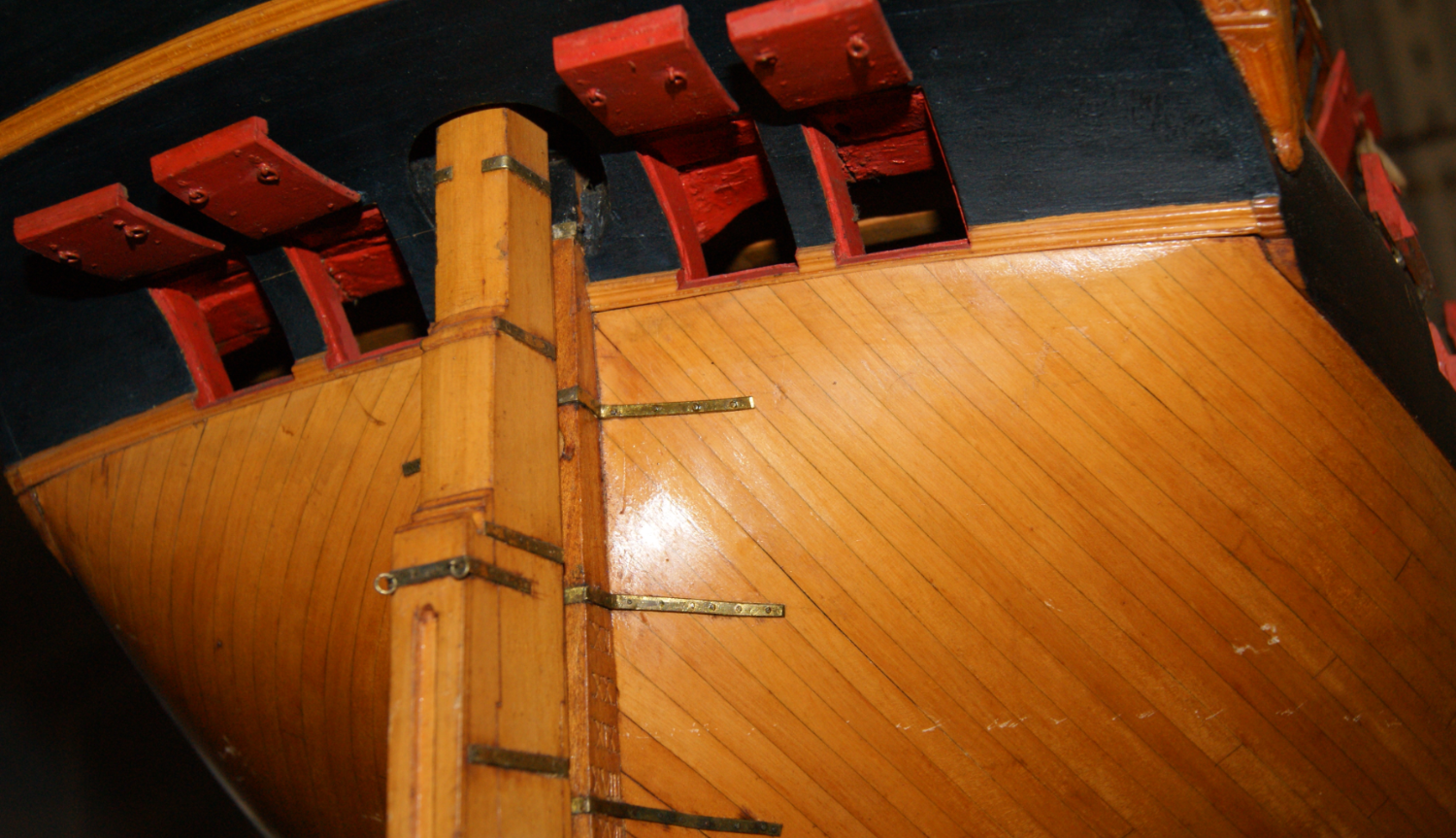
Good Evening Phil; The answer to your question is probably best explained by photographs; basically, a square tuck stern has a large flat area, approximately vertical, with planking, which is separate from the hull planking, laid diagonally. A round tuck stern has the hull planking continued through a rising, curving line until it reaches the lower counter, or 'tuck' line. Note that in both designs, the tuck line is in the same place, roughly in line with the bottom of the main wale. The first picture below is of a round tuck stern, the second of a square tuck. A round tuck gives more effect to the rudder by allowing the water a smoother run to it; at least, that was the reasoning for it, I seem to recall. A square tuck was introduced to give stronger support for guns placed in the stern when such things first came into vogue. In English ships this was changed back to a round tuck in the 16th century, whereas Dutch (for example) retained the square tuck for much longer. All the best, Mark P
-
Good Morning Gentlemen; Not being any kind of expert in Dutch ship design and building, I do not feel qualified to comment on the various points of view put forward above. I can say, though, for those who have not seen it, that Ab's claim that the drawings in question are forgeries was published in an article in the NRJ for Spring 2020, p.33. I will also add that, to my personal knowledge, several very notable persons in the world of research were extremely sceptical of the reasoning used in the said article, and remain so. The matter should certainly not be regarded as closed. An important point to consider is that as Ab has nailed his colours to the mast, so to speak, by stating categorically that technical drawings were not used in 17th century Dutch shipbuilding, it then becomes an absolute necessity that any and all evidence which might indicate the contrary should be discredited. All the best, Mark P
-
Good Morning Gary; I have heard back from the NMM; they only have one drawing of the Queen, and it is not the same as the one which you show. The plan curator believes that It must be part of the Kriegstein Collection. All the best, Mark P
-
Good Evening Sam; I wish you the best of success with your extended project, and hope to see the results when they are ready. The book by Simon Stephens & Nick Ball, 'Navy Board Ship Models', has a directory near its end which lists the locations of most known models which are constructed in what is known as the 'Navy Board' style, ie with open framing visible, and not fully planked hulls. These models tend to be 17th & early 18th century in date, and the directory lists approximately 30 different collections, large to small; a few are now in an unknown location, following sale at auction, but most are still accessible. The collections listed frequently also comprise other models of later date in the 'Georgian' style, where the hulls are planked. Some of the collections have been mentioned above, but some are quite obscure; with a range of others in between. All the best, Mark P
-
Good Evening Gary; The NMM's website now is a bit of a joke, to say the least. Their own staff are in despair at the fact that the new version was ever switched on so long before it was ready. Search results now are very limited. One drawing of 'Queen' of 1769 does appear, but it is not the same one as shown in the book. I have sent a message to some contacts in the plans archive to ask for reference numbers for any other draughts of her which might exist, and I will let you know what they might tell me. All the best, Mark P
-
Thanks for your reply Mike; No self-serving assumed, don't worry. If you can find a solution, that would be very encouraging. I understand that multiple items become cheaper for shipping, but quality books like these can't be low-priced, and my wish list always has far more books in it than my monthly budget will cover. All the best, Mark P
-
I was looking forward to purchasing something, until I saw the shipping cost to England; it was more than the book itself! Mike: is there any way to reduce shipping? I can get books sent from Europe for about £15, and I have had books sent from the States before at reasonable rates. The postage rates I have seen will have an impact on sales; they certainly did on me. Highest was $90, although that was fast. I don't care if it takes a month to get here, and I don't expect it to be cheap, necessarily. All the best, Mark P
-
Good Evening Mark; Druxey is quite correct; however, one thing which is perhaps surprising is that many contracts contain large amounts of very similar wording, even as far back as the mid seventeenth century. It would appear that it was quite customary that every time a new build needed a contract to be drawn up, the first thing to do was to reach for the previous contract and copy it; perhaps adding a few extra words or paragraphs here and there. Contracts grew gradually in length. The oldest one I have found is from the 1580s, and is three pages long. The ones dating from the decades before the French Revolutionary Wars began frequently run to thirty or more pages; and those pages are quite large, A3 size. All the best, Mark P
-
Good Morning Mark; I believe that the Marlborough specification is missing a couple of words; the writer is near to the bottom of the page and may well have been trying to condense what he said as much as possible, leaving out a word or two in his haste. The sentence does not really read very smoothly at all as it stands. All the best, Mark
-
Good Evening Mark; I interpret this phrase to mean that the sheer strake is to be parallel to the waist rail (or concentric to it; virtually the same thing) Once this is applied, there is no trouble with definitions of what rail is what in the contract. Falconer is still in opposition, but I believe that he is in error; firstly because he is outnumbered by other contemporary sources; but secondly because of the following: William Keltridge, in his book giving many dimensions for ships of the latter part of the 17th century, lists the 'plansheer' rail. Since the 'plansheer' is what we know as the planksheer, which is the moulded capping plank laid over the tops of the timbers in the waist, it would seem a fair deduction that the 'sheer' rail was once called the 'plansheer' or 'planksheer' rail, and is fixed directly below the plansheer/planksheer. The waist rail is, as most sources indicate, and as you first described, the moulding which is interrupted by the gunports. It may also be important that Keltridge was quite prolific in his output and was a renowned ship's carpenter, ending his career as carpenter of the first Royal Sovereign in the 1690s, which would make him the Navy's most senior ship's carpenter (he was not in this post by the time she burnt at her moorings) and lived much longer than Falconer, who was lost at sea on a voyage to India, whilst still only 37 years of age. Falconer served as a seaman, and a purser; and briefly as a midshipman. He was also well fairly well-known as a poet. On balance, Keltridge's experience-derived knowledge will have been much more fitted to enable him to correctly name the parts of a ship. All the best, Mark P
-
Lovely work Siggi; A pleasure to watch her taking shape. Concerning the mast wedges, there is an interesting passage in a book about the Dutch Wars in the 17th century: The Navy Records Society published a book about the Wars, and it includes the following memoir of a sailor. He was part of a group of men who had recaptured a former English ship, which had been taken by the Dutch some time previously. As they sailed the ship out of harbour, they came across a Dutch ship, which realising that they were English, turned to escape, and gradually got further and further away. The English commander asked if any of the crew had served on the English ship before she was captured, and when one man said that he had, the commander asked him what was the ship's best point of sailing. The sailor's answer was that they should alter the rake of the masts by slackening the backstays and having done this, they gradually overhauled and captured the Dutch ship. So small differences in mast rake could make a difference in the sailing qualities of a ship. All the best, Mark P

Our Emblem ®