


Mark P
-
Posts
1,774 -
Joined
-
Last visited
Content Type
Profiles
Forums
Gallery
Events
Everything posted by Mark P
-
Roter Löwe 1597 by Ondras71
Mark P replied to Ondras71's topic in - Build logs for subjects built 1501 - 1750
Lovely work, Ondras; Happy New Year of modelling and everything to you. Mark P -
Good Morning Michael; I must express my great appreciation of your work on your model. When I was a nipper, I had the exact same model; dreamt of it for a long time before it was actually given to me as a present. Unfortunately I cannot remember if I ever actually completed it; and even if I had, it would have been the bog-standard kit; not very well painted, and with the black plastic shrouds (like something out of Shelob's Lair) So I congratulate you on the standard and completeness of the changes which you are making, and wish you the best of success in your endeavours! All the best, Mark P
- 327 replies
-
- 4
-

-
- Sovereign of the Seas
- Airfix
- (and 1 more)
-
Good Morning Trevor; Thanks for your thoughts; I always appreciate discussion of the various points that are raised around this remarkable ship. All the documents upon which my conclusions are based will be either included in the appendices (most of them) or clearly referenced. As you say, we will have to agree to disagree, perhaps; but with regard to her 1659-60 rebuild, the twin facts, preserved in the contemporary records, are that the Navy Board specifically ordered that she was not to be altered in her build; and that the list of works ordered to be done quite clearly could not in any way alter the shape of her hull, together make it clear that, barring very specific evidence to the contrary, her hull was not altered in its shape. This statement is then backed up in a letter from the Navy Board in 1687 which states again that she was not altered, and the list of approved works again shows that she was not altered. The reason for the length of time which the second repair took is that the money kept running out; the men were unpaid for over 15 months at one point. There was a constant shortage of timber also, due to lack of funds or credit. Other work may have been authorised as work progressed, and I am currently searching for proof of this, but have so far found none. Nonetheless, you are completely free to hold a contrary opinion, and I certainly don't expect others to agree with me, although once published I would expect the contrary opinions to at least diminish. The book was born out of a feeling of disgust with the last couple of books published about the Sovereign: McKay's, which while beautifully illustrated, as always, is so demonstrably wrong in so many ways that it is not fit to be taken seriously (and which I know seriously teed off Frank Fox by the inclusion of his name in a way which implied he had endorsed the work, when in fact all his recommendations had been ignored) The other is Sephton's book, which is poorly illustrated, not well written, wrong in many places, and fails to give references for almost every assertion which he makes. The book is a joint venture with a well-known author, who will be providing many of the illustrations. As you write, our intent is to base it as much as possible on contemporary sources. Obviously much will still be speculation, but it will be informed by a long-term study of the structure and appearance of other vessels before and after the Sovereign (the size of most of the main timbers of the Prince and many other vessels is recorded, for example) I very much doubt that any other individual has seen, photographed, and studied as much of the contemporary documents as I have since I commenced this (which was actually for a different era and vessel originally) I have documents which list her draught in three places at her launch, and laden; the dimensions of her masts, yards, sails (including the royals) tops, parrels, deadeyes, and rigging. Her armament is well-attested, and I have all the documents relating to this also, as well as others which demonstrate that her guns were indeed placed aboard her (which some have argued never took place) Some of the financial records of her building, which are detailed in some ways, but not others, also survive. There will also be, some time next year, an article in the Mariner's Mirror concerning the decoration of Elizabethan ships; if all goes as planned. There is some delay at present due to a change of editor, but this will hopefully be sorted soon. This article (which has not yet been accepted) has some interest beyond its subject, as it lists the decoration of one of Elizabeth's 'first-rate' ships, rebuilt around 1601, which is described in sufficient detail to make it clear that she was decorated in a very similar manner to the Sovereign. Phineas Pett would have been very familiar with her appearance; draw your own conclusions! All the best, Mark P
- 327 replies
-
- 3
-
-
- Sovereign of the Seas
- Airfix
- (and 1 more)
-
Good Afternoon Trevor; 'Dead-men-eyes' is not a reference to fairleads, although Boteler does seem to be using it in that context, I agree. This phrase is the original wording of what became later called 'dead-eyes'. The frequent occurrence of the earlier version of the phrase in rigging lists with shrouds, or in lists quite clearly describing them being set up with lanyards for the shrouds makes this beyond doubt. Mainwaring's dictionary refers to a rope designed to perform the same function as Boteler mentions, but I forget what it was called. It was not a horse, though. Perhaps it was 'Timenoguy' (although I think this was a later term) or something similar. I am afraid that there is no link to the rigging inventory document. Something similar to it exists in the Science Museum collection, but neither is available online. I have been carrying out extensive research into the Royal Navy of the later 16th and early 17th centuries for many years, and I am now engaged in putting some of the results of this down into a book; one which which will deal with the Navy and many of its aspects at this time; but before this another which will be about the Sovereign of the Seas, and probably the Prince also; about both of which vessels I have accumulated a large archive of contemporary documents, many of them never before referred to anywhere in print, and quite possibly unknown previously except to a very few. I have seen no published reference to most of them, nor heard anyone else mention any of them. Unfortunately, even so, they are nothing like as extensive as I would like, and still leave many questions unanswered. However, they do most certainly add a worthwhile amount to the knowledge previously available. The fires at the Navy Office which destroyed all the early records were an unmitigated disaster for all with an interest in this time. All the best, Mark P
- 327 replies
-
- 1
-
-
- Sovereign of the Seas
- Airfix
- (and 1 more)
-
Well, gentlemen; my apologies: I am about to put a large cat amongst the pigeons, by disagreeing with much of the assertions made in several previous posts, too extensive to quote here individually. I do, however, completely agree with Trevor's interpretation of the landing stage; I read this passage and came to exactly the same conclusion. Any attempt to build a bridge from the shore to the Sovereign, which was moored in the deepest part of the river, well away from the banks, would have been totally impracticable, and I must admit cannot be seen as one of Frank's finer moments. Regarding the authorship of the 'Morgan' drawing of the Sovereign, this is a new argument to me, and I must look into what Laird-Clowes wrote about it. Before I continue, I will state that everything I am about to write here is completely based upon clear contemporary documents, which I have seen and photographed, and is not the interpretation of limited documents carried out by some earlier authors. Although one or two of these documents are referred to in articles & books from the 20th century, I do not believe that any of them are available on the internet, and I also believe that few, if any of them are catalogued anywhere, or online, as they are bound up within larger volumes. They are available to a keen researcher, and with the exception of some of the documents relating to her 1680-85 repair, are not easy to find, and are not in obvious places. The combined meaning of all these documents is clear enough to have led me to the conclusions set out below. Misconception number one: although a large amount of work was authorised to be carried out on her in late 1651, this was in fact not done; in February 1652, Peter Pett, the man in charge of Chatham Yard, wrote to his superiors asking permission to dock the Sovereign to carry out the works intended. However, only a few weeks later, in early March, she was ordered to be fitted for sea with all haste. This was in response to the rising fears of war with the Dutch, which did indeed break out shortly thereafter. Any ship which was capable was then outfitted with all speed, including the Sovereign. She was not docked at this time. This is not a personal opinion, but a proven fact. Peter Pett, seeking permission to dock the Sovereign in 1659, due to a serious leak which was proving impossible to to fix whilst she was afloat, stated unequivocally that she had not been docked at all since she was launched 21 years previously. Minor alterations may well have been carried out to her topsides in 1651-2, but there is no record of this, so it remains only a hypothesis. As Pett, the man on the spot, thought it necessary to dock her to carry out the work, and she was not docked, it is difficult to justify any modern statement that the work was indeed done. Misconception number two: the Sovereign was rebuilt twice. This is a total fallacy: she was never rebuilt before she burned. She was repaired twice, in dry dock. The first time in 1659-60, and the second in 1680-85. In both cases the list of works to be carried out survives, along with the letters authorising this work and the corresponding expenditure. Neither list contains sufficient work to justify in any way being described as a rebuild, and contemporary records refer to 'repairs' only. There are references to the fact that she was found to be exceptionally sound in many of her timbers. On the occasion of the first repair the Navy Board gave orders before it commenced, that she was 'Not to be altered in her build'. See also the Navy Board letter mentioned in the next paragraph. Misconception number three: that her gundecks and ports were altered due to an increase in draught. This again is a totally mistaken interpretation of very limited evidence to even hint at this, and is based, I believe, solely upon figures given for her draught. Such a measurement is rather subjective, and covers a range of figures. It is also based upon different methods of measurement, which has given rise to the oft-repeated assertion that her keel was lengthened in the second repair, despite there being absolutely zero evidence anywhere else to support this. A letter from the Navy Board to the Admiralty dated 1687 states the following facts: firstly, 'The Sovereign was never altered in her principal dimensions, since her first building, although she has been twice repaired, the last of which was almost new, yet kept to the same shape with her old timbers'. Secondly, 'The number of guns of the Sovereign is the same now that she carried in her first building. The Ports being the same'. As there is no mention in the list of works to be carried out that the decks were to be raised, or ports altered, this second sentence is best interpreted in its most obvious meaning: ie that the ports are unaltered. All the best, Mark P
- 327 replies
-
- 1
-
-
- Sovereign of the Seas
- Airfix
- (and 1 more)
-
Good Afternoon Trevor; I am sorry to say that I cannot support your hypothesis re the ropes running over the Sovereign's bowsprit. They are not connected to the forestay in any manner. A rigging inventory for the Sovereign exists from circa 1643, which, under the bowsprit section, describes the item you are referring to as the 'Ladders in the head'. They are made of 4" rope, a total of 15 fathoms; or 18ft per up and over length; which seems a perfect fit to the engraving. Payne also clearly shows ratlines across these ropes. To access the bowsprit via this seems totally logical, as although the beakhead may indeed have been wet, it was a lot firmer footing than the top of the bowsprit would have ever afforded; the beakhead was used for handling the rigging of the headsails, some of which belayed to a pin rack in the head; as well as being the location of the seats of ease, and would have been very familiar territory to the crew. One puzzling entry here is the 'Horse under the Bowsprit', which is 10 fathoms of 6" rope. This is not the same as the 'Horse to go up the Bowsprit', which is listed separately, and is clearly shown in Payne's engraving. If anyone knows what this is, I would be pleased to hear about it. All the best, Mark P
- 327 replies
-
- 3
-
-
- Sovereign of the Seas
- Airfix
- (and 1 more)
-
Wales
Mark P replied to -Dallen's topic in Building, Framing, Planking and plating a ships hull and deck
In answer to the original query, I would make two clarifying statements: Firstly, the post which gave birth to this query was based on practices of the 18th century and earlier, and as it states, the method of constructing wales changed considerably over time, and is one of the diagnostic features used to assess the age of models. Planking practices of the 19th century were not under consideration at the time. Diminishing strakes under the main wale go back at least to Elizabethan times, although there is no evidence that they were ever flush with the wale. All evidence points to the contrary being true. Secondly, regarding the chamfering of the tops of the wales, this would indeed seem a desirable feature, and is shown on draughts of the early 17th century; so I would posit that it would be done, even if not shown on draughts. All the best, Mark P -
Amazing quality of work and detailing; a bar set very high for normal mortals to aspire to reach! Envious congratulations from one who has not yet reached it. Such models create a means of really appreciating the skills possessed by the men who built the full-size versions of these vessels. All the best, Mark P
- 1,215 replies
-
- 2
-
-
- sloop
- kingfisher
- (and 1 more)
-
Giampiero that is a most beautiful model, I congratulate you on a great achievement! The tidiness of your workshop is almost as impressive also! All the best, Mark P
-
Good Evening Mike; Thank you for suggesting this. I for one much prefer to see the book on the bookshelf; although I can also understand that a digital version of the book would be a great aid in the workshop, more so than a book, actually. I already have all four of the Swan series; any idea when you might be re-printing Vol II of Ed Tosti's Naiad books? All the best, Mark P
-
Good Evening Tony; I would definitely attempt to quarter saw your logs, rather than just through and throughing it. Boxwood is like all other woods, and if the grain in your planks, when viewed in section, is dish-shaped, it will try to straighten the curve. The only difference is that being by now well-seasoned, this movement will take a considerable time; unless exposed to damp conditions. I am surprised to see that your log does not appear to have radial cracking in it; perhaps because it is so long, or because the seasoning was very gradual. Were the cut ends of the log sealed to prevent rapid evaporation? If so, well done to whoever did this. The dark streaks in the timber are actually a fungal infection, in my experience, and can lead to a fuzzy mould growing out of the cut surfaces if the air is at all damp and unventilated. However, yours may well have died off by now. When this occurred with some of my stock, I cleaned it off with a mild antiseptic wipe and let the strips dry, and increased the ventilation in the storage area. There has been no recurrence so far! On a last point, boxwood is fine grained, however, I have some which if I did not know, I would almost swear it was a high quality pine wood, as it appears to have the usual banded grain of pine. However, I know that it is box (I cut it from the tree myself) and it is still very fine grained, hard and heavy. It just does not look it! All the best, Mark P
-
Good Evening Mark; I am very glad to see that you are posting again, and that you are at such an intricate, complicated stage of the work. Quarter galleries are a tremendously difficult area to do well, but they are one of the first parts to catch the eye when looking at a model; so it is vital to be absolutely happy with each stage, and to discard what does not meet your exacting standards. I don't doubt for a moment that yours will up to your usual extremely high level of excellence; a standard nearly all of us can only aspire to, and never equal. I wish you all success and good health in continuing what you have begun in such an exemplary tour-de-force. All the best, Mark P
-
Good Evening Joachim; I cannot think that there is any difference between the two. I note two points from the list shown above: Firstly, the sheets pass through a shoulder block. This is the same as a quarter block, yet the inventory also lists shoulder blocks separately. However, as the quarter blocks are for the bowlines, they must be located on the bowsprit, near its outer end, with the running end coming inboard over the bowsprit. When the rope is hauled, this could cause the block to be pulled down against the bowsprit, with the rope being compressed between the two, and becoming jammed. For this reason a shoulder block is needed here, and has been listed using an alternative name for the same item. As evidence of this, I have checked my images of the rigging warrant for the cutter 'Kite', of 1762. This lists the blocks for both the bowlines and the sheets as 'shoulder blocks'. They are both the same size, as they are on the list you show above. Below is a picture of a shoulder block, from Steel's Elements of Rigging. All the best, Mark P

-
Good Morning Joachim; Re your original query, a quarter block had a small projection worked on it, so that it would not be pulled flat against the yard-arm causing the rope inside to bind against the yard, preventing movement. Typically used for sheet blocks at the yard-arm. An iron-bound block has a strap of iron around it, rather than a rope strop. It also has an iron pin, which is set into holes in the strap each side of the block. A coak is a metal plate of iron or brass, set into the outside surface of the shell of the block, to form a bearing for the pin through the sheave. This prevents the pin bearing on the wood, which would wear out more quickly than the iron will. All the best, Mark P
-
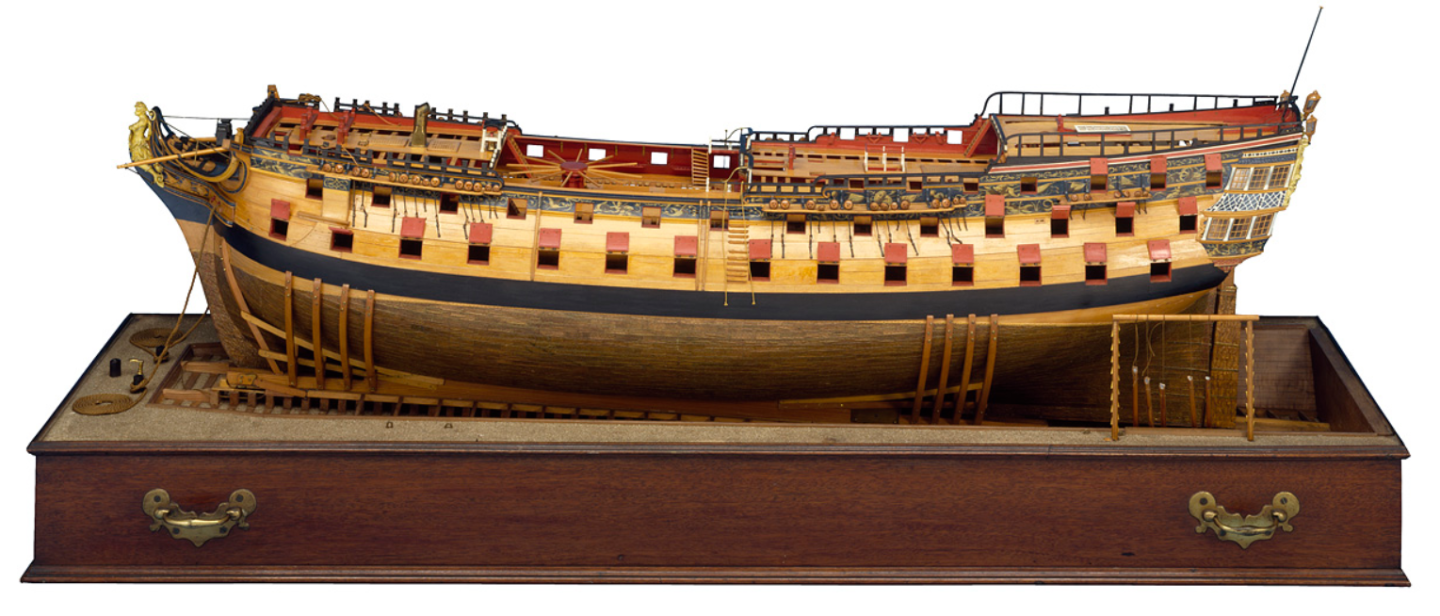
Good Evening Masa; In the Eighteenth century most ships of any size were built or repaired in a dry dock. An existing ship would be floated in on a high tide, and as the water receded, the hull would be propped up with a large number of shores, whilst her keel would settle on a line of timber blocks. The base of the dock sloped towards the river, both to allow the water to drain away thoroughly, and to facilitate launching on a slipway. Once the dock was empty, a pair of gates would be shut across the entrance to keep the water out. In earlier periods, the dock would be closed with a bank of clay and stones. The floor of the dock was made of stout timbers, called the 'ways' which were set in like railway sleepers. The blocks to support the keel, and the shores, would be nailed to these ways to prevent them moving. A new built ship could be launched by opening the gates and allowing the dock to fill with water; this was best done with extra high tides. On the other hand, if there was no high tide soon, the ship could be launched down the ways; this was done by setting down timbers like a railway track, called a slipway, running into the water. The ship was fitted with launching cradles at the bow and stern, which sat on the slipway, and the blocks under the keel were knocked away. The ways were well-greased. Sometimes the ship would slide down the ways easily, other times she needed a good pull to get her moving. The book 'Building the Wooden Fighting Ship', by James Dodds and James Moore, describes the build process in detail, with a large number of hand-drawn, good quality illustrations, and also covers the launch. There are several models of ship on the ways ready to launch, including the well-known model of the Bellona, and the Victory of 1765. All the best, Mark P
-
Congratulations on such a lovely model; well done indeed.
- 648 replies
-
- 1
-

-
- Indefatigable
- Vanguard Models
- (and 1 more)
-
Thanks Allan; This is too wide-ranging a field for us to know all of it. Belaying pins were certainly used from the Tudor times, but in combination with many other belaying points. As ships developed, and rigs became more and more complicated, the number of ropes needing to be belayed multiplied, and it is easy to imagine that racks of pins in the bulwarks rationalised the forest of ropes coming down the rigging. In addition, pin racks on the inside of the shrouds were definitely in use by 1750. One day I hope to produce a typical English belaying plan for the early 17th century and late Tudor period. Just have to live long enough! All the best, Mark P
-
Good Afternoon Allan; Sorry to say this, but please check your memory, as Phil is actually correct; and this subject has been discussed at least twice before. Belaying pins were used in the early 17th century, and can be seen on early models (granted that the earliest surviving models date from the mid seventeenth century) Henry Mainwayring, a noted seafarer of the times of Elizabeth and James I, described belaying pins in his nautical dictionary, which he wrote around 1623. I am not sure, but I believe that they are also mentioned in a treatise on rigging which R C Anderson believed dated from around 1620 (must check that) So carry on Phil; all I would say is do not place racks of belaying pins inside the bulwarks everywhere, as this might well be not historically accurate. In this respect Allan is correct, and it is this configuration which did not appear until later in the era of sail. All the best, Mark P
-
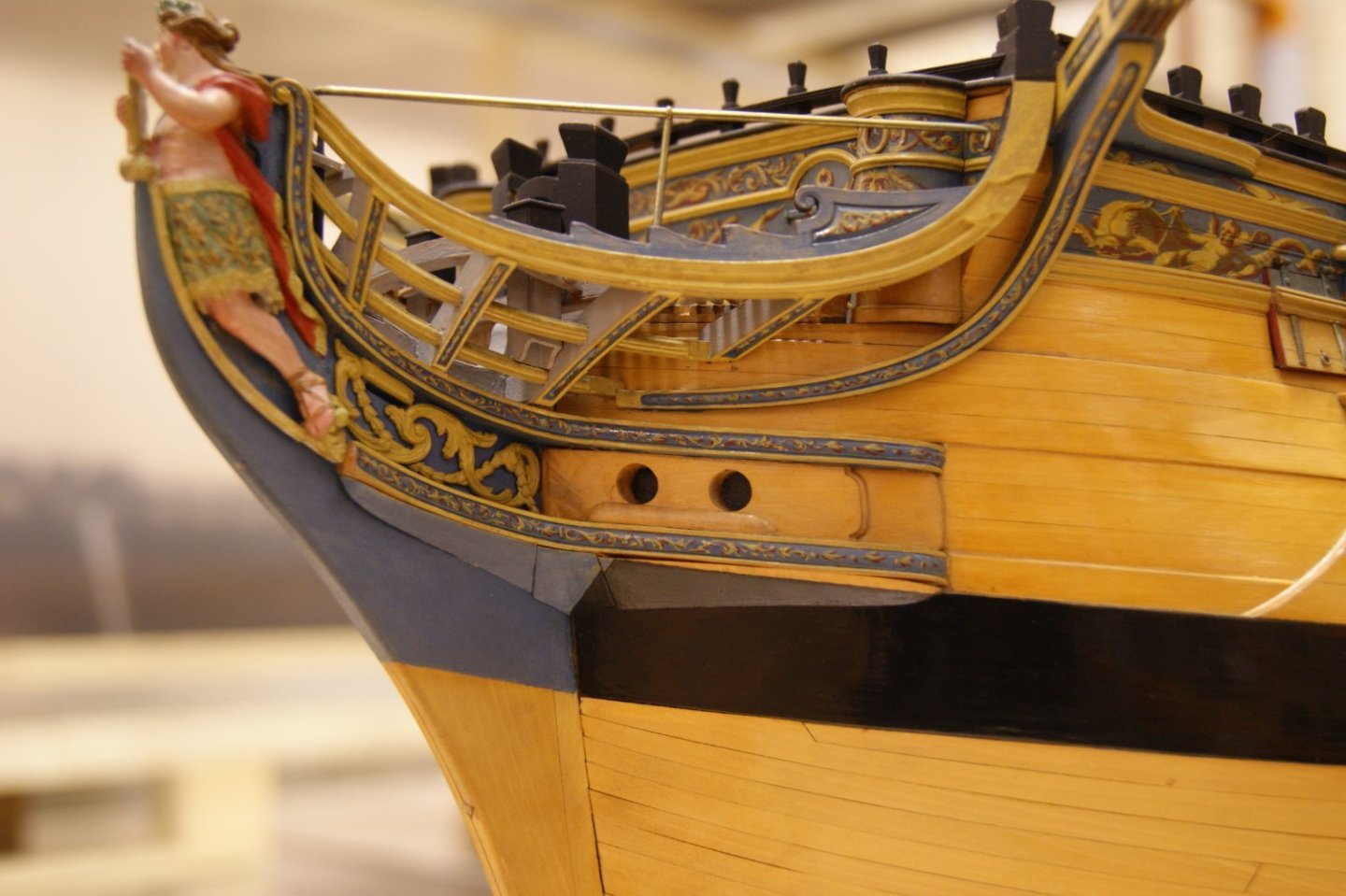
Good Afternoon Brunnells; I have a large selection of English boxwood (I know it is because I cut the branches from the trees myself, or got them from gardeners who had cut them down, with the leaves still on them) This has a good range of colour, and some of it is indeed very noticeably yellow. Some is very pale yellow, more of a cream colour, and there is a whole variety of inbetween shades. Some of it has no grain visible at all; some is prominently marked, with the end-grain looking like pine softwood; which of course it isn't, it is much too heavy, and must be the result of some growth rings being very close together, with others which are more dispersed. The main characteristics are that it is heavy, hard, and extremely fine-grained. Below is a picture of a model made with boxwood planking, which is very yellow; presumably sealed with something, but the colour looks lovely. All the best, Mark P
-
Thank you Morgan; That is a really interesting picture. My immediate reaction is that it is 17th century, for two reasons: Firstly, the underside of the floor timbers have notches in each timber for the limber passage. Secondly, the futtocks appear to stop short of the keel, which is strongly indicative also. However, more photos would make it clearer. I will see if I can contact the chap who took the pictures. The closeness of the timbers would also seem to indicate a warship, although I would not state that with any certainty. I don't think it is a particularly large vessel, as the outer planking appears to be quite thin: 2-3 inches. All the best, Mark P
-
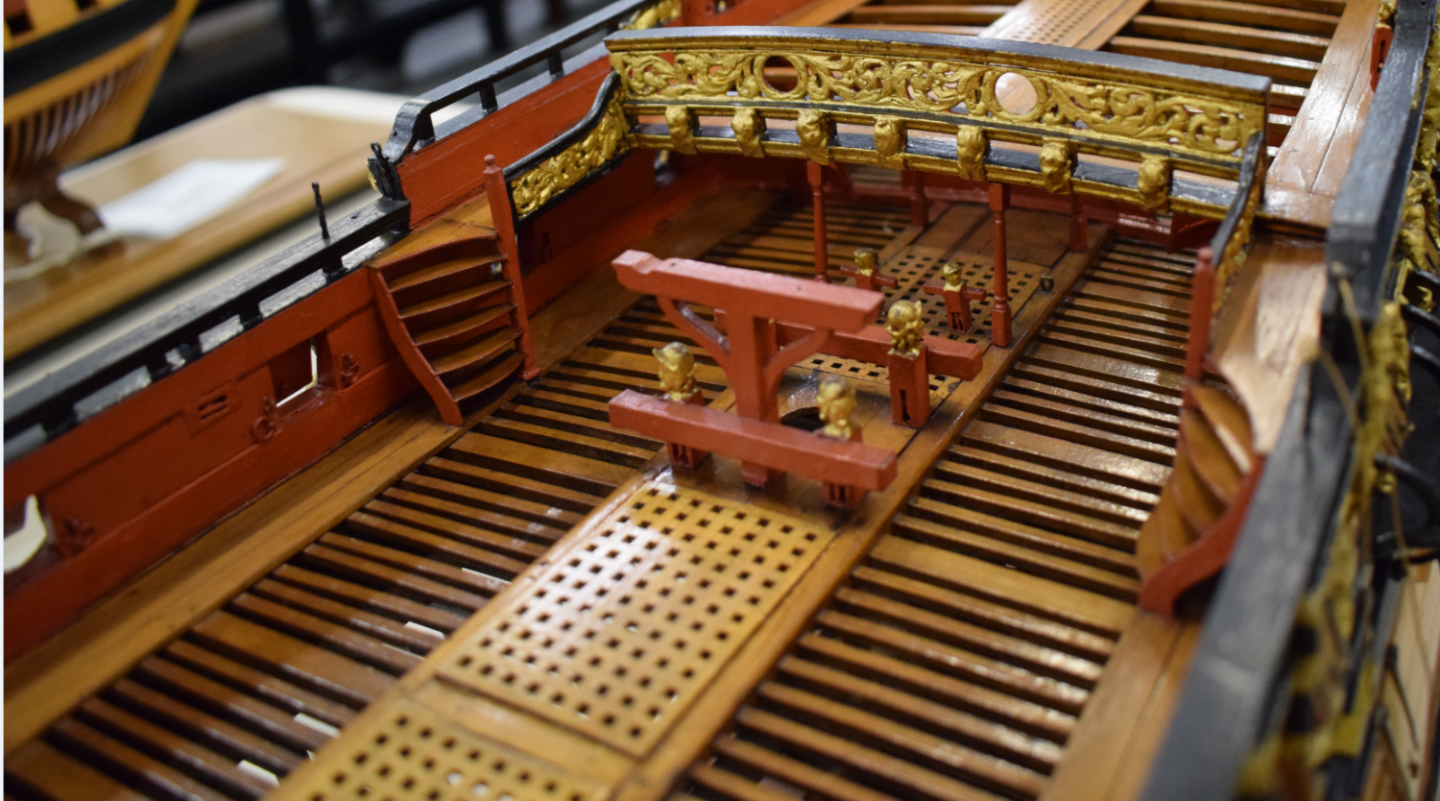
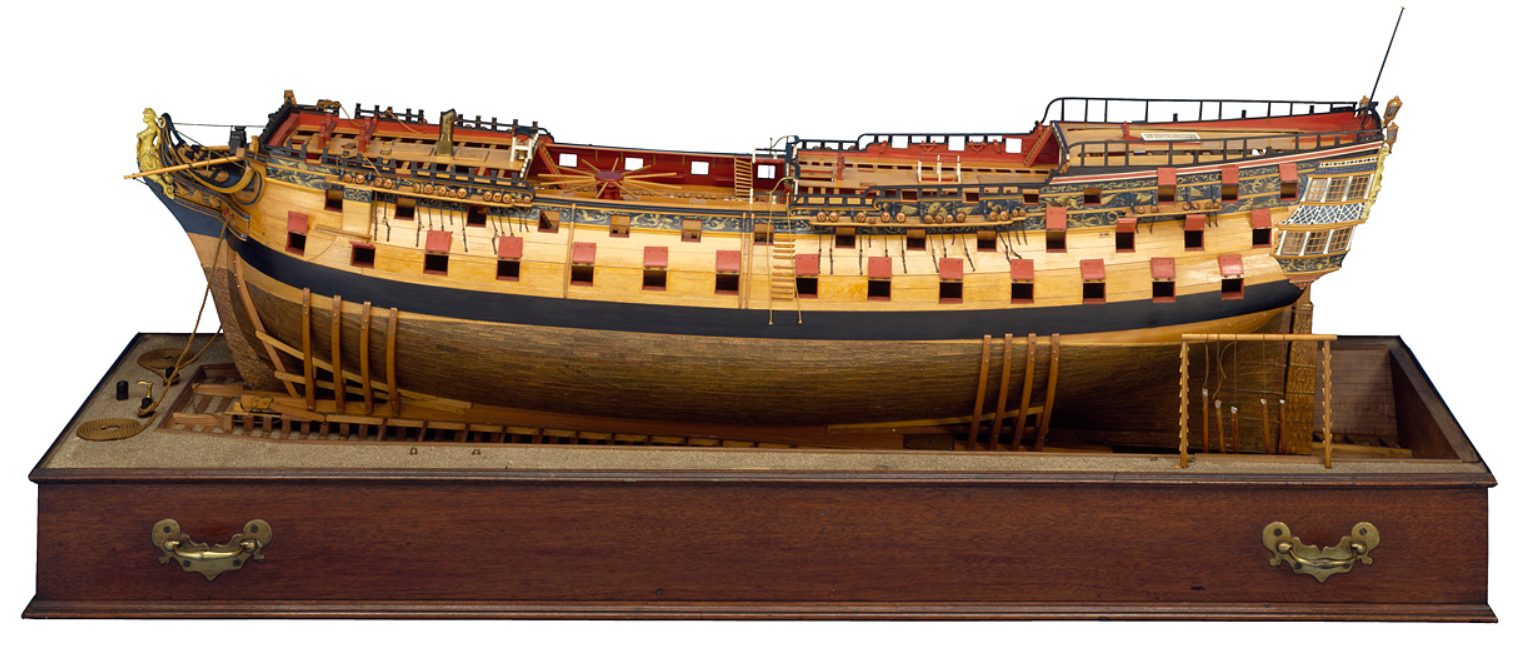
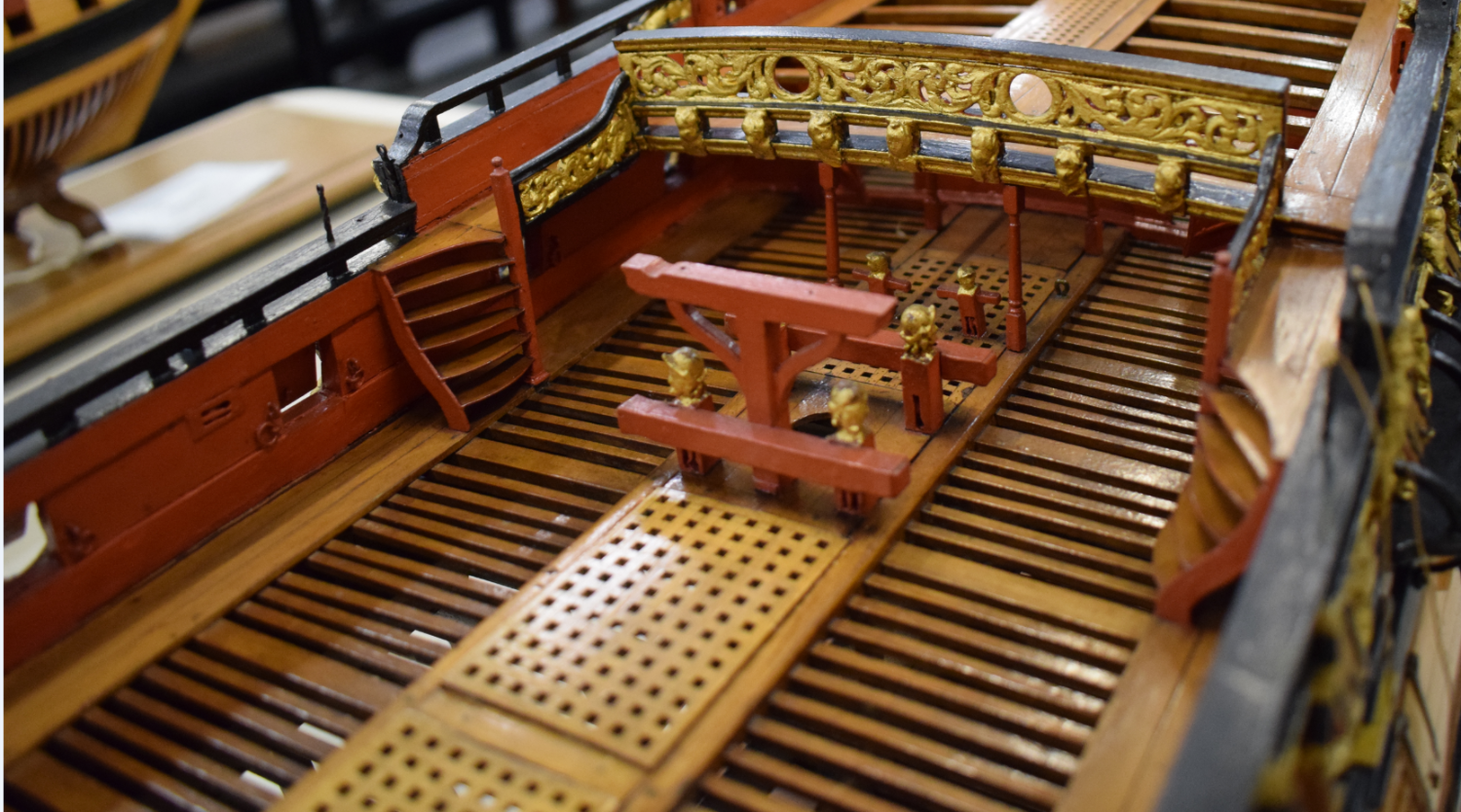
Good Evening Markus; Your question touches on several separate topics; not being knowledgeable concerning American ships I cannot perhaps answer with full authority, but I can tell you the equivalent English practice. Firstly, all timber used in ship-building was classified in various categories, according to its size and intended use. For planking, this comprised 'board', 'plank' & 'thick stuff'. Board was around 1" thick, and was used for bulkheads and partitions. Plank was up to 4 or 5" thick, and was used for most of the hull covering, in and out. Thick stuff was used where extra strength was needed, and was up to around 9" thick. Generally, anything over this thickness was only used (in larger ships) for the keel and related pieces, along with deck beams. Compass timber was anything curved, the main use of which was for forming the curves of the frames. The thicker strakes of deck planking, which are flush with the main deck coverings, but are let down into the top of the deck beams, are known as 'binding strakes', and their purpose was to stiffen the ship's structure. They were also often used to fix the ring-bolts for the train-tackles for the ordnance. Lord's survey is obviously a very thorough one, and much attention has been paid to detail. I would be very dubious that he shows anything that was not there when he carried out his work. In the 17th century, the central portion of the deck was normally raised above the planking outside this strip, and was delineated by timbers known as 'long carlings'. See photograph below from a model of the 'Boyne'. This practice continued in the 18th century; see photograph of a model in the National Maritime Museum, dating from the early 1760s. Thanks for posting an interesting drawing. All the best, Mark P
-
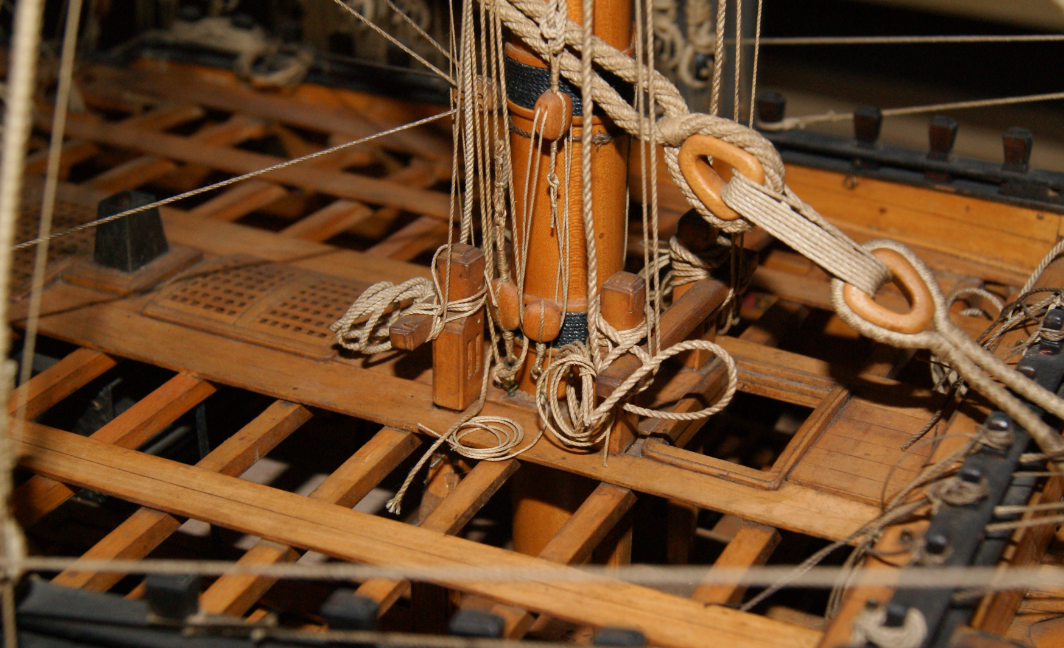
As a piece of interesting trivia, the earlier name for these items was 'dead men eyes'. This was especially apt when they were triangualar rather than round, making the resemblance to a skull face more obvious. All the best, Mark P
-
Help with understanding the rigging diagram
Mark P replied to Linda DOBLE's topic in Masting, rigging and sails
Good Morning Linda; To help you understand what is happening in the rigging diagrams you show, a simple rule can be applied: The mast and sails on the left show the 'sheets'. All sails shown on the mast need a rope to keep their lower corners from flying up in the air, in which event the sail would hold no wind, and the ship would not move. The sheet performs this function, and is essentially the same on all the sails shown. The right hand mast and sails show the ropes which are designed to do the exact opposite to the sheet, and to raise the lower corner of the sails to the yard when it is time to furl the sail. These are known as 'clew-lines'. To haul on the sheet opens the sail; to haul on the clew-line furls the sail. When the sheet is hauled, the clew-line must be 'paid-out', or slackened so that it runs free. By far the best reference book I know of for ships of this era, which covers the rigging of such ships in great detail, is the 'Masting and Rigging of Clipper Ships and Ocean Carriers', by Harold A Underhill; first published in 1946. He was a very skilled modeller and draughtsman, and knew many of these ships personally. He also wrote several other books dealing with simiilar vessels, and produced a wide range of plans for such ships, which have very good masting and rigging details on them. If you are building your model without sails, then the ends of the clew-line and the sheet would be shackled or tied together, so as to be ready in position when time came to fit the sail back to the yard. (edit) I have just checked and the book is available online from £16, with many copies listed by different sellers, with different qualities and prices. Wishing you all success with your modellling! Mark P -
To be fair to Mike he does say he is not sure if those two are in the Rogers Collection or not. Vol III covers fourth to sixth rates. Presumably the brig is unrated, and so is too small to fall into this category; and must wait for the next volume, along with any single masted vessels. However, as a frigate one would expect that the Shannon would be in vol III if it was part of the Collection; something I know not. Unless it is intended to produce a separate volume of American vessels? All the best, Mark P
-
Thank you Mike; I am greatly relieved to hear that. See you at the checkout! All the best, Mark P

Our Emblem ®
