

Egilman
-
Posts
4,377 -
Joined
-
Last visited
Content Type
Profiles
Forums
Gallery
Events
Everything posted by Egilman
-

Bugatti Type 35B by CDW - FINISHED - Italeri - 1:12 Scale
Egilman replied to CDW's topic in Non-ship/categorised builds
The Sheave for the cable is centered on the pivot point of the spindle, the brake lever remains at the same distance around the pivot point no matter which way it is turned... I forget what the geometry term is for this phenomena, but believe me it's real... If you moved the sheave to any other location, yes, you would have a cable tension problem as you turned the wheels... Mechanical brakes only work correctly as long as there is little to no slack in the operating cable.... If there is any minor slack in operation, a simple spring tensioner on the cable is employed to take that up.... (that is what your "S" chain in the middle is doing, it runs around two gears pulling against spring tension, travel is small only enough to take up the slack... Keeps the cable taut without overcoming the brake lever springs at the shoe) -
The AMX-13 project by RGL - Heller - 1/35
Egilman replied to RGL's topic in Non-ship/categorised builds
GOOD DEAL!!!! They are not easy to come by.... Just two more to complete the set.... Excellent find... -
The AMX-13 project by RGL - Heller - 1/35
Egilman replied to RGL's topic in Non-ship/categorised builds
Probably, the shipping to Aussieland from the US is atrocious brother... You already have the VCI, VCA, VTB & AMX 13-155 The AMX 13-75 should be easily available, they reissued it in '04 and '13 as Heller #81122, Unfortunately, the AMX 13-105 and DCA were never reissued... (there are a couple of DCA's available on US ebay right now, one Gunze AMX 13-75 (Heller 784 reissue), and one AMX 13-105) Gunze Sangyo AMX 13-75 on Australia's ebay... It's a nice collection of a rarely seen weapons system... Would be nice to have them all, the 105 & DCA are not getting any easier to find... -
rolltop desk by kgstakes - FINISHED - 1/4 scale
Egilman replied to kgstakes's topic in Non-ship/categorised builds
Proxon, schmoxon... the brand of saw make no difference at all, all they do is spin a blade on an axis... Yes, some do it better than others, but no matter how good the saw is, it still comes down to the skill of the operator.... And you sir are an artist with a saw.... Very well done... -
Bugatti Type 35B by CDW - FINISHED - Italeri - 1:12 Scale
Egilman replied to CDW's topic in Non-ship/categorised builds
Back in that era, spark advance was mechanical, controlled by a lever mounted to the center of the steering wheel... Pull down to retard, Push up to advance.... Operation was open the throttle, (pedal on the floor) and when the engine started pinging or backfiring as the RPM's increased, you pushed the advance lever up to get the spark ahead of TDC for better combustion.... When the distributor was developed, they realized that they could advance the spark based upon manifold vacuum automatically and much more accurately, and the manual lever magneto controls went away... Average speed jumped by 10 MPH... -
The "Zipper", another skunkworks beauty... I'm in....
-
Bugatti Type 35B by CDW - FINISHED - Italeri - 1:12 Scale
Egilman replied to CDW's topic in Non-ship/categorised builds
Yep, they do this to aircraft engines all the time... (and to aircraft skins before the advent of flush riveting) And, it's not really a bias, it done in opposition to the way the fastener turns... Think about it for a sec, the bolt or nut turns right handed to tighten, left hand to loosen, so the wire will run from the bottom side of one hex head to the top side of the next hex head on the left preventing either from turning left handed... But this is the first time I've seen such done for an entire line of bolts or screws continuously... (usually done in pairs) Beautiful work so far Craig... -
Yep that is two of Mr. Gatto's well known plans... (engine-tender & Car) I have his Mack Dump Truck, Ford loader backhoe and Trailer plans which I built for a friend back when I could still do that type of work... His Road Grader is currently sitting half finished on my workbench... Unfortunately his website is down... (www.gattoplans.com) But from what I can see his plans are available from several online sources commercially... Fred is a great guy, I sure hope nothing has happened to him.... Beautiful Job Mike, Love the trestle presentation, that's above and beyond....
-
A BAC Lightning would be VERY cool, something seldom modeled....
-
Never tell the difference.... Nice repair..
-
Bugatti Type 35B by CDW - FINISHED - Italeri - 1:12 Scale
Egilman replied to CDW's topic in Non-ship/categorised builds
Looks darn fine to me brother.... -
Fw-190F-8 by RGL - FINISHED - Eduard - 1/48
Egilman replied to RGL's topic in Non-ship/categorised builds
Hey brother, shiny aluminum needs to go down over a super smooth hard gloss black surface... The black is what gives it's it's depth of color, the smooth shiny surfaces give it it's reflectance... And they are very fragile, they won't take a whole lot of handling until they are sealed.... If you were doing a dull aluminum finish that's perfect... The depth of color is there but very muted and the reflection is very subdued due to the rough surface... (but it is there) -
Lotus 72D by gsdpic - FINISHED - Tamiya - 1/12 - PLASTIC
Egilman replied to gsdpic's topic in Non-ship/categorised builds
Good looking engine... Cosworth's dominated racing and HIPO ICE's for almost three decades, they were winning in all forms of 4 wheel racing... They broke the 70 year dominance of the Peugeot-Miller-Offenhauser line of 4VDOHC engines and their line was broken by the Honda's of today... The upper end of the Cosworth line could produce almost 800hp on 175ci at 10k revs.... (at under 300lbs as well) The racing engines of today all owe their pure performance to the original Peugeot L76, (for 7.6 liter) which first ran in 1911 and was dominating racing until the development of the L30, 183ci (two years later) The first 4VDOHC engine which blew away the 7 & 11 liter racing engines of the day.... 3 liters producing more raw power that three times the cubic displacement at half the weight... That 1913 design has been copied too many times to count and the principles of it's fuel induction system have been applied to and tweaked into everything that used internal compression to generate power... To me it's always been a wonder that the simple principles of the 1911 L76 and the 1913 L30, are still alive and well today.... -
P-38J Wicked Woman by DocRob - FINISHED - Tamiya - 1/48
Egilman replied to DocRob's topic in Non-ship/categorised builds
She's a real beauty!!! Freshly minted P-38!!! Nothing else comes close... Well done Brother, very well done... -
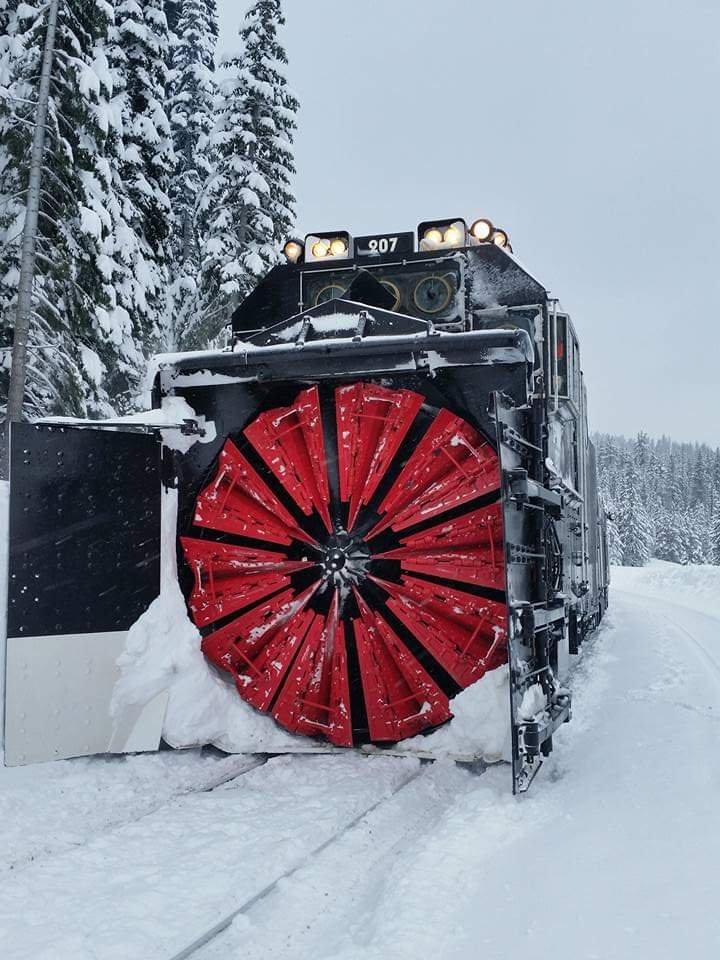
It would be painted at the factory, and in usage would strip the paint off the leading edges, it wouldn't be completely bare metal but would look streaked and scraped bare metal with paint remaining in the areas that don't take a lot of stress.... (same with the inside of the shroud/intake chute which would be streaked with scrapes) they didn't chew much ice, mostly semi-compacted snow on the main routes... One of the few still in use, this is the Donner Pass Blower/Plow... Pretty much they are rebuilt/repainted every year in the off season...
-
Lotus 72D by gsdpic - FINISHED - Tamiya - 1/12 - PLASTIC
Egilman replied to gsdpic's topic in Non-ship/categorised builds
Now you have... https://www.indycals.net/decals/f1/77wolfwr1.html https://www.bestbalsakits.com/tamiya/tamiya-detail.asp?kitnumber=4145 https://www.ebay.com/itm/234972506380 Indycals does most of the tamiya kits in any scale... Bestbalsa is also a good source.... Hope it helps... -
Sorry bout that little history dribble brother, there are quite a few serious RR modelers here that already understood the differences, so I probably shouldn't have brought it up, but for the few that are unawares, it is a good thing to understand.... Didn't mean to de-rail your build log....
- 102 replies
-
- 10
-

-

-
Well to actually get down to the brass tacks of model railroad scale, it is ALWAYS based upon the gauge of the rails, which is the distance between the rails.... "O" gauge being 1/48 the distance of real live american gauge rolling stock... This is known as "Standard Gauge" in real railroad parlance, all others are based upon this standard.... European gauge is also "Standard Gauge" as that is where it was mandated by law in 1846... Standard gauge, 4' 8.5", (56.5 inches, 1,435mm) is the most prevalent gauge around the world..... so, true "O" scale would have a gauge of 29.9mm or 1.177 inches... And since everyone serious about model rail knows that "O" gauge is 32mm where does it get it's relation to 1/48th scale? The point of what I'm saying, is there are 4, (maybe more) different standards for "O" gauge model railroading, which isn't 1/48th scale... (more accurately 1/43rd scale) in the '50's the american model railroad manufacturer's started building for scale accuracy and chose 1/48 scale as their standard for rolling stock (including Lionel) but stayed with the original gauge for their track, and over the years "O" gauge has given way to the term "O" scale in model railroading... Scale and gauge are not interchangeable terms... any serious discussion of Model railroading scales needs to take this into account....
-
SU-85 WW2 Soviet Tank Destroyer by CDW - MiniArt - 1:35 Scale
Egilman replied to CDW's topic in Non-ship/categorised builds
Or, any Feldwebel with a panzerfaust..... -
{chuckle} It might be in miniature, but the engineering remains the same..... Good work!
-
The AMX-13 project by RGL - Heller - 1/35
Egilman replied to RGL's topic in Non-ship/categorised builds
That Twin anti-aircraft gun is probably the rarest of them all... I'm here my friend.. -
Actually, they had a very healthy fixation on Power to Weight ratio, which up until 1940, heavily favored radial engines...
-
So, the lightning strikes! Works for me....
-
Designed in '38 it was the first cannon armed British aircraft, it was also the fastest thing the RAF had in development... At the time, anything the British could get into the air was being produced, remember this was designed as a bomber killer, they needed rate of climb and raw power more than they needed speed for that role.... Merlins didn't fit that bill besides all the merlin production was spoken for for the next few years given the situation at the time... (it's why they licensed production out to Packard for the P-51) The RR Pregrine's developed valve problems which lengthened it's development time and as a result only a few were built, barely over 100 of the type and with the success of the Typhoon and Tempest it was decided that the Whirlwind wasn't needed/too costly to manufacture and maintain compared to it's contemporaries.... The type was retired in early '43 in favor of the Typhoon/Tempest line.... (also cannon armed) Think of a P-38 with cannons instead of machine guns for it's effect on a target.... And the Tempest was 60kts faster at sea level as well.... That's what war does, speeds up the development decision policies, there was no time for prolonged development....
-
A fresh issue bird, EXCELLENT!!! not too many build to a new look anymore... It is just as beautiful as an end of the line veteran.... Well done brother...

Our Emblem ®
