

wefalck
-
Posts
6,664 -
Joined
-
Last visited
Content Type
Profiles
Forums
Gallery
Events
Everything posted by wefalck
-
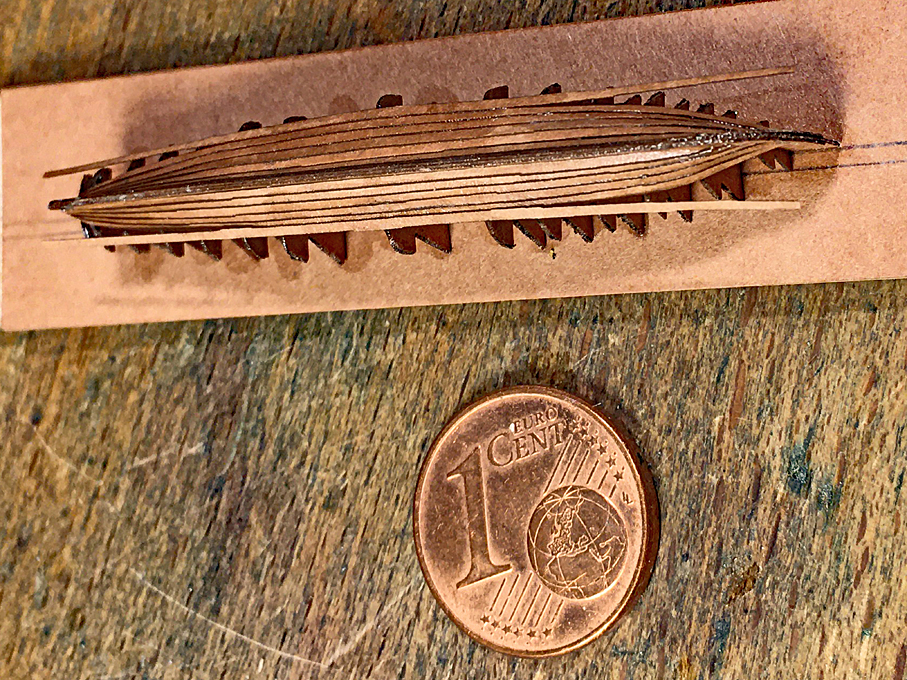
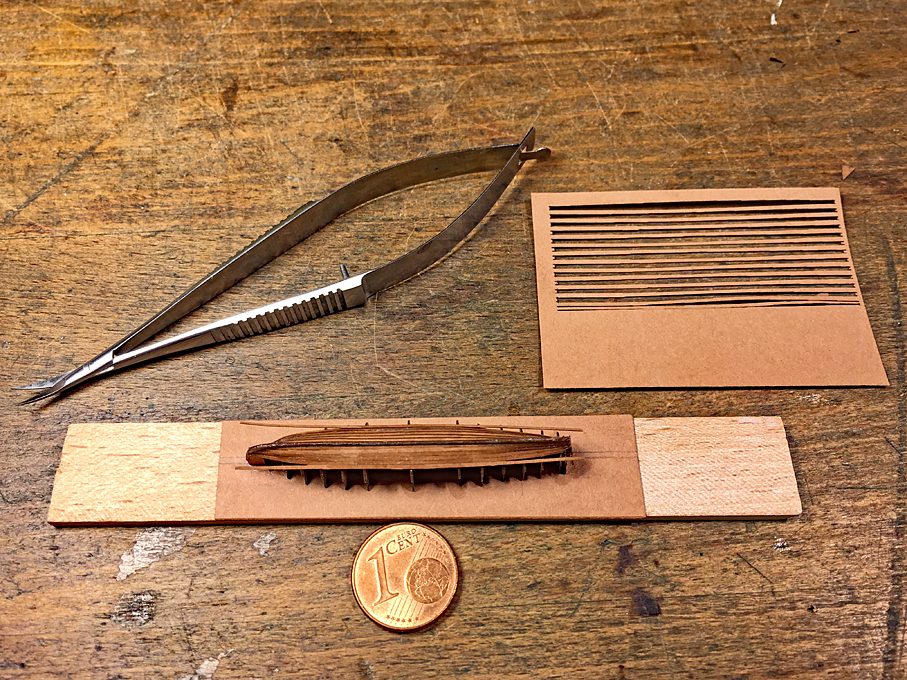
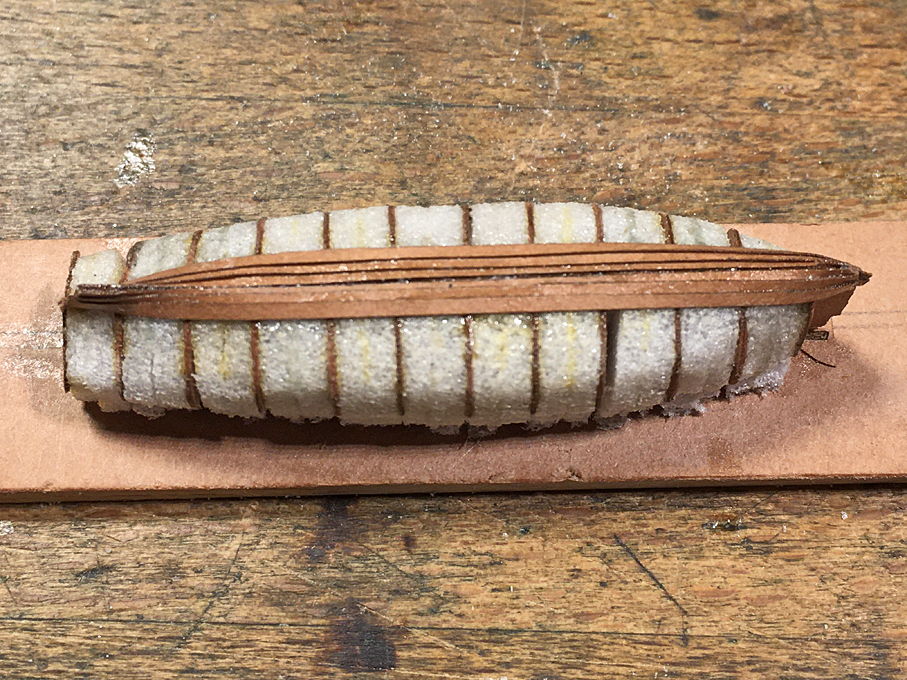
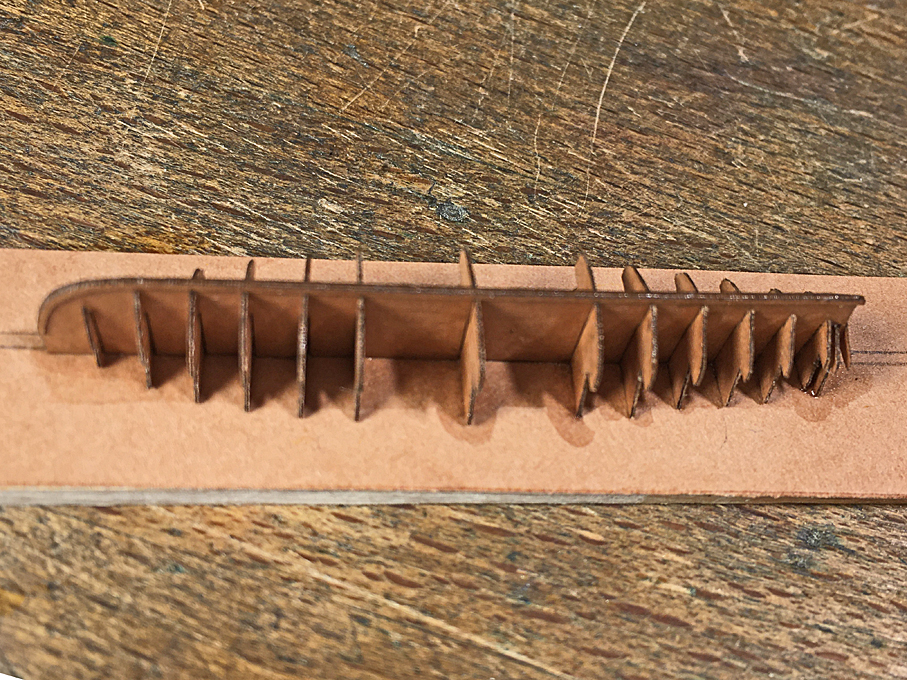
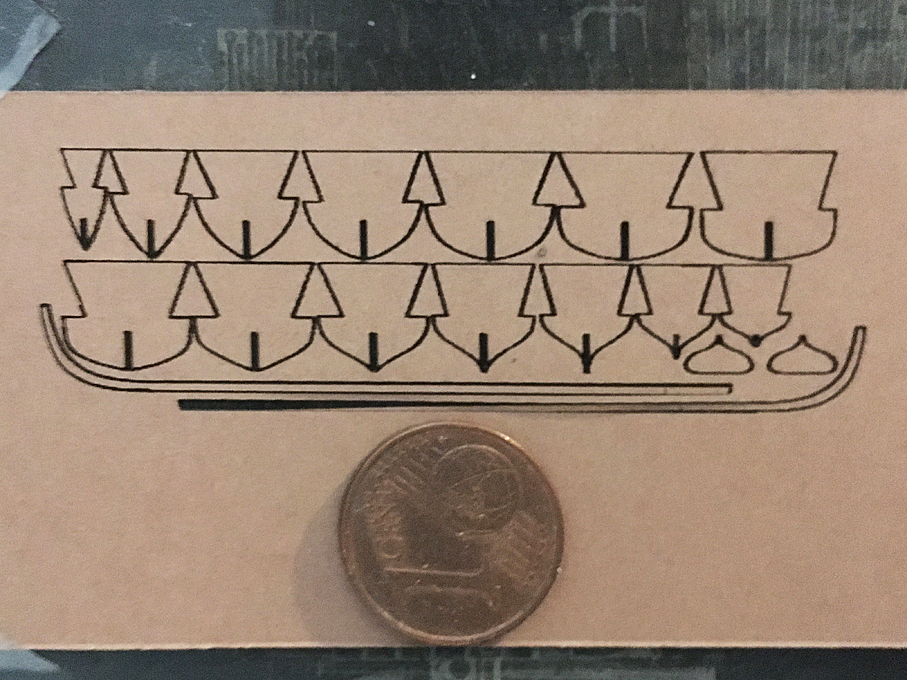
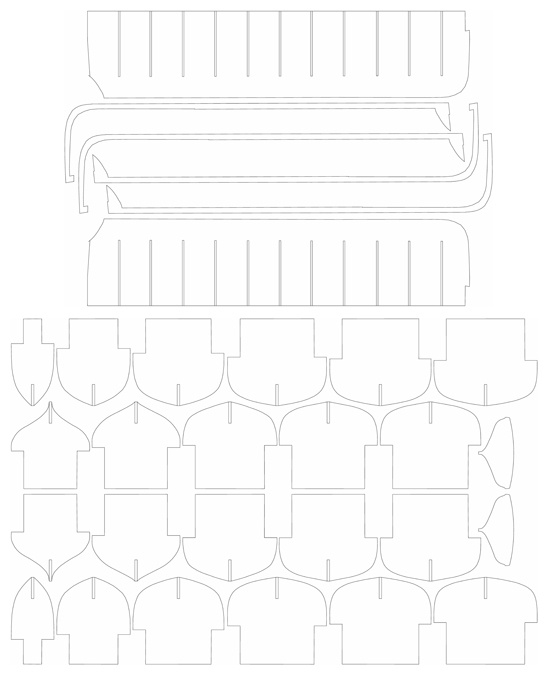
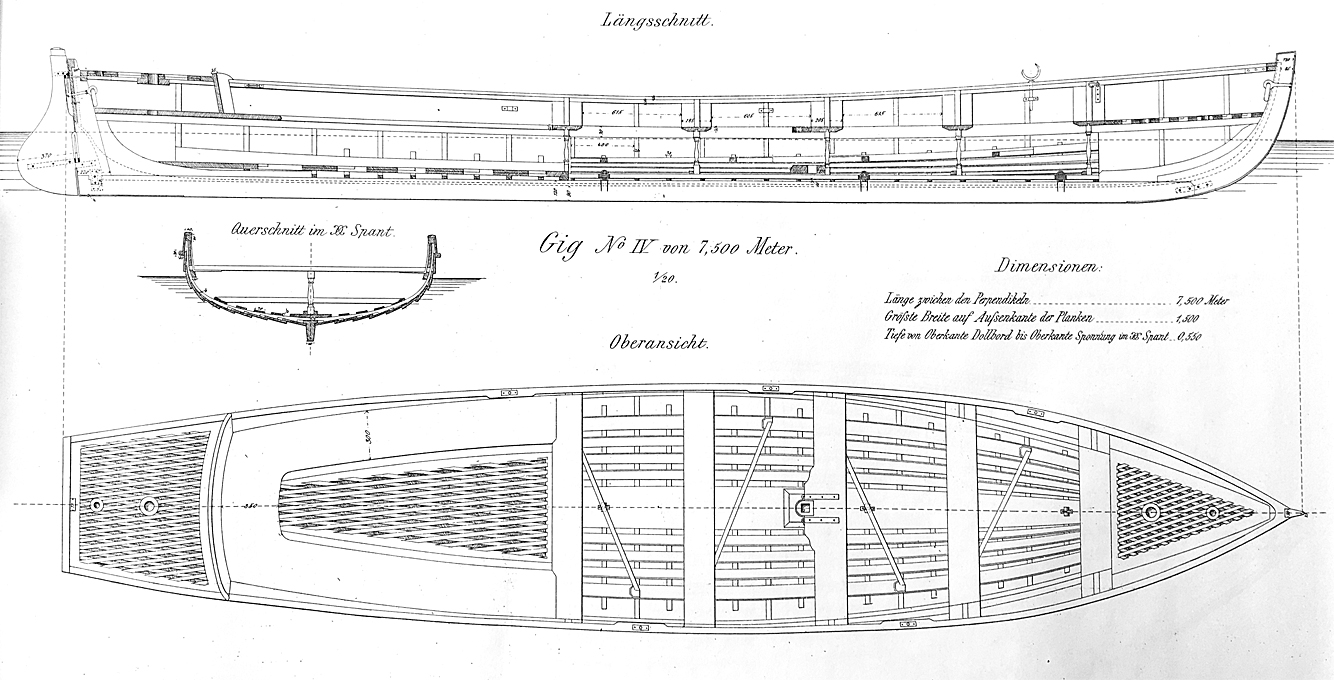
 This has been buried deeply in my building-log for S.M.S. WESPE and not everyone is interested in 1870s warships. Thus, potentially interested people may have missed this description of building small-scale clinkered open boats. So, I decided to pull this part out, edit it for the purpose, and post it separately. Clinkered open boats in small scale (the examples below are in 1/160 or N-railway scale) can be a challenge. The processes described below are based on paper parts cut with a small and cheap 3W laser-cutter. If one has a stronger laser-cutter, the same method can be used with thicker cardboard or even styrene and may give even crisper results. There are even various laser-cut kits for such small boats in 1/72 on the market. Actually, the construction methods described below are adaptations of the well-known plank-on-bulkhead (POB) and plank-on-frame (POF) methods. Starting point, of course, are a set of suitable plans, line- and body-plan, plus ideally information on the actual construction, dimension of scantlings etc. Example of a drawing for a gig from the early 1880s. Two construction strategies are described one for boats covered with canvass, so that the interior structure is not visible and does not need to be modelled. The other example is for a plank-on-frame open boat model that shows all interior and construction details that one can possibly show at the chosen scale. Plank-on-Bulkhead (POB) construction of open boats closed with a cover Traditionally, one would carve a ‘plug’ for the boat from a piece of wood, that is based on the dimensions inside the planking(!). Such a plug can be re-used in case another copy of the boat would be needed. Otherwise, one can plank directly on the plug. For the method proposed here, each individual framing stations from the body plan was redrawn as a bulkhead to be cut out with the laser-cutter. Additional material is left on the top, so that all bulkhead scan be glued to a building board arriving at the right height. As backbone, a longitudinal profile of the boat, inside the planking, is drawn. All pieces were slotted as it is common practice in POB construction. The slots were twice as wide as the paper, as all pieces were cut in double to be soaked and varnished together back-to-back with a view to increase their stiffness. In addition, two pieces that represent the outboard profile of the stem-post, keel, and stern-post were cut, plus two copies of the transom. The bulkheads etc. were arranged on a drawing that controlled the laser-cutter. Template for laser-cutting the keel-pieces and the stem-keel-combinations for a cutter The material used is so-called Canson-paper, which is around 0.12 mm thick and an unglued, but heavily rolled paper. Its surface thus is quite smooth. This kind of paper turned out to be the most suitable for cutting with the low-powered (3W) laser-cutter. Laser-cut bulkheads and keel-pieces The pieces then are assembled as is tradition for POB-construction and mounted onto a piece of Canson-paper for extra stiffness. The whole assembly is then mounted on a small piece of wood to ease handling. The assembled parts for the POB-construction To increase the stiffness of the assembly (which in fact is already surprisingly robust), the spaces between the bulkheads are filled with a hard foam. I am using an acrylic resin foam, that is being produced by the manufacturers of Plexiglas, but any hard foam will do. The foam is sanded back to the profile of the bulkheads and then soaked in varnish. Imperfection can be corrected with automotive putty. This will give ample surface for the planking to attach to. Note that due to their thinness, the bulkheads do not need to be bevelled. Foam-filled framework with three strakes on The planks are laser-cut from the same paper. Tapering such planks by hand would be too much of a challenge and not quite feasible in paper, I think. However, my 2D-CAD program gives the length of the Bezier-curves used to draw the outline of the frames. So, one can simply take this length, divide it by the number of planks and add 50% for the clinker overlap in order to arrive at the plank width at each station. In reality that planks would overlap above and below only for about 25% of their width, but the extra width will not be seen on the completed model and gives extra leeway to accommodate small inaccuracies during construction. With this information somewhat too long planks were drawn with a few extras, as not all turn out well. A wider plank is provided for the garboard. In theory, the planks should not only be tapered, but also curved in the plane, but I do not have a software to develop a full planking diagram. However, when wetted with varnish, the paper, unlike wood, can be relatively easily bent and shaped across the wide side of the plank. Materials and tools for planking When laser-cutting the tapered planks, the curves are so shallow, that the ‘stepping’ due to the 0.1 mm resolution of the cutter becomes quite pronounced. For this reason, the planks were drawn with a straight line on one side and the tapering curve only on the other. The straight edge will become the visible lower edge of the plank, while the stepped, curved side will disappear under the plank above. When fitting the planks, the best way is to fix them in the middle first and then work towards the ends. As can be seen on some of the pictures, originally, I put the doubling of the stempost-keel piece in place before the planking in order form a rabbet against which the planks run. This turned out to be not very practical, as precise fitting is quite difficult with this material. Now I am drawing the backbone to the inside of the planking and add a false stempost-keel piece afterwards. This greatly facilitates the planking at the bow. Planking progresses from the middle to the ends All planks are cut flush to the interior backbone using a micro-scissors or cuticle scissors. When heavily soaked in varnish, the paper can be cautiously sanded. The soaking in fast-drying varnish has to be repeated after a few strokes with a diamond nail-file to prevent the paper from fraying. In clinker construction, at the bow, where it meets the stem-rabbet, the lower planks are thinned out by the width of the overlap and over a length of 1.5 to 2 plank widths or so. In this way the planks are flush at the rabbet. This is a feature, that at this scale is neigh impossible to reproduce, so one needs to cheat a bit again. Luckily, as long as the varnish is still wet, the paper can be squeezed and moulded. The thinning can also be simulated by squeezing the edge with flat pliers or splinter tweezers that have been ground flat at the end. While the varnish sets, the edges are squeezed tight using locking tweezers. The same thinning procedures is applied to where the planks touch the stern-post or the transom. Clamping the planks tight at the bows The planking is done mostly by eye, as it is difficult to mark out the planking run with sufficient precision on such a small workpiece. It is advisable to use an organic solvent-based varnish for the purpose. A drop of acetone softens the varnish and allows to make small corrections in the run of the planking. To be continued …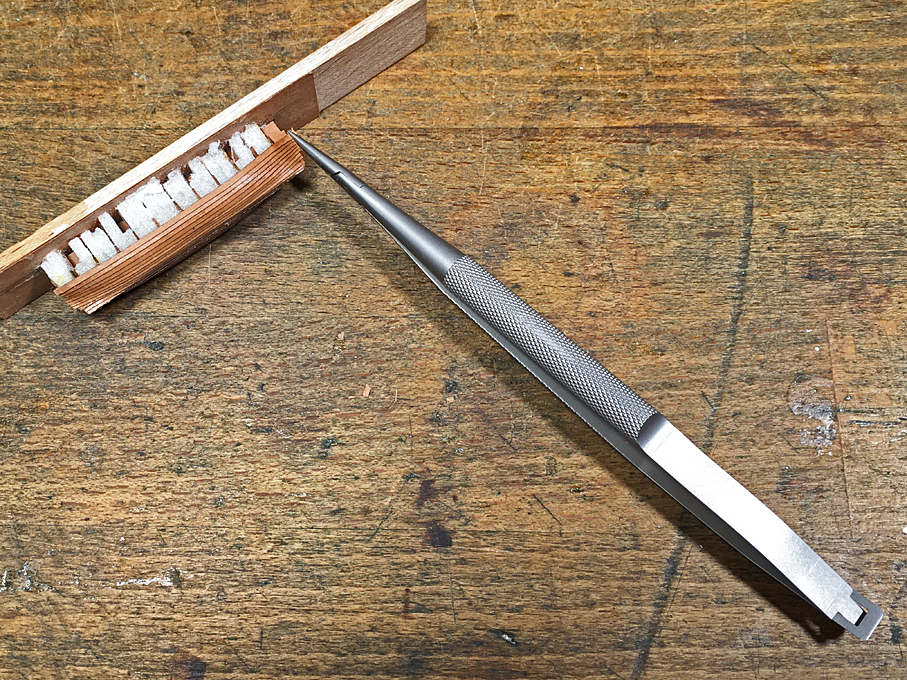
- 13 replies
-
- 17
-

-

-

-
Yep, hunting down materials can be a challenge, regardless where you are. And it seems to become more difficult with time, as many speciality shops disappear and other shops only stock what sells with a certain minimum quantity over the year 🤨
-
My newest Challenge
wefalck replied to James Flynn's topic in Building, Framing, Planking and plating a ships hull and deck
Would make a change to the usual kit-built cross-sections of HMS VICTORY 😁 -
My newest Challenge
wefalck replied to James Flynn's topic in Building, Framing, Planking and plating a ships hull and deck
If really wanted to reproduce a fully-framed model, you would need to make all those frames as shown above the keel in the blow-up below: All the vertical lines above the keel indicate frames. You would have to draw each of them, paste the drawing on suitable pieces of wood and then cut them out using a scroll-saw. Frames are also made of several pieces to ensure a good run of the wood-grain. So you would have to know from how many pieces the frames are made up of and reconstruct this pattern. This kind of construction usually goes by the term 'dockyard model' (though real dockyard models often used a simplified scheme of frames). If you search for this term here on the forum you will find several models constructed this way. In fact the Atlas du Genie Maritime gives all the construction details, but not necessarily for a particular ship. All this requires a lot of research, planning and drawing (i.e. real lofting, copying plans is not enough). Perhaps a worthwhile project, but one has to know that one will be spending probably a couple of years of spare time just for the preparations, before cutting any wood. I don't want to discourage you from such an ambitious project, but I have the feeling that you should build up some more basic knowledge of shipbuilding techniques pertaining to such large ships in the middle of the 19th century. Perhaps an idea would be to split the project in two, building a POB model of such a ship and another model of a considerably smaller ship that shows such interior arrangements ...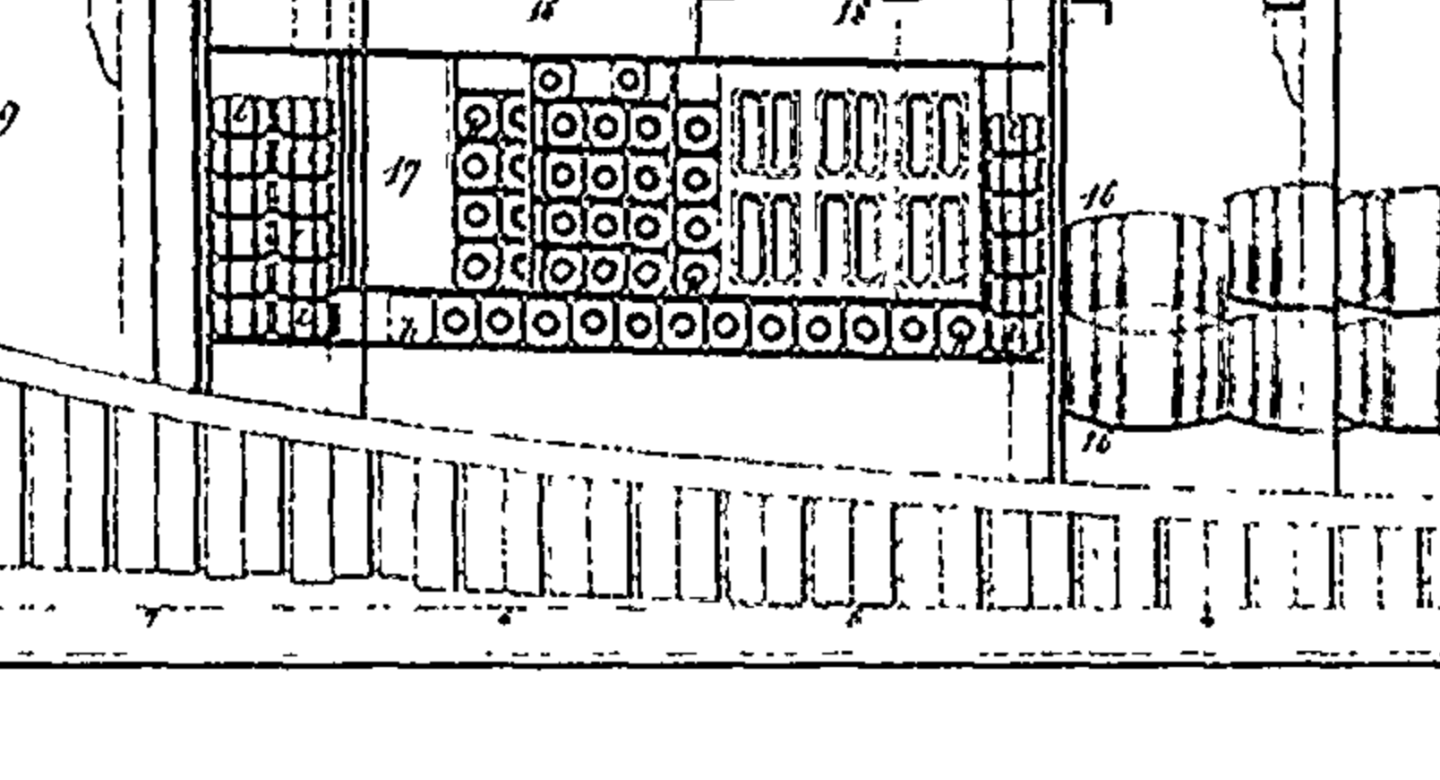
-
My newest Challenge
wefalck replied to James Flynn's topic in Building, Framing, Planking and plating a ships hull and deck
Another thing to consider: for a true POF contruction, you would have to loft dozen of intermediate frames, as they were spaced very closely on these ships, only a few inches apart ... a major investment in time and in material. -
My newest Challenge
wefalck replied to James Flynn's topic in Building, Framing, Planking and plating a ships hull and deck
Keep in mind that this is only the hull, the whole ship will be something like 50% longer, taking into consideration the bowsprit etc. However, I think you put a tall order onto your plate, something that will keep you busy for the next ten years ... -
My newest Challenge
wefalck replied to James Flynn's topic in Building, Framing, Planking and plating a ships hull and deck
There are data for the dimensions as well as a scale in metres for the small sail-plan. From this you can work out the scale for a hull of 4 ft. length. It seems that the hull was around 67 m long (= 220 ft., I didn't check where exactly this was measured), which means that at 4 ft. length we are talking of a scale of something like 1/55. -
On a German forum the colleagues try to coerce him to approach e.g. ANCRE to write up the building-log as compendium to (French) rigging practices in the early 19th century and their implementation in models 😁 Of course, this is entirely up to him and I know a couple of other exemplary modellers, who say that they rather spent their time at the workbench than at the computer-desk (and I can't blame them for that).
-
My newest Challenge
wefalck replied to James Flynn's topic in Building, Framing, Planking and plating a ships hull and deck
The drawings posted here and on the linked Web-site come from the 'Atlas du Genie Maritime' that was collated from the middle of the 19th century on until about the 1880s, so contains information and plans from different periods. There is also special volume on rigging details that is a fantastic source (see archjofo's building log for LA CREOLE). The exact contents of this Atlas varies depending on the different copies preserved. It was meant as a sample book and teaching resource for naval engineering students. Unfortunately, there never seems to have been a textbook with explanations for the numerous plates. Not sure what scale you want to build in. At the beginning you wrote the model would be 4" long, which is probably wrong. Otherwise it would be a veritable miniature. If you envisage such miniature, have a look at the building log in 1/700 scale here: http://www.shipmodels.info/mws_forum/viewtopic.php?f=59&t=382477. The two body-plans are, indeed, puzzling. As the lower one seems to show one more frame station I would venture the guess that it may refer to a possible lengthening of the ship, when in 1851 she was converted into an auxiliary steamer. However, Wikipedia on her is quite spartanic and I did not have time to dive deeper into her history. Lengething old warships to make space for machinery was a common procedure at the time. Concerning the language challenges: if one dives into a project from another country, one should be prepared to learn at least the basic terminology in that other language. Today it is easy to find on-line all sorts of specialised and period dictionaries due to the libraries digitising their holdings. Take modern bilingual on-line dictionaries with a pinch of salt - they do not always get it right ... Here are some useful dictionaries that also can be found on-line: PAASCH, H. (1885/1901): From Keel to Truck.- 206 + CIV p., New York/Antwerp. ... that's a classic for English, French, Dutch, and German, later also in addition for Spanisch and Italian. BONNEFOUX, P.-M.-J. DE (1834 and later editions): Dictionnaire abrége de marine. Contenant la traduction des termes les plus usuels, en anglais et en espagnol.- 338 p., Paris/Havre (J.A. Dezauche/C.-B. Matenas). BONNEFOUX, P.-M.-J. DE (1848?): Dictionnaire de Marine à Voiles et à Vapeur. Marine à Vapeur.- 771 p., X pl., Paris (Arthus Bertrand, Éditeur). -
Yep, phenolic resins are so much better, because harder, for many applications ... If you consider building a serving machine, you may also consider building yourself a rope-walk. Basically, you need the same kind of parts and materials, as for the serving machine. Ropes made from fly-tying threads or certain high-quality threads (e.g. Alterfil L 400, a German brand used now by various museums in Europe) will have a 'lay' and no fuzz.
- 2,699 replies
-
- 3
-
-
- heller
- soleil royal
- (and 9 more)
-
Perhaps it has become merged in my memory over the decades, but I seem to remember also to have seen one of those helmet divers at work then, perhaps to inspect that the piles were set correctly. A small barge with a handpump and crew, a diver on the ladder into the water, etc. could be a nice complement, but would be a real challenge in 1/120 scale 😁
-
To be honest, I don't remember, as it is many decades ago since I last saw one like this in action in a harbour. I was a small boy or teenaber at best then. Modern sheet-pile drivers in civil construction seem to work at higher frequencies and sound very metallic.
-
I only ever experienced this standing at the quay ...
-
Strange, unless you expressely forbid this, you should get an automatic email notification that someone responded to a thread on which you posted before.
-
Yes, the 'weathering' makes all the difference! Once thing made me wonder though: normally, shingles are off-set by half the width of a shingle in each row, so that the row above covers the seam between two shingles in the row below. I gather your shingles came in laser-cut strips, with half-heigh notches between two shingles? So, when you lay out the rows, the row above should touch with its lower edge just the notches of the lower row and being off-set by half a shingle width. Perhaps you should try this arrangement, if you have any shingles left. Re. 'weathering': a bit of soot (black pastel) around the chimney would be good and slightly greenish tint (some mid-green pastel, if you have it) here and there to simulate algae/moss would not be amiss.
-
I can almost hear the poff-poff from the ram ... Yes, pastels pull everything together and make models looking less clean and toy-like. I use a variety of old soft brushes and cotton-sticks to apply them and rubbing them in. Grime (unless oily) and rust are usually dead matt and that comes across very well with the pastels. Another thing one can do is to set highlights with a soft black pencil, say on the edges of the water reservoir, on pipes etc.
-
Lacquer is (at least in my understanding) a generic term, see https://en.wikipedia.org/wiki/Lacquer. Different materials and appropriate solvents can be used to prepare lacquers for application, such nitrocellulose in different types organic solvents or shellac in alcohol. Thus, shellac can be used to make sanding filler when 'filled' with some suitable powder or as lacquer, when applied neat. Depending what type of resinous substance (see above Wikipedia article) is used, the lacquer can be more brittle (e.g. shellac) or more elastic (e.g. acrylics, mastic). More brittle lacquer is more amenable to sanding obviously. Conversely, it can make rigging break, when used to soak thread in it (note: a drop of shellac on a knot or splicing doesn't do much harm).
-
Help identifying anything about this ship?
wefalck replied to tula's topic in Nautical/Naval History
Would you mind showing the whole painting? This may give more clues ... -
Not sure why someone would say that shellac is not suitable for ship models. It has been used for centuries on all sorts of fine woodwork, including ship models. In carpentry, shellac was used to build up what is called 'French polish': the wood was rubbed down with a pumice stone, dedusted and then thin shellac applied with a brush. It was then rubbed down with the pumice stone again, dedusted and somewhat thicker shellac applied. This procedure was repeated several times, but the shellac was applied with a tampon, a lint-free rag-bag filled with wool, stroke by stroke and very quickly. It results in a very glossy, glass-like finish, when done properly. The effect of the pumice is double, it has a sanding effect and the abraded pumice fills the pores of the wood, which then is solidified with the shellac. To make things simpler and quicker, today sanding-sealer are sold, which are basically a suspension of pumice or other fine-grained filler in a lacquer, which could be shellac or the cheaper nitrocellulose lacquer. To your last question: after staining you probably need to rub down the wood lightly, but don't use steel-wool at this point, as the swarf would get locked into the wood pores. Light sanding. Then comes the same procedure as if you were preparing for painting, but of course the last application of varnish (e.g. shellac) is not rubbed down anymore. As shellac dries very fast, it cannot really applied with a brush as last coat, which is why a tampon is used.
-
Help identifying anything about this ship?
wefalck replied to tula's topic in Nautical/Naval History
Sorry, but what 'sitter' are you talking about? Is the ship part of a larger picture that you didn't show? -
I think the sail already looks rather good! My first thought was that two layers of filter paper would make it too thick for furling and give it too much volume. Perhaps you could indeed use only one layer. I don't know what kind of filters you have down Mexico-way, but ours here tend to be quite thick. The wet ripping resistance that has been built into filter papers is definitely an advantage. In case you feel like experimenting further, you could watch out for some screen-printing silk, which is essentially the same as silk-span. There may be a print-shop in your area that may be willing to give/sell you some rests. Anyway, at your scale you seem to be on the right track with the filter-paper.
-
Polyurethane is a totally different animal ...
-
My nitrocellulose-based sanding-sealer dries in a couple of hours or so, but it also depends on how much of it soaked into the wood. It dries faster on hardwood, than on softwood. Normally, the sanding-sealer is the primer. A primer is used, when painting on certain metals or plastics, where some paints do not adhere to very well. Acrylics adhere well to sanding-sealers. So in your case no primer needed. The only preparation you can do on wood to be stained is to wet and sand it a couple of times before applying the stain. The stain may raise the grain again though. Staining softwood, such as basswood, is difficult, because the grain may keep rising. This then can lead to a mottled appearance after sanding it again. Hardwoods are easier to stain. BTW, I usually do not sand after the second application of sanding-sealer, but rub the surface down with fine (0000) steel-wool. This results in a satin and very smooth surface and reduces the risk of sanding through to the bare wood. Make sure to remove all swarf from the steel-wool or it may rust under your acrylic paint. I use an old clothes brush or a magnet for this.
-
Ad 4: Sanding acrylic paint is difficult and can only be done really successfully after several weeks of drying. When you apply the acrylic paint, the acrylic molecule begin to form an interlinked network that actually traps some water, this is the reason, why acrylics stay a bit rubbery for a long time, which makes sanding so difficult. When sanding painted surfaces, it is easy to sand right through the paint. Don't use paint as a filler, but rather prepare the surface carefully. And yes, the purpose of the wood-filler is to prevent other things from penetrating. Hence, wood has to be stained first. However, it is not so easy to sand stained three-dimensional surfaces without sanding through the stained part of the wood. As to wetting or not, it really depends on the wood. Some woods barely react to water, while others really swell. It also depends on the direction of how the wood is cut. The use of gesso (Italian for plaster of Paris) is a traditional method of preparing wood sculptures, picture frames and the likes for painting or gilding. It was used, however, mainly in order to add additional features, such als mouldings to picture frames or to save time in preparing complex wood surfaces, such as those on sculptures. Real gesso is quite brittle and breaks off easily. Today, acrylics-based 'gesso' is sold by arts and craft suppliers, which is more robust, being essentially 'filled' acryl gel. For a 'technical' project, such as a boat, where the shape is well defined, I would not use gesso.
-
Yellow and Yellow Ochre
wefalck replied to Fishooks's topic in Painting, finishing and weathering products and techniques
Druxey is absolutely right! Another aspect to consider is, whether you want to replicate a period model or a period ship. On models, due to their representational value and often intended as expensive gifts, more expensive materials and pigments were used, which give us today a false impression of the ships of the time. So, when replicating a real ship, the duller earth pigments should be used. Ochre is an interesting pigment, as it can vary in hue from almost blue to quite bright yellow, depending on the chemical composition (which depends on the source) and impurities. For this reason, it is very difficult to determine with any certainty the actual colour for a given ship or period. Also, the ochre often was mixed with the even cheaper chalk, which brightens it and makes it lighter in colour. The lineseed oil as binder in turn makes the paint darker thant the original pigment. I gather any 'average' yellow ochre will be close to reality and no one can prove you wrong with a good justification ...

Our Emblem ®
