


tmj
-
Posts
773 -
Joined
-
Last visited
Content Type
Profiles
Forums
Gallery
Events
Everything posted by tmj
-
 That's some extremely impressive 'Tiny-Scale' work, Glen! "Fantastic!"
 -
Have you watched the following video? Perhaps it will be helpful.
- 15 replies
-
- 1
-

-
- cutter
- Sherbourne
- (and 1 more)
-
For small diameter steel rings, as well as brass or copper sheeting and wire you might want to try something like 'THIS'. Round and square wire can be hard on shears like this so you might want to consider buying 2 pairs... one pair for cutting sheet material and one pair for cutting wire.
-
Hmm, I used to think that I was the only one who had problems like that. It's nice to know that I'm in good company! 😊
-
That's pretty darned amazing! Those wheels, and everything else look fantastic! Captain Engel would feel both honored and proud!
-
That's going to be a challenge indeed! Can't wait to see this project take shape!
-
I was thinking that maybe the required decking was wider than your available material, and 'that' was why you made the planks running cross-grained.
-
If you're going to loft the plans 'anyway'... doing a simple deduct for the thickness of the planking is nothing. I'd do the deduct myself. If you're concerned with the scale 'thickness' of the planking itself... I wouldn't worry about that. Either choose ready-made planking 'close' to scale, or mill your own as close to scale as you can. Nobody will ever know if you are a few thousandths of an inch off in scale plank thickness nor the scale beam of your model. 😉
-
Why not butt join two pieces together, with the grain running in the proper direction and use the butt joint as a seam?
-
Looks 'GREAT'! Nice job!
-
At least you are honest about size! I too try to avoid exaggeration whenever possible, however. I'll never forget that that time when I caught a Brook Trout in this little, teeny, tiny mountain stream that was 'Thisssssssssssss' BIG! 😮
- 73 replies
-
- 8
-

-
-
- Steam Cutter
- Harriet Lane
- (and 2 more)
-
Greetings from Dallas! 😊
-
I hear you! 1:76 is currently 'my' limit, no smaller than that! Old eyes, old hands and way too much frustration involved in messing with the really small stuff. What is that next build, at four feet going to be?
- 73 replies
-
- 5
-
-
- Steam Cutter
- Harriet Lane
- (and 2 more)
-
That 'scant' amount of rope is only used to hold the anchor up. You can see the actual anchor chain going into the hawse hole, below deck, to where the rope, capstan and rope storage would be. Here's a short video that might help you understand how everything works. It's a different ship, but the same principles would still apply.
-
Cutters, Choppers, Guillotines, Slicers
tmj replied to MintGum's topic in Modeling tools and Workshop Equipment
It's time for me to leave this thread. Find whatever tools suit you best. That's what counts. Good luck and Happy New Year to you! -
Cutters, Choppers, Guillotines, Slicers
tmj replied to MintGum's topic in Modeling tools and Workshop Equipment
Please reread my responses. I've already answered that, as well as your OEM questions a few posts ago. -
Cutters, Choppers, Guillotines, Slicers
tmj replied to MintGum's topic in Modeling tools and Workshop Equipment
Sorry, but you were asking for opinions from folks with firsthand use of certain tools. You got those opinions then quickly switched to OEM. If OEM is more important than how well the tools work... maybe, you need to rephrase your question and ask again on another thread. Useability and OEM are two totally different things. Good luck! -
Cutters, Choppers, Guillotines, Slicers
tmj replied to MintGum's topic in Modeling tools and Workshop Equipment
OEM? Some Chinese company, I'm pretty sure. Chinese companies ripping each other off, in competition, to see who can effectively grab the biggest market share before some 'other' Chinese company takes them down! Who cares? The darned things simply work... despite there being a hundred different labels of the exact same silly thing! LOL -
Cutters, Choppers, Guillotines, Slicers
tmj replied to MintGum's topic in Modeling tools and Workshop Equipment
If I'm not mistaken, Harbor Freight is where I bought mine way back when! -
Cutters, Choppers, Guillotines, Slicers
tmj replied to MintGum's topic in Modeling tools and Workshop Equipment
Here 'tis! 😁 I've cut tons of stuff on this little thing, mostly hardwoods. It's really a great little tool, despite its origins and price! As for 'thin' stuff? It'll cut a 1/32" thick plank, or a 'stack' of 1/32" thick planks just as easily and pretty as you please! Nice clean cuts even on the thin stuff!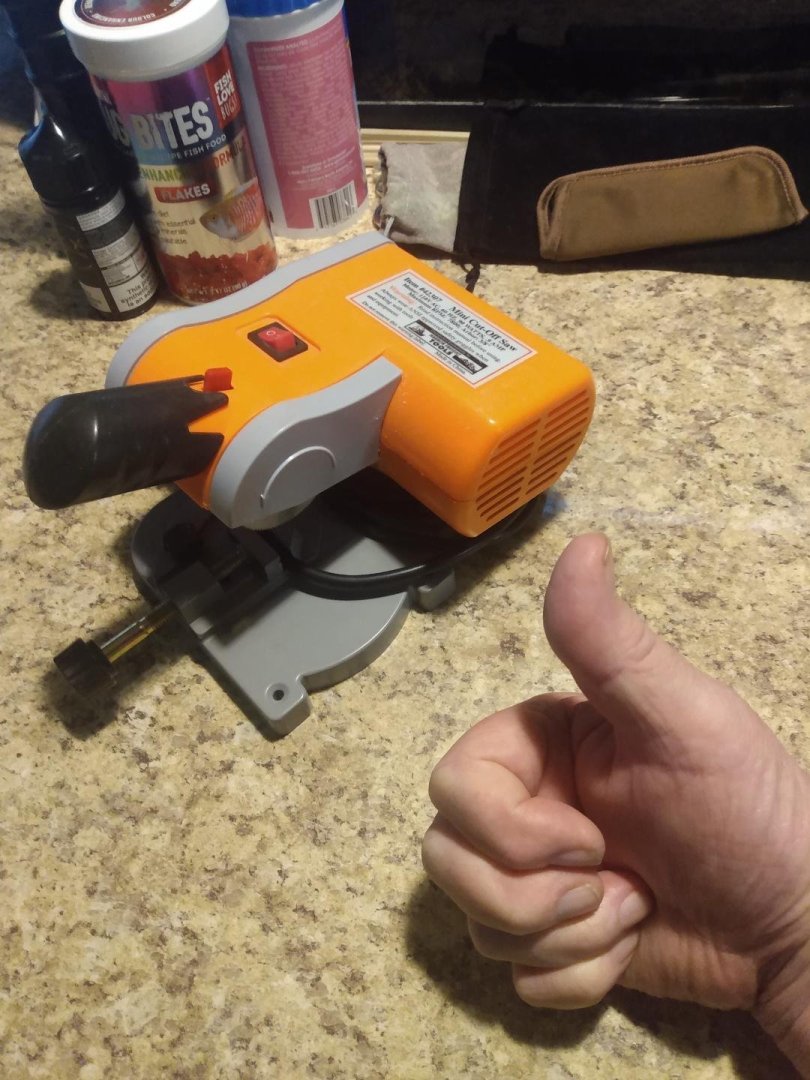
-
Cutters, Choppers, Guillotines, Slicers
tmj replied to MintGum's topic in Modeling tools and Workshop Equipment
This is kinda goofy but works 'GREAT' for square cuts on thicker stuff that the Ultimation won't like. It's cheap too! Look for mini table saws on Amazon. I've had mine for 20 years and it still works like a champ!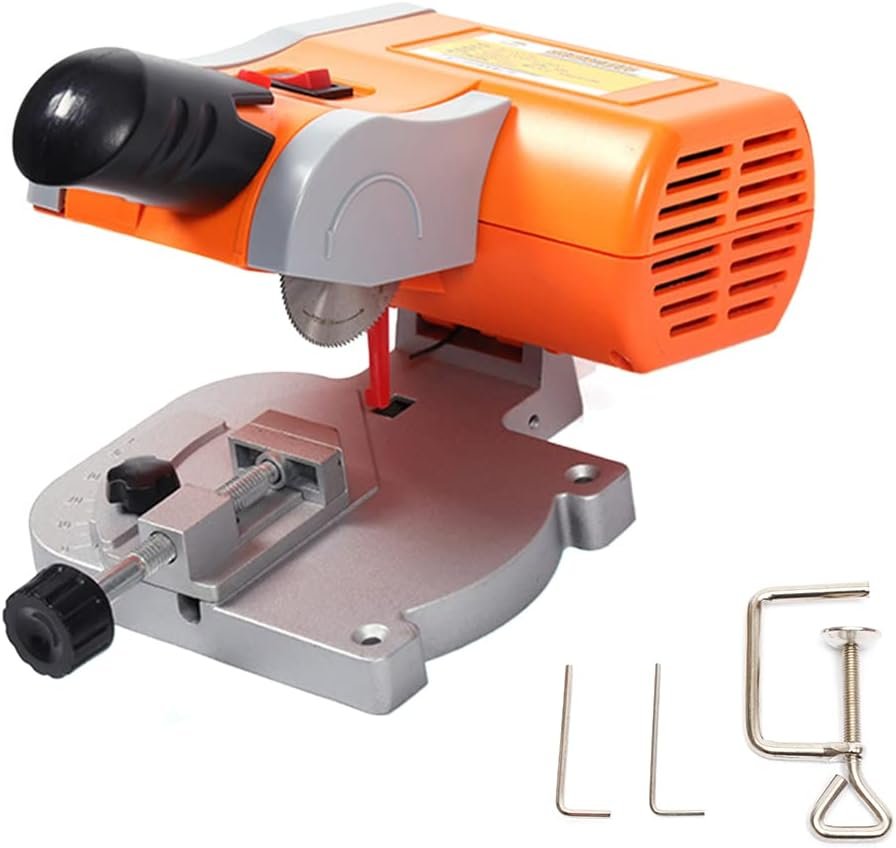
-
Cutters, Choppers, Guillotines, Slicers
tmj replied to MintGum's topic in Modeling tools and Workshop Equipment
I have the complete 'Ultimation' line of products and love them all. The chopper will indeed cut a bevel on one end, but I deal with that in one of two ways. If it's planking, I'll often use that bevel to my advantage by turning the points 'up' and making a really tight butt joint against the preceding planks. If I don't want the beveled cut, I simply cut my pieces a tad long and use the sanding repeater to sand all of those parts to exact lengths while also removing those tapered cuts. As for the hand powered sander, itself. It is a gem, indeed. It's saved me many times when the complex geometry of a curious part and compound angles would make it difficult to accurately sand such a part via a powered disk sander where you must sand on one side of the disk due to rotation, etc. With the Ultimation sander, I just turn the crank in whichever direction best suits the needs for the part needing to be sanded. I have nothing but 'PRAISE' for all of my Ultimation tools! -
Capt. Engel on one of his 'good' days!

-
What's your budget for said 'machine'?



Our Emblem ®
