

Mark P
-
Posts
1,774 -
Joined
-
Last visited
Content Type
Profiles
Forums
Gallery
Events
Everything posted by Mark P
-
 Good Evening Mark; Further to Hubac's Historian's comment above, as David does, whenever I have to carve a human face, I start with the silhouette of the forehead, nose, chin and throat, cut with a chisel around 2-3 times wider than the nose, and create the outline in a plane at right angles to the face's line of sight (imagine cutting the face's silhouette with a bandsaw) Then I check this carefully in the side view. Once happy with this outline, mark on the centre line carefully, and use this as a reference for all remaining features. This is especially helpful when the head is looking to one side, or downwards/upwards. But it's never easy! Wishing you every success. One further thought: if you were to put her left hand behind the shield, it would look much more as though she meant business, and also have the happy result of one less hand to carve! All the best, Mark P
 -
Good Evening Jeff; That is some lovely work you have done. Using sandpaper for a felt roof is a great idea; I would not have thought of that one in years! All the best, Mark P
-
Good Evening Guy; Sea Watch Books are indeed intending to do a reprint of volume 2; Mike, the 'Sea'-eo told me himself. You are not the only one wanting a copy! Hang on to your loot, and send Sea Watch an email telling them that you want to purchase Vol II, and ask when will they reprint it. The more people who write to them, the sooner it might happen. All the best, Mark P
-
Good Morning Ron; One of the chief and most noticeable characteristics of gun carriages of this period is that they had a solid bed of timber forming the carriage base, with the cheeks on top, and the axles below. There was also a type of cannon called a 'drake', which had a partly tapered bore. These had a solid timber skid instead of a rear axle. Their recoil was vicious, though, as a result of which they fell out of favour. As Waldemar says above, Richard Endsor's works do indeed have much information about guns, which are very carefully illustrated in colour, although the guns & carriages generally relate to the second half of the 17th century (although the barrels may well have been cast in the first half) Another point to perhaps consider is that during the first half of the century, many ships carried a real mixture of gun types and calibres, with some cast in bronze, and some of cast iron. All the best, Mark P
-
Good Evening Mike; Your work shows a very high degree of care and craftsmanship. The joints between the various pieces are so equal and consistent that it is hard to believe that this is hand worked. You are a master at this art, and I salute you. All the best, Mark
-
1500 blocks in a day; no wonder the blockmakers at Portsmouth Dockyard got so upset over the introduction of Brunel's blockmaking machines. I would consider making 50 miniature blocks a day a success if making them by hand. All the best, Mark P
-
2nd rate London 1656 – the art of the shipwright
Mark P replied to Waldemar's topic in Nautical/Naval History
Good Evening All; This is an interesting thread, from its beginnings, which has now somewhat departed, most regrettably, from the higher standard of interchange of ideas normally prevailing on this forum; which I believe, from many years reading others' postings, is mostly courteous and considerate of varying or contrary opinions. It is also important for all contributors to remember that their ideas, opinions and postings are often of their own formulation, and based on a personal interpretation of what is known; what can be extrapolated; and what is hypothesised. In the end, though, some of what is posted in the field of research is personal opinion; and one person's opinion is as valid to them as is that of others to their own selves. If varying interpretations of what is known result in a discussion in detail, this is a good process for all concerned, and having to justify one's opinion or interpretation is a worthwhile endeavour, as it is in this way that we acquire an even more thorough understanding of the particular subject under consideration. I once exchanged views with Martes on the likely origin of a draught, purportedly of a 17th century first rate; but the draughting of which had obviously been carried out in the nineteenth century. For this reason, I saw it as a later invention, with no historical validity. However, the late and much-missed Frank Fox gave it as his opinion that the draught, although much later, was genuinely based on a no-longer extant draught which was indeed from the 17th century. I was rather mortified to be found in error, but at the same time, pleased that the sum total of knowledge of those involved, including my self, had been increased. Right or wrong will always contain some degree of subjectivity; and as Mr Endsor states, we are all colleagues. We all share a mutual interest, in acquiring and disseminating knowledge; and this has the obvious corollary that there is a responsibility upon us all to either be absolutely sure of what we say, because it is based on firm evidence; or to be prepared to change our opinions when our interpretation is questioned. This is not a process of opposition, and should not be interpreted as competition; this is a process, by means of which knowledge is distilled and purified. Stereotypes exist to be challenged; as do opinions; and it is important not to take umbrage at a perceived slight, where none is intended. A difference of opinion should be discussed with respect for the other party's opinions, and restraint needs to be exercised, lest the debate degenerates into a situation where responses become based around comments on the character of a contributor, rather than dealing with the validity of any hypotheses or interpretations being expressed. An important factor to consider here is that early draughts do not include body plans as we understand them from later periods. The use of rising and narrowing lines is symptomatic of the system of whole moulding. In this system of design and construction, there is no need to draw the frames at individual stations; all that is needed are the rising and narrowing lines; the midship frame; and perhaps the stern view. From these, any capable shipwright of the era could construct a ship, using the system of hauling up and down with the same basic template, with the degree of difference indicated by surmarks for each frame. There is therefore no need to construct a body plan, and the production of such is only ever going to be an exercise in drawing and analysis skills, unless it is intended for use to make a model. I know for certain that Frank Fox considered these drawings of the London with considerable suspicion, and believed that they were made more for decorative purposes than for any other reason. There are certainly inconsistencies in the section with regard to the pointers, which are described in various documents as having their upper end fixed to the gun-deck beams, not protruding above it. To my mind this, and knowing that there are other reasons for doubting the authenticity of at least some of what it purports to represent, is sufficient to conclude that any work based on these drawings cannot be taken as incontrovertible proof of anything. I can admire the skills and knowledge displayed in the drawings which Waldemar has constructed, and certainly my total knowledge has increased by reading this thread; however, it is my personal opinion that to use this draught as the basis of an argument that floor sweeps varied, when all other sources contemporary to English practice in the mid seventeenth century state that the floor sweep was of a constant radius, is to invite contradictory opinions; which, when they are expressed, need to be accepted as part of an open debate, and not as evidence of 'competition'. That is best left to those involved in politics and business, neither of which encourage the development of the better aspects of human nature. All the best, Mark P -
Good Evening All; As Murphy says above, the contract is for the Hampshire, and stipulates that the ship is to carry fifty guns. There were at least half a dozen of these 50-gun fourth rate contracts awarded to merchant builders around 1695-6, a time when the demands of what was often called 'King William's war' made it imperative to increase the forces available to the Navy. I suspect, subject to confirmation on closer reading, that the collection comprises a variety of documents gathered over a period of time, and may well have been taken to Russia following Peter the Great's tour of European, including English, dockyards, wherein he spent many months learning the shipwright's trade in some detail (and indulging in some hard drinking after working up a thirst) It seems to include at least one of the formal 'Establishments', possibly that of 1706, the first really formal one; although it may be the more informal establishment of the 1690s (the exact date of which I cannot recall) If not taken by Peter the Great himself, they may well have gone with an English shipwright who went to Russia to help set up Peter's nascent Russian Navy. I will have to check these dimensions against some of the multitudes of various scantlings which exist from the latter part of the 17th century for an idea of the exact source of the Russian archive's documents. The information about the ships of 1677 may well appear because in the 1690s there were at least two acts of Parliament authorising a large programme of ship-building. Lacking a Navy Board member of sufficient stature to force Parliament to pay more than the bare minimum it wanted to, and advise them fully of the reasons why they should pay more for better results (a role ably fulfilled by Samuel Pepys in the 1670s) Parliament relied upon a resurrection of the scantlings and dimensions for the 1670s programme, the ships of which had been regarded as successful designs. What they did not realise was that King Charles II (died 1685) had insisted that the earlier ships were built to increased dimensions and tonnages, rather than those which had been authorised by the act of Parliament. Hence the later ships were of inferior performance. The section on the construction of a drawing of a ship is of great interest, certainly. Many thanks to you Eugen for posting this. All the best, Mark P
-
Good Morning All; Another suggestion for Ferrus Manus re a good book to purchase for information about galleons is Peter Kirsch's book 'Galleon', which is based around contemporary sources, and contains plans for a complete galleon. I don't remember my copy being particularly pricey when I bought it. All the best, Mark P
-
backing up a log
Mark P replied to Knocklouder's topic in Using the MSW forum - **NO MODELING CONTENT IN THIS SUB-FORUM**
Evening all; For anyone who is still interested in this topic, I have found a reliable method to copy a log or post, with the creator's permission. This is for Windows; I have no idea how this would play out in Mac. Right click on the current page, and this brings up a context menu. Click on 'Save as', and create a folder for the saved image where you want it to be. Name it, and save it. Job done! This will save the entire page you are on; not just the visible part, but all the rest also. If a build log has 5 pages, you will need to do this 5 times, saving each page separately. This is much faster than working on only what is visible on the screen. The saved images are identical to the screen, nothing is lost. All the best, Mark P -
2nd rate London 1656 – the art of the shipwright
Mark P replied to Waldemar's topic in Nautical/Naval History
Good Evening Martes; You are quite correct in your recall; the wreck is located close to a busy shipping lane, and the prop-wash from passing ships, and tidal scour of the exposed remains, are causing rapid deterioration. A further unhelpful factor is the refusal of Historic England to allow any items to be removed from the wreck site. This means that artefacts and ship's timbers can be observed when they are exposed, but cannot be removed to preserve them. Important pieces of the ship's structure and artefacts have been noted, which have now disappeared without any chance to make an official record or attempt to preserve them. Which is very frustrating for all those who want to know more about this time capsule's contents. It is possible that the circumstances have now changed, and recovery of at-risk artefacts etc is now allowed; my information is not up-to-date; but I am not overly hopeful of anything involving a complicated bureaucracy's minions. Especially as many of them are now, post Covid, probably 'working' from home. There is a charity devoted to preserving/raising the remains, 'Save the London', managed by the Nautical Archaeology Society. All the best, Mark P -
Good Evening Rob; I wish you all the best with your project. The model of Bristol in the Ontario Art Gallery has always been one of my favourites. It is also one of the very rare examples where the name of the builder, and the date of the model are known. A note was found inside her, informing posterity that she had been built by George Stockwell, dated 7th May 1774. A further line informs us that he was a shipwright at Sheerness Yard, which is where the Bristol was built, so he presumably knew her very well. The draught is a beautiful example of art; its rendition of the internal details of the ship is one of the highest quality examples of which I am aware, and it is my intention to purchase a digital copy of the draught one fine day when funds are plentiful. Interestingly, the frieze on the model does not match that shown on the draught. All the best, Mark P
-
In early records, late Elizabethan, or early Stuart, the jolly boat is generally referred to as a 'jolly-watt'. Don't ask me why! All the best, Mark P
- 24 replies
-
- 6
-

-

-
- Small boats
- cutter
- (and 2 more)
-
Good Morning Allan; There are other examples from this period of made yards for 74 gun ships and larger. Some are made by splicing on a piece at one end only; others by joining in the middle in the same manner as deck beams were scarphed, with tabled joints; and others as per your example above, with both ends spliced. The dimensions for a main yard at this period does seem to have been 22 5/8" diameter, with a length of 95'. As has been discussed for masts previously, this is quite probably related to the loss of the American colonies, leading to a shortage in the supply of longer trees previously used for yards. However, made masts go back long prior to this period of time, so they were certainly nothing new. I have no information about yards, though, and when they were first made in more than one piece for large square sails. All the best, Mark P
-
Good Morning Thor; I assume that you are building the Royal Caroline of 1749. There are multiple paintings of her in existence, and they all seem to show the masts and yards the same. Masts are natural wood colour, except for the sections between the trestle trees and the cap, which are black. The bowsprit is black, but the jib-boom is natural. All the yards are black. Ensign staffs fitted above the top-gallants (if fitted) are also black for their entire length. All the best, Mark P
-
Prize Papers lecture from the National Archives, U.K.
Mark P replied to druxey's topic in Nautical/Naval History
same here -
Good Evening All; Well, I must say full marks to the people at SeaWatch. I ordered 3 books on Monday 5th December, and they arrived at my home in England today, the 9th December. That's damned good service, and deserves a mention in dispatches. Thank you one and all involved; whoever does the shipping is obviously well-organised, and worth the cost. I shared Druxey's pessimism, I have to admit, and did not expect to receive anything for at least another week. All the best, Mark P
-
Good News for all nautical book addicts: I have just ordered the three volumes of Ed Tosti's Young America work (more for techniques, tips and jigs, as I am unlikely to ever build the model) and not only is there a discount for purchasing the three together, the postage for all three to England was only $35 total. Shipping costs have indeed been reduced dramatically. All the best, Mark P
-
Good Evening Bruce; One small point to note is that there does not appear to have been a standard stave width, with the cooper making a stave as wide as each piece of wood would allow. I have seen old barrels, and frequently the staves vary in width quite noticeably. All the best, Mark
-
Royal navy - stern colours?
Mark P replied to Vane's topic in Painting, finishing and weathering products and techniques
Good Evening Allan; I would not be guided too much by the colours displayed in the model of Granado. Whilst she is a beautiful model, I am pretty sure that it was actually constructed by Bob Lightley? in the 20th century, and purchased by the NMM at around the same time as they also bought the excellent model of the Egmont, built by (Oh God! I can't remember his name! Mind is going!) Which is not to say that the colours shown are not in accordance with contemporary sources, of course. All the best, Mark P -
Mathew Baker's early concept of ship hull design, ca. 1570
Mark P replied to Waldemar's topic in Nautical/Naval History
Definitely 90 in the original, not 93. Phineas Pett, in his autobiography, spells Baker's first name with one 't', as Wayne mentions above. All the best, Mark P -
Mathew Baker's early concept of ship hull design, ca. 1570
Mark P replied to Waldemar's topic in Nautical/Naval History
Good Morning Waldemar; You may find the following description of the construction of a mid-ship mould, by Matthew Baker, to be of use. This is from a contemporary document in the British Library, which I transcribed several years ago. All the best, Mark P Matthew Baker How to draw Mid section MSW.pdf -
Good Morning All; I am not sure if this was mentioned before in another thread on this painting, but there is some indication that Lely (if indeed it was him who painted the ship) did not work from life, but from draughts or sketches of the ship: this is that the perspective of the quarter galleries is completely wrong. He depicts them as parallel to the waterline, whereas in life the forward ends are considerably lower than the stern ends. The quarter galleries follow the sheer of the ship, which those depicted quite obviously do not, being shown parallel with the deck line (look at the line of slightly open gunports on the lower deck) To my mind, this throws into doubt that anyone of Lely's stature, who quite clearly understood perspective, would have depicted the ship thus if painting it from life. Even if it was not Lely, the artist is clearly highly talented, and the same should apply. All the best, Mark P
-
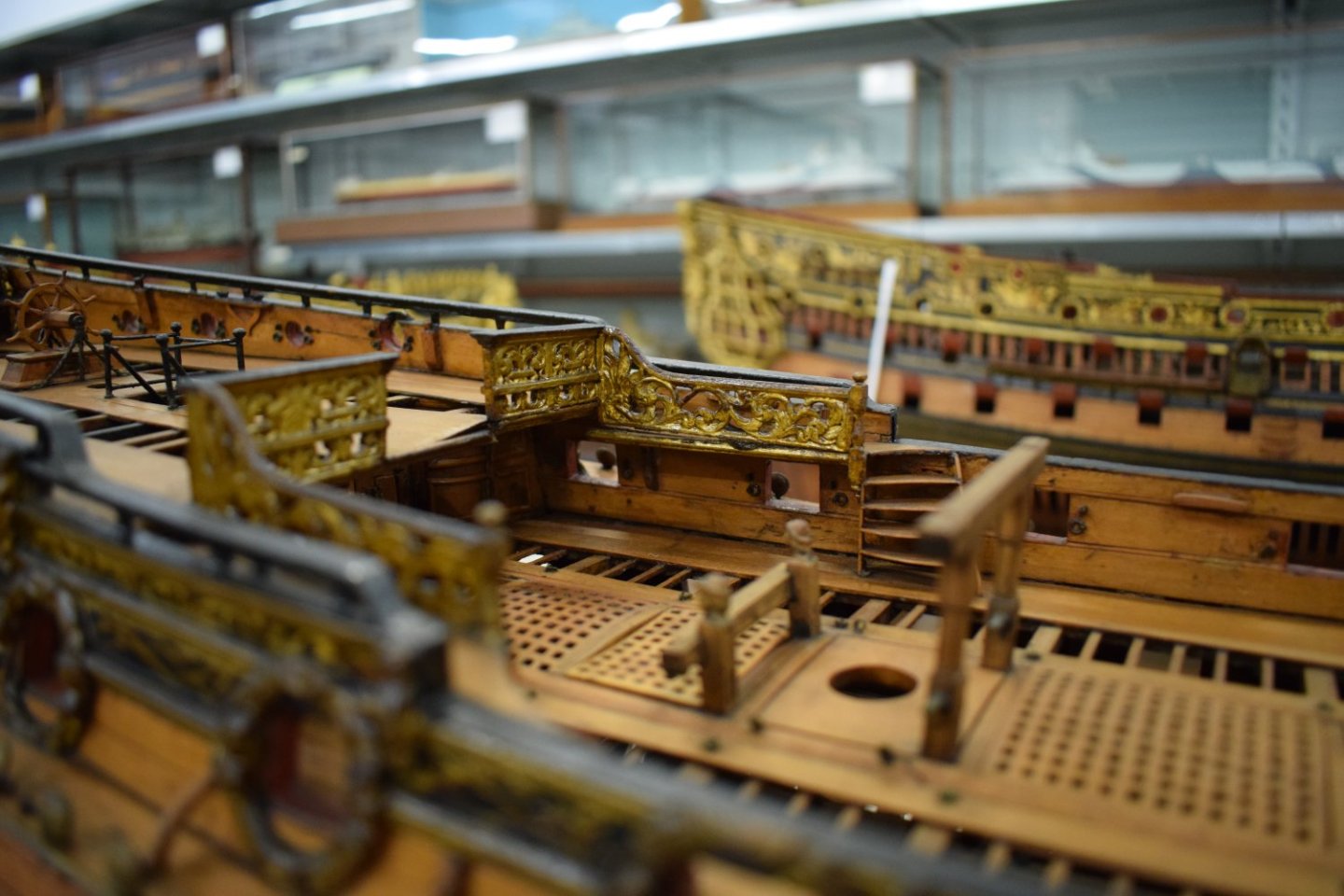
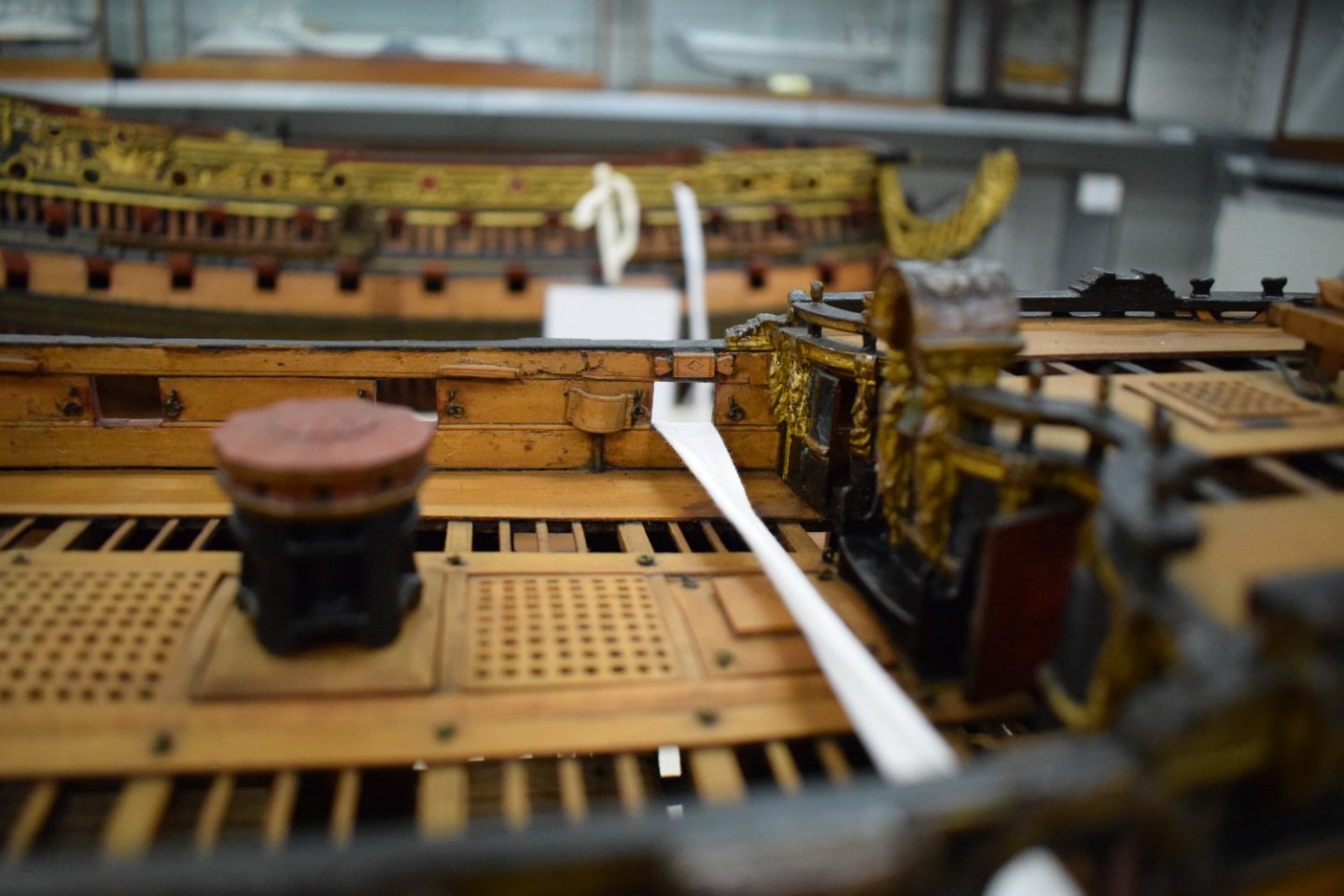
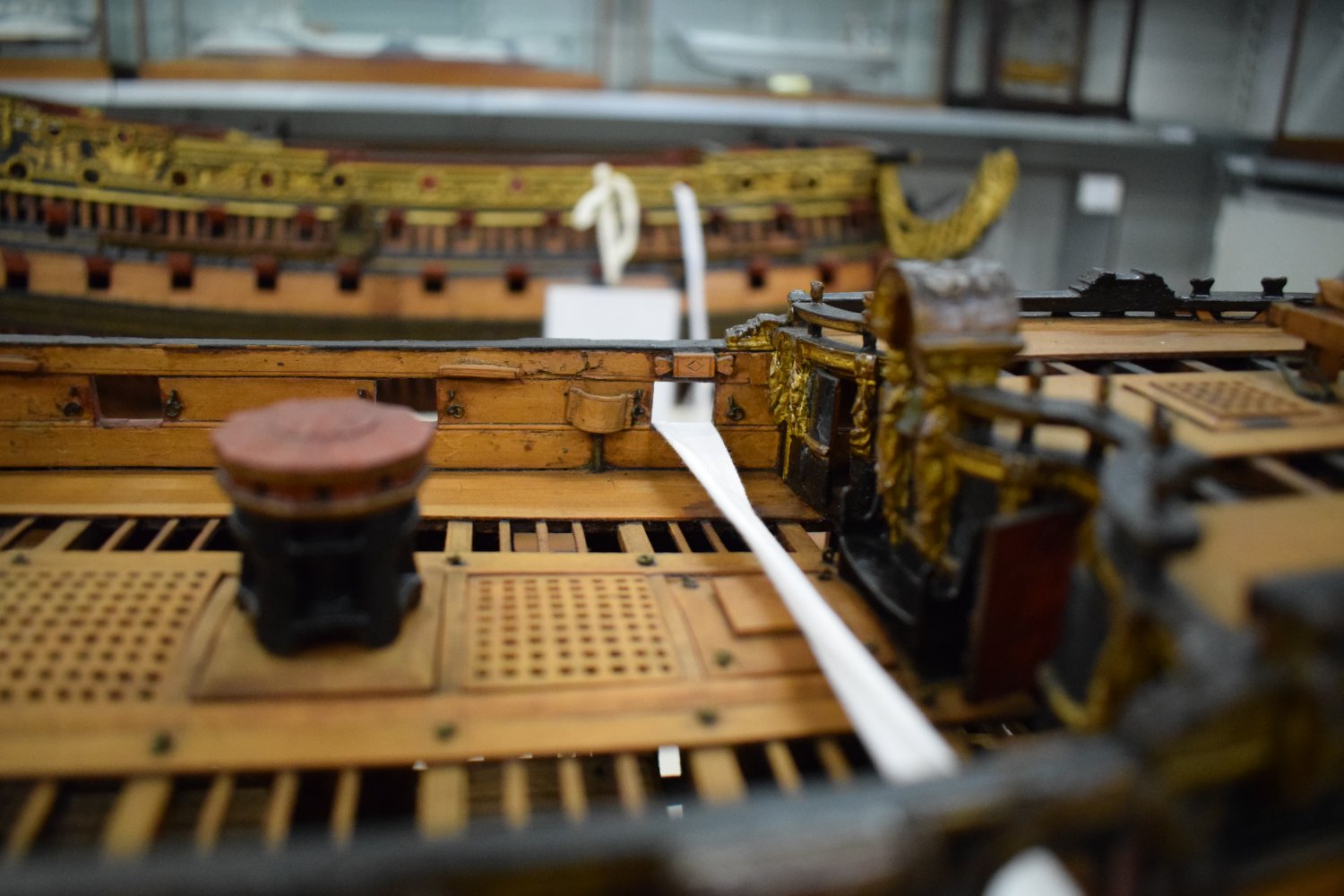
Good Evening Ollie; To judge from the few mentions of such things in early written works, the same belaying points were used from early in the 17th century as are shown on models of a later period. Whilst it is not possible to be certain, it is likely that these also extended backwards to the 16th century. See below photos of belaying points on a model in the NMM's collection, all of which are fixed to the bulwarks. These comprise two forms of cleat, a staghorn and kevel. Cleats and kevels often had sheaves within them. When no specific belaying point was provided, the rope's end was made fast around the fife rail. There is a rigging treatise written around 1625, a transcript of which was published by the Society for Nautical Research. This describes the standing and running rigging of a ship in some detail, and includes details of where the majority of the ropes were belayed: 'belayed to the Gunwale'; 'fastened to the aftermost tymber'; 'belayed to the gunwale under the shrouds'; 'belayed to bit-pins on the fore castell'; 'belayed to 2 cleates set to ether side of the mayne mast'...etc. This is very helpful. I am not sure what you believe to be the date for the start of using belaying pins, but it is most likely that these were in use in the 16th century, as they certainly existed in the early 17th. Sir Henry Manwayring, in his nautical dictionary written around 1623, describes pin racks on the gammoning and on the forecastle head. All the best, Mark P
-
Greetings to anyone interested in this topic: I have recently photographed a document among the State Papers surviving from Charles I's reign, dated 1630. This is a specification for the repair of the Vanguard in dry dock. One item of great interest is this: 'To Birth upp the Sterne on both sides alike, with Buttock planckes wrought out of Rounde Tymber (which I take to mean that the sharply curved planks forming the round tuck were to be sawn out of timber with a suitable curved grain) to bringe on a Transome uppon the Heades of the Buttocke plancke without Boarde to finish the same' (presumably the later tuck moulding, not the wing transom) As the specification was drawn up by Phineas Pett and William Burrell, the two foremost Master Shipwrights in the kingdom, this would make it very likely that this was considered, by this date at the latest, to be normal. If Phineas Pett was involved in specifying a round tuck stern for a rebuild/repair in 1630 it can reasonably be considered unlikely that he would design the later Sovereign of the Seas with a square tuck. All the best, Mark P

Our Emblem ®