


Louie da fly
-
Posts
7,990 -
Joined
-
Last visited
Content Type
Profiles
Forums
Gallery
Events
Everything posted by Louie da fly
-
 The Sutton Hoo ship replica is now ready for planking, and the builders have put out an appeal for woollen blankets to use for caulking between the strakes. Anybody in the UK who wants to donate blankets, I'm sure they would be gratefully received. https://saxonship.org/?fbclid=IwAR2GOjy1YvC5l2ZmSSgF3cx98Wvs2ZIbasDdh-JLq1Jgz_09ezGK9JZTDMQ Steven
 -
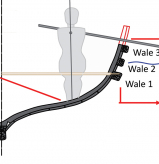
The trireme reconstruction Olympias is apparently very tender - she tips over quite easily. This must make it hard to row her in anything except a flat calm. However, using a theoretical reconstruction to prove anything is fraught with risk - the hull shape of Olympias itself is the result of theorising based on fairly scanty evidence and may not necessarily be correct. But it must be a common factor with all galleys no matter what the era - the flatter the angle of the oars, the more efficiently they use the energy of the oarspersons, so the oarports have to be as close to the water as possible - so if they heel they become difficult or impossible to row. Cross-sections of the Byzantine galleys found at Yenikapi in Istanbul are shown at https://journals.openedition.org/archaeonautica/3684 and perhaps these should be taken into account despite the huge time difference between them and the Mycenaean galleys. Interestingly, the bilge shape seems quite similar - maybe a bit more angled - to that of the bases in Woodrat's photo. Steven
-
Dick, though it's a round ship and your is a galley, the Uluburun wreck (14th century B.C.E.) might help in determining the underwater cross-section, as far as stability goes.
-
Very interesting, Roger. So, given the shape of the bilge as indicated by the ancient base, what shape would you suggest for the rest of the hull have as it goes upward from the bilges, to be more stable? Steven
-
That sounds very interesting, Dick. One thing I've been forced to look up in following this is the periods you're dealing with. So now I know Late Helladic (at least according to Wikipedia) is also known as the Mycenaean age and corresponds to 1550-1050 B.C.E. whereas Geometric is 900-700 B.C.E. and Late Minoan appears to be something like 1500-1100 B.C.E. (that one's a little hard to work out, as the terminology has been revised, but seems to tie in with Late Helladic/ Mycenaean). So the difference in time period between the late Helladic and Geometric is several centuries, in which one can expect quite a bit of evolution in ship types, as well as differences between shipbuilding cultures. So am I right in thinking that the hull shape of the ship you're planning to build is based mostly on the illustrations in your post #7, but with supplementary information from the other illustrations from other periods to fill in details they don't provide? Steven
-
https://www.wessexarch.co.uk/news/rare-elizabethan-ship-discovered-quarry-300-metres-coast Sorry about the late notice - looks like the TV programme has already been shown. Steven
-
I just came across this paper on the Black Sea wrecks - https://www.academia.edu/2603215/Ward_and_Ballard_2004_C_Ward_and_R_Ballard_Black_Sea_shipwreck_survey_2000_International_Journal_of_Nautical_Archaeology_33_1_2_13?email_work_card=view-paper You might need to join Academia to access it, but it's quite a valuable site and joining is free (unless you want the super-duper upgrade). Steven
-
One thing to keep in mind is that you need to ensure a smooth run between the bulkheads so you get a smooth curve on the hull. Use battens or thread to show you the line and alert you to any discrepancies in the smooth curve. Then you can adjust the shapes of the bulkheads as needed. Steven
-
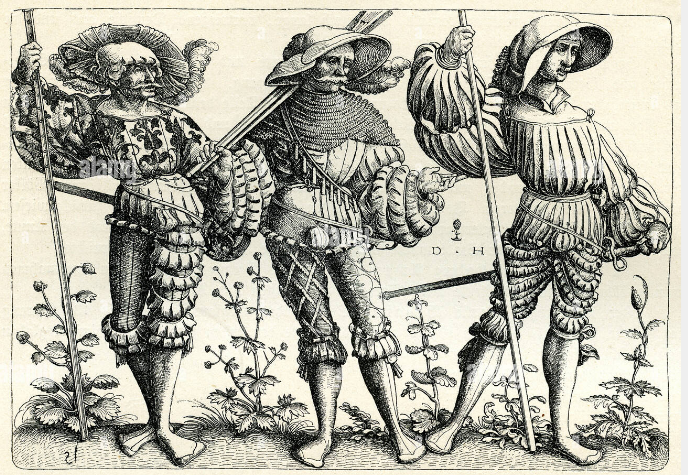
Yes, the fashion reached the height of absurdity in the Landsknecht (mercenary footsoldier) with puffed and slashed outfits in a mix of fabrics and colours - sometimes one colour on the left and another on the right . . . and of course emphasised cod pieces (no, that's not some form of packaged frozen fish). Steven
-
Oops. Had trouble getting the rotten thing to post. Then it did it three times! (extra unnecessary posts now removed). Steven
-
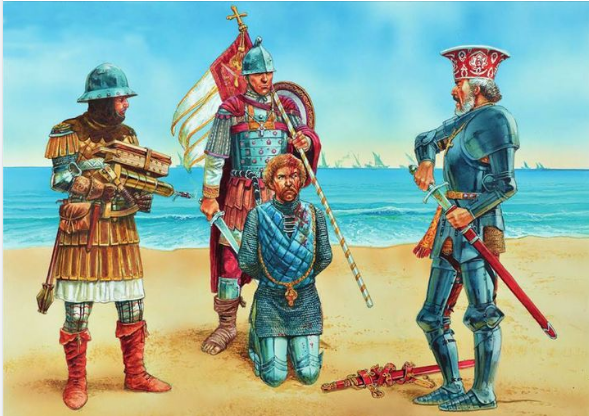
Which reminded me of this picture from a Byzantine re-enactor site supposedly illustrating a Byzantine soldier guarding a prisoner with a cheirosiphon (hand-held Greek Fire flamethrower). One of the comments was "Mega duke to syphonarios " if he moves,light him up....and also me and the bloke next to me "
-
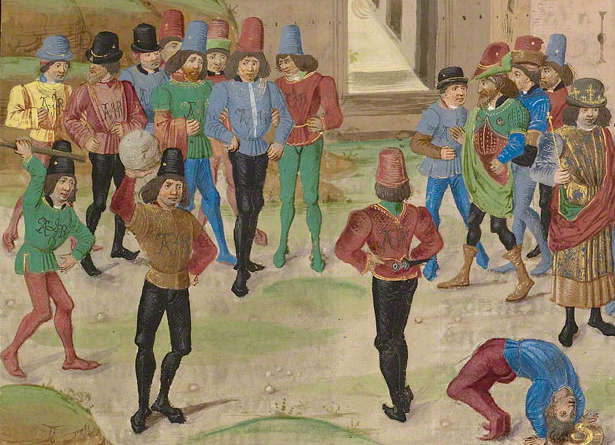
Not before the 15th century! Up till then the skirt of the jupon/doublet covered the naughty bits. The attached pic is from the transition time - looks to be mid 15th century - some of the guys are modestly covering up, others are flaunting . . .
-
Hi Mark, The Contarina ship, on which Woodrat based his 14th century Round Ship was about 20 metres (60 feet) long. But there were merchant ships of every size in the Mediterranean from quite tiny, and I don't know what the maximum size would be, but probably smaller than we'd normally expect for something of this type. I'm making mine the same size as Contarina, despite having three masts instead of Contarina's two. Unless I change my mind, which I might - at this size it would be slightly smaller than my nef, which in turn is based on the size of the knarr Haithabu/Hedeby 3. Steven
-
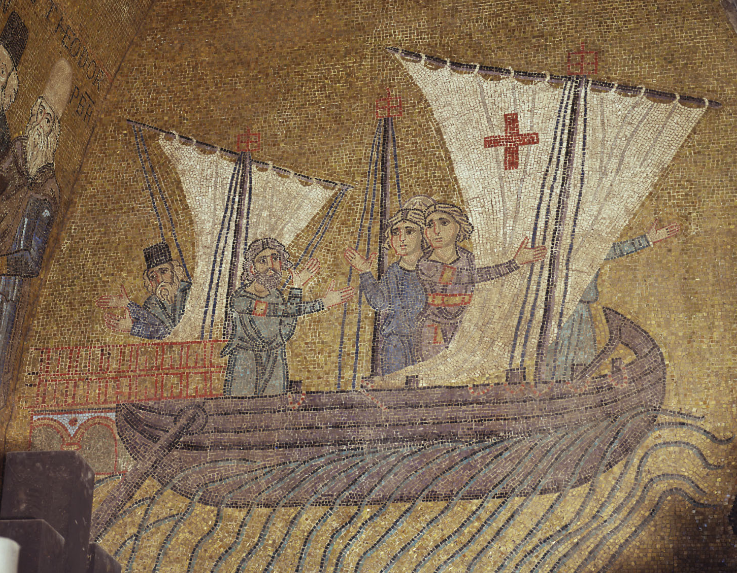
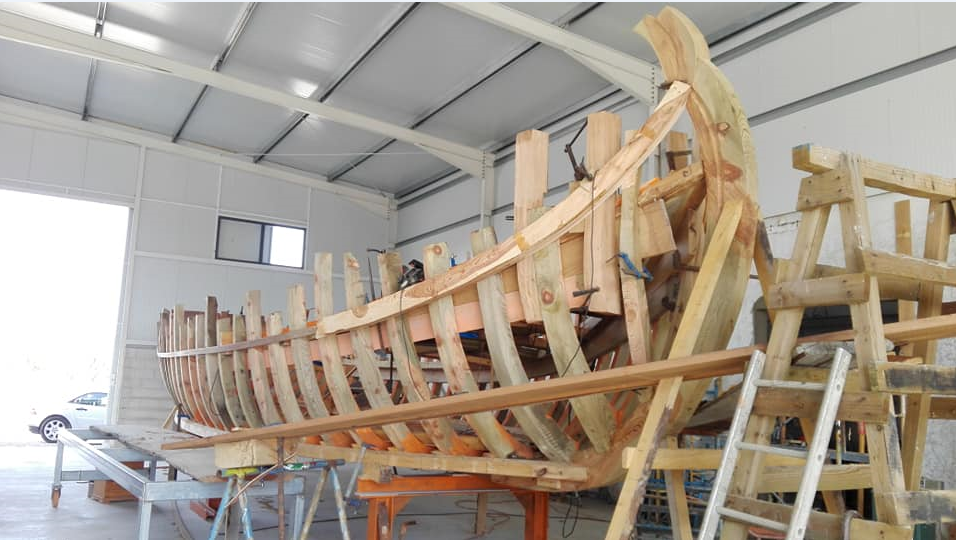
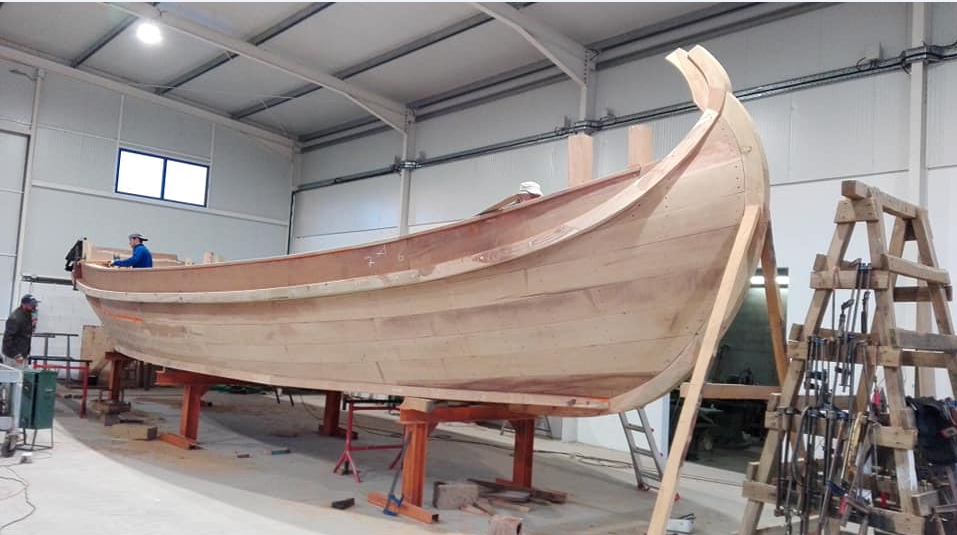
Looks like I'm on a roll today. I just came across these photos of a Portuguese vessel under construction with a bow that is very reminiscent of many mediaeval Mediterranean ones, particularly those of the San Marco mosaics. Could be of great use. Steven
- 508 replies
-
- 11
-

-
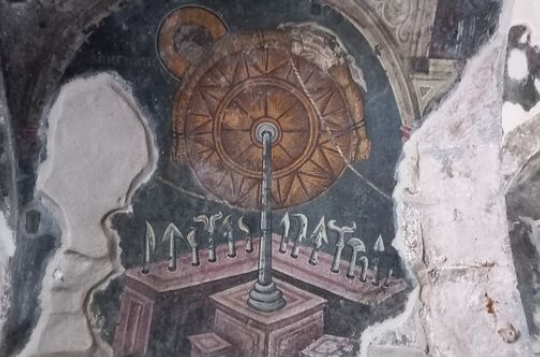
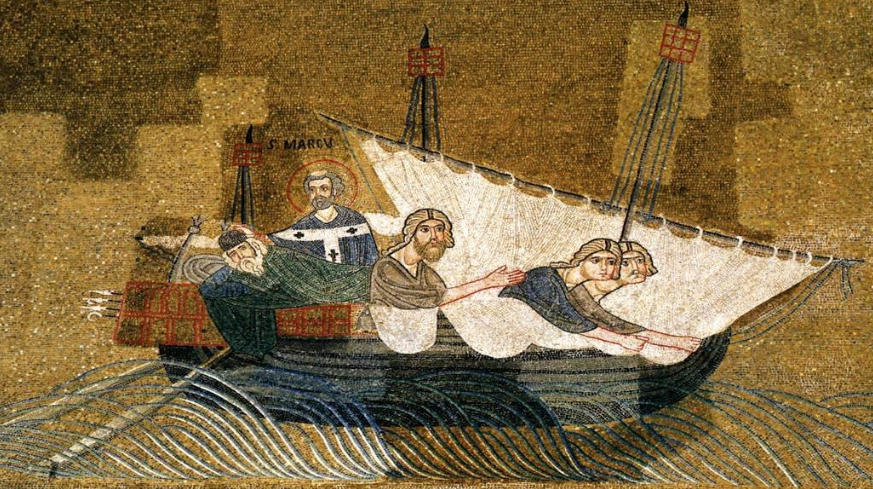
Look what I just found! It's from the church of Saint George Omorphokklesia in Athens (Galatsi). The episode of the torture of Saint George at the wheel is also narrated in Jacopo da Varagine's "Legend Aurea": .... The next day the prefect ordered that George be placed on a wheel surrounded by double-edged swords; but immediately the wheel broke and George was found unharmed.... But look at those sticky-out pointy things and then compare them with the ones on the mosaic ships in San Marco. Maybe this is how those things were stored - each shaft slid into a hole in a "cabinet" - it should work as well horizontally as vertically. Steven
-
Wonderful research, Dick. I've come across a few of these pictures before, but not with any serious intent to do anything about them. I look forward to seeing the conclusions you draw from all this. Steven
-
https://www.heritagedaily.com/2022/11/14th-century-shipwrecks-discovered-in-sweden/145395?fbclid=IwAR1dVHRYf1SbuQf6XKTnsh5NDJNWBEyYD7sEJvaXjNkaBcN7dMYJtZwGdAE
- 1 reply
-
- 9
-
-

-
Welcome to MSW, Lyle. The idea of making a BIG model of Mary Rose is very adventurous, but by no means impossible. I've done a speculative model (still working on it) of Mary Rose's sister ship Henry Grace a Dieu (or Great Harry), and if you actually end up making your model, I'd be happy to share any information I may have collected in my years of research on the subject - especially the bits of the ship that didn't survive, which can often be reconstructed from contemporary pictures, for example the forecastle - see Steven
-
That's interesting that you've got the decking following the curve of the mast step. I've never seen that before. Is it based on something in archaeology? Steven
- 75 replies
-
- 1
-
-
- Oseberg
- Billing Boats
- (and 1 more)
-
That's all very well for you 18th century guys. What about us mediaevalists (puts on jerkin, hose and hood with liripipe) . . .)
-
The answer to carving is persistence. The first attempt is almost always a disaster, but with practice you'll develop your skills. Keep at it. For shield patterns, have a look at the bottom of the page at http://members.ozemail.com.au/~chrisandpeter/shield/shield.html - spiral arms seem to have been very popular, but by no means the only decoration on Viking shields. Unfortunately many so-called "Viking shield patterns" on-line are just made up. It's unfortunate that the shields supplied with the kit are so thick. Real ones were less than 1/2 inch. Still, making a huge number of shields of the correct thickness would be an enormous task (don't ask me how I know!), so you're probably best going with the ones supplied. Only you and I know the difference anyway Steven
-
I'm looking forward to seeing your progress on this, Dick. I love your speculative reconstructions of historical ships about which little is known. I've said it before, half the fun is in the detective work before the build even starts, plus the discovery of "OH! THAT'S why they did it that way!" I'm sure you're already aware of the strange paddled galleys in the frescoes at Thera, so I won't burden you with them. Fascinating subject. I'm pulling up a seat. Steven


Our Emblem ®
