
Chuck Seiler
-
Posts
1,878 -
Joined
-
Last visited
Content Type
Profiles
Forums
Gallery
Events
Everything posted by Chuck Seiler
-
 About the model/kit. This is a card model by “SHIPYARD”, a Polish company who specializes in quality cardboard and paper models. Many of their models are featured in MSW build logs. I got my model from “Ages of Sail”, an MSW sponsor. Currently Chris Coyle is building a wooden version of Wutender Hund by SHIPYARD. A description of the kit can be found at: https://modelshipworld.com/topic/23468-172-wütender-hund-by-shipyard-hanseatic-cog/ His build log can be found at: https://modelshipworld.com/topic/24243-wütender-hund-by-ccoyle-shipyard-172/ Clare Hess is building a card version of the stripped down “Bremen Kogge”. His build log can be found: https://modelshipworld.com/topic/23434-hanse-kogge-by-catopower-shipyard-172-scale-card/ As I write this, I am well into the model: I am into the hull planking and deck planking. For that reason, I can give some thoughts on the kit. --The cardboard is pre-printed, but must be painted to give it color. I am not wild about this…my painting skills are not up to the task. Be sure to use a very watered down paint or else you will cover the pre-printed material. Be careful when painting the cardboard. Because the watered down paint will soak into the cardboard I needed to use long brush strokes to keep it from being splotchy. I eventually had success with the single planks/strake, but continued to have issues with wider assemblies. This caused me to go in another direction. --Practice painting. --Challenges of cardboard. In some cases (frame) I used Elmer's white glue and in some cases (planking) I used contact cement. In both cases you need to get the piece set quickly. Unlike with wood, if you need to deconstruct, it is very hard and there will be damage. Once glued you are screwed. While cardboard can be sanded, there are challenges with pre-painted parts if they are not flush the first time. Sanding and repainting looks less than great. --In my opinion, the instructions are good, but not great. The instruction book is 55 pages and is mostly pictures. The written instructions are pretty limited and normally not required, but sometimes a little more explanation is nice. As Clare noted, sometimes they seem to skip steps, but if you look hard enough you can find what you need. --The laser cut pieces are cleanly cut and clearly marked. Most of the pieces stay put until you need them. I marked the ones that disconnected and stored them in the box until needed. --Many of the part have tabs and notches to help with assembly. This is good because it helps ensure most of the pieces-parts go together correctly. BEWARE. For the basic hull, the bow looks alot like the stern and I was often confused. I had to mark the bow to remind me. --The stiffeners are marked with arrows (forward and up) to help with placement...you are fine as long as you remember which way is forward. 🙁 I am sure I will have other words of wisdom as I go along. Let's start.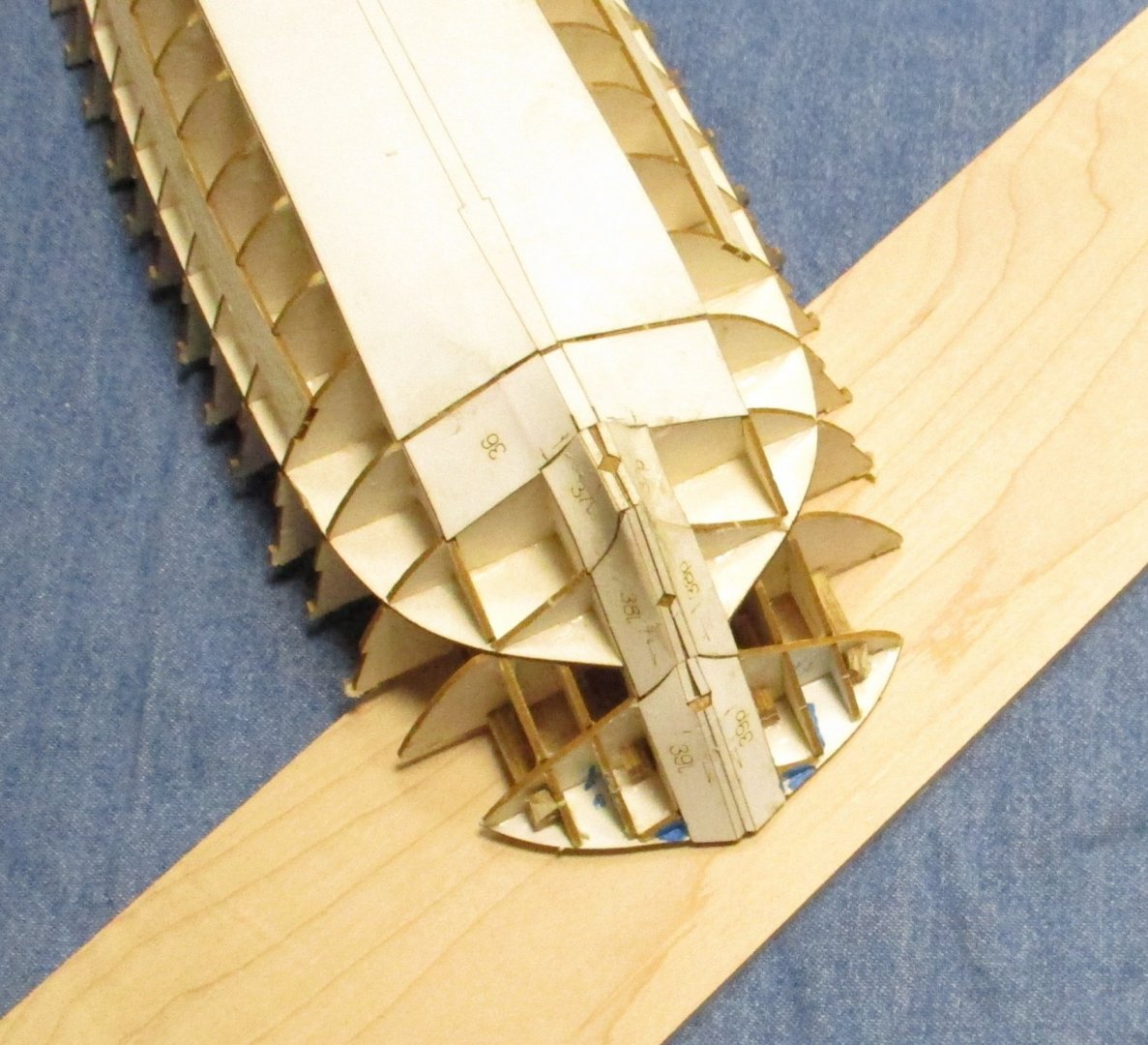
- 130 replies
-
- 5
-

-
- wütender hund
- hanseatic
- (and 2 more)
-
Is it possible that you put the false deck in backwards? The hull is very symmetric and I often ALMOST made a mistake, expect it fit one way (tabs and sots) but not another. I don't recall any slots missing. I assume the laser template for the card model is the same for the wood model.
- 179 replies
-
- 1
-
-
- shipyard
- wütender hund
- (and 1 more)
-
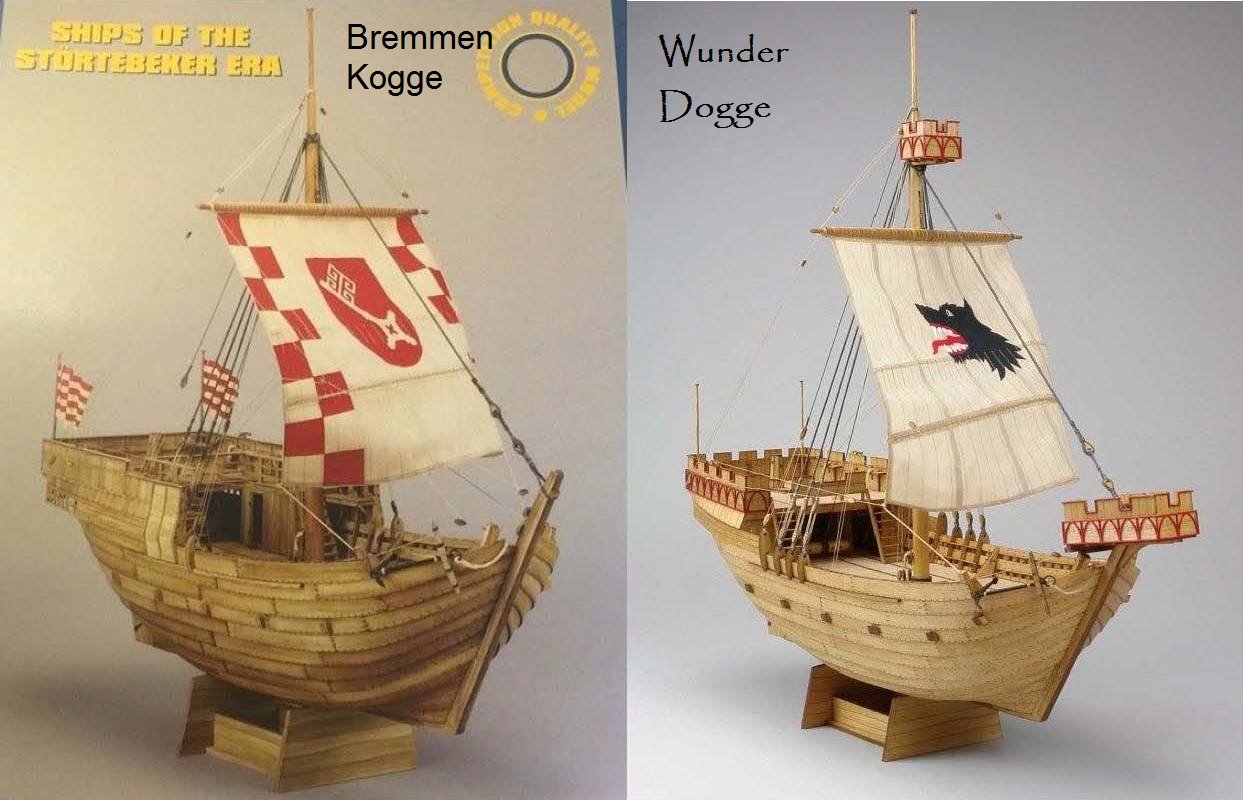
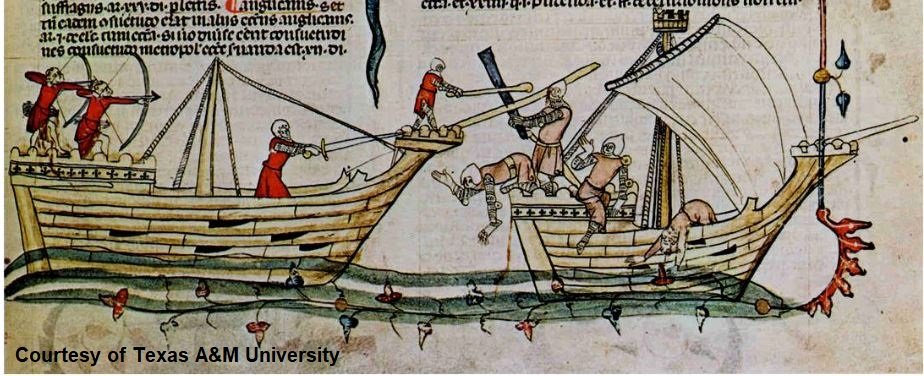
About the Wutender Hund. According to Chris Coyle, Wütender Hund was the vessel captained by Klaus Störtebeker, the leader of a group of North German privateers that were active at the end of the 14th century. Wütender Hund roughly translates to “Mad hound” or “Angry dog”. I will often refer to it as “Wonder Dog”. If you look at various paintings and drawings of cogs, as well as more modern replicas, you will see some pretty plain cogs, some with stern castles and some with both fore-castles and stern castles. The very pronounce castle structures and “fighting top” show that WH was intended for fighting. Many had a raised stern castle for defense, while also providing a space to operate the ship, allowing more deck space for cargo. The two models (Bremen Kogge and Wutender Hund) show the difference between the trading cog and war cog. In these two SHIPYARD kits, the hull form is almost exactly alike, as are the parts. The hull form appears to be based on the same ship that inspired the Roland von Bremen, above. The “trading cog” was often called into service as a “war cog”. I am not sure how easy it was to add or remove the stern castle, but the fore-castle appears to be easily added and removed. BATTLING COGS or THE FIELD TRIP DURING TH LAST NRG CONFERENCE...you make the call. This shows the value of the higher castles.
- 130 replies
-
- 5
-
-
- wütender hund
- hanseatic
- (and 2 more)
-
Fortunately for you/unfortunately for me, it is easier to unglue wood than cardboard.
- 179 replies
-
- 3
-
-
- shipyard
- wütender hund
- (and 1 more)
-
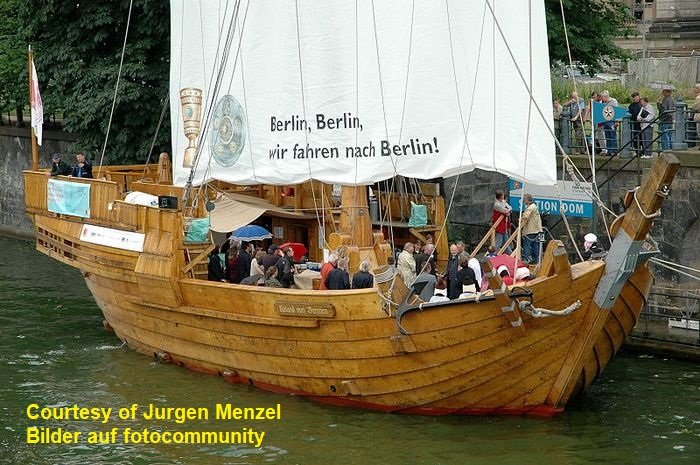
Background. For most of my life I have been a student of history. I have focused on wars and other extraordinary events. Armies, warships, wars. Warships, like fezzes, are cool, bristling with armament. They are normally an expression in the pinnacle of technology of that society. In 1992, during the 500th anniversary of the Columbus expeditions, I had an epiphany. Why did Columbus sail west from Europe and end up in the new world? He was looking for pepper. By the 1300s, trade between Europe and China/Asia was well established. Exotic items such as silk and spices were high on the list of items traded. Even common (for us) spices such as pepper was in high demand due to the poor quality of the food of the day. Unfortunately (for many) the overland and oversea trade routes to the east were dominated by Islamic traders and the eastern Med by the Italian city-states such as Venice, Genoa and Pisa; which added significantly to the cost of the product. How do you cut out the middle-man? Spain looked west and Portugal looked south, around Africa. The result of those decisions could, and do, fill volumes. My eyes opened to the importance of trade. Trade, like war and religion, cause cultures to expand, to bump into each other and interact for the benefit and/or detriment of all involved. Trade and commerce may not be flashy, but like water it is constant and powerful. If you are interested in trade, you have to consider the vehicle of trade whether it be a caravan, a railroad or a ship. How did the products get from point A to B? The Hanseatic Cog is one of those vehicles. About the ship. The cog was the work horse of the Hanseatic League, a confederation of northern European trading nations from the late 1100s to about 1450. The cog was the modern day tractor-trailer truck whose large numbers accounted for a huge amount of trade transported to and fro. Cogs are first mentioned in 948 AD, in Muiden near Amsterdam. These early cogs were influenced by the Norse knarr, which was the main trade vessel in northern Europe at the time, and probably used a steering oar, as there is nothing to suggest a stern rudder in northern Europe until about 1240. The influence of the knar is not a coincidence. Viking exploratory trading adventures, raids, and piracy occurred early throughout the Baltic region. Over time, the center of trade moved from Denmark to what is now northern Germany. As range and cargo amounts increased, and expanded into open ocean, the vessel changed. It became large and more seaworthy (although nothing to write home about). The need for spacious and relatively inexpensive ships led to the development of the first workhorse of the Hanseatic League, the cog. The new and improved cog was no longer a simple Frisian coaster but a sturdy seagoing trader, which could cross even the most dangerous passages. Fore and stern castles would be added for defense against pirates, or to enable use of these vessels as warships, such as used at the Battle of Sluys. The stern castle also afforded more cargo space below by keeping the crew and tiller up, out of the way. Cogs were clinker-built, generally of oak, which was an abundant timber in the Baltic region of Prussia. This vessel was fitted with a single mast and a square-rigged single sail. They ranged from about 15 to 25 meters (49 to 82 ft) in length with a beam of 5 to 8 meters (16 to 26 ft). It was a bulky freighter with one mast and a square sail. A helm at the stern and a flat floor made it possible to ship in low water. Unlike the Nordic longboats they were more economical to use. A cog could transport a relatively large amount of cargo with just a small crew, on average up to 90 tons; the largest cog ships could carry up to about 200 tons. They could be produced relatively quickly and inexpensively at that time. Larger loads could be transported more cheaply and by a smaller crew than previously. That’s what made this type of ship so successful. There were cogs of different sizes, between 15 and 25 m in length, 5-8 m wide and with a moulded depth of 3-5 m. The measurement of the capacity of a cog was called “last”, equivalent to 2 tons. This was the capacity of a carriage drawn by four horses. A small cog of 50 last was able to carry the same load as an endless convoy of 50 waggons pulled by 200 horses. There were also cogs twice as big. With the castle (aft) the surroundings could be observed well. Due to the lack of keel, the cog could also fall to ground during low tide, but it was also restricted to navigate because of that. A cog could only ride with the wind and not cross the wind. REPLICA COG "Roland von Bremen"...before it accidentally sank. (oops) The cog was not going to win any beauty contests. It was a klunky beast, but very functional.
- 130 replies
-
- 4
-
-
- wütender hund
- hanseatic
- (and 2 more)
-
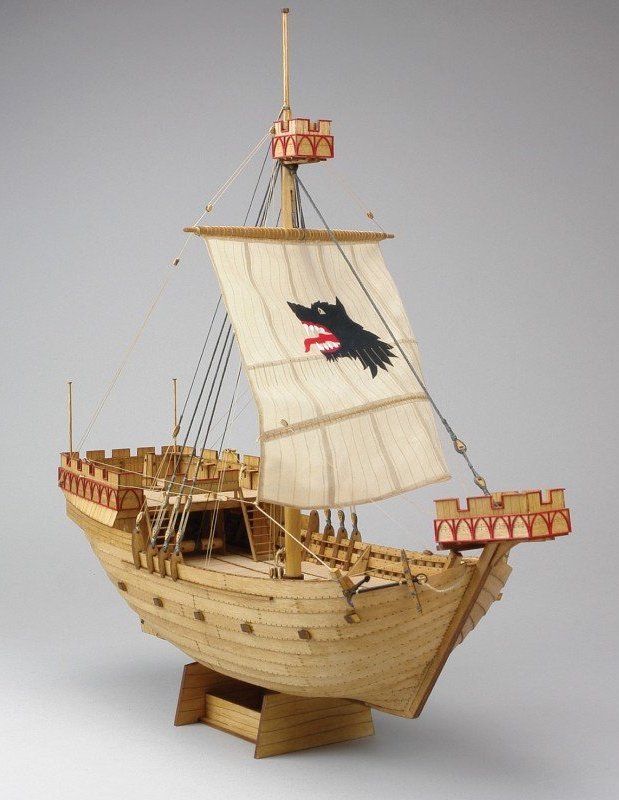
My current project is a cardboard model of a late 14th century Hanseatic cog (kogge). If you have followed my builds before, you will know that walking and chewing gum are not my strong suit. When I try to build a model AND document it with a build log, I usually get distracted. Here goes. Here is what is SUPPOSED to look like when completed. We'll see.
- 130 replies
-
- 4
-
-
- wütender hund
- hanseatic
- (and 2 more)
-
Chris, I am pulling up a chair. I will be following your log closely. I am working on the card version of WH and will be debuting at a MSW forum near you this weekend. I am curious if, other than material, there are any differences.
- 179 replies
-
- 4
-
-
- shipyard
- wütender hund
- (and 1 more)
-
New Young Model Builder from Minnesota LOOKING FOR ADVICE
Chuck Seiler replied to Kenna's topic in New member Introductions
Clamps...you can never have too many clamps. And magnification. -
New Young Model Builder from Minnesota LOOKING FOR ADVICE
Chuck Seiler replied to Kenna's topic in New member Introductions
Kenna, Welcome to you and your Dad. Cautionary Advice to New Members is there for a reason. Many people get into ship modeling because they want to build something grand and glorious. Soon they find they are over their head, get discouraged and quit. By starting with a simple model first, you get a feel for how things work, what to do and what not to do. You also slowly acquire the tools you need (if you don't already have them. It sounds like you have tool #1...patience. A good second model would be, as Chris suggested, a galleon. That way you can see how a galleon is actually constructed and much of the guesswork is eliminated. There is nothing wrong with starting a new model while still working on the old. That way once you get one part of the process down, you can use that knowledge on the new model. Make your mistakes on the prototype. Good luck! I look forward to seeing your build log. -
Greetings from Southern California
Chuck Seiler replied to Allamagoosa's topic in New member Introductions
San Francisco is Northern California-maybe. Central. Certainly not southern. Sacramento is, well....Sacramento. It is like the New Jersey of California, with fewer beaches. -
Greetings from Southern California
Chuck Seiler replied to Allamagoosa's topic in New member Introductions
What flavor of SOCAL are you? LA area or San Diego area (or option C)? -
Start with clamps. You can never have too many clamps. ...and magnifiers.
-
Clare, When is Ages of Sail getting the wood versions? I noticed on the "SHIPYARD" site, they not only have the wood "Wonder Dog" (yeah, i knw, i know, it's Mad Dog or Wunder Hound), they also have a kogge...although it appears different than the Bremen Kogge.
- 175 replies
-
- 3
-
-
- hanse kogge
- shipyard
- (and 1 more)
-
Clare, A lot of good advice. I think I will follow the "write the part number on the part" advice. The multi-plank piece is below the turn of the bilge so I don't think many people will see it. I don't hold out much hope for more visible areas. I have decided to do the decks, the crows nest, the forecastle (it is a REAL fore-CASTLE) and...aft castle in wood. Other areas to be determined. At this point, I am still working on the planking. I found my camera. If the hull planking doesn't look too crappy, I will start a build log.
- 175 replies
-
- 4
-
-
- hanse kogge
- shipyard
- (and 1 more)
-
I managed to get the single strakes looking pretty good. The dilemma is that if you use too much paint on the brush you gob a lot of paint and it seeps in. If you use too little, you have to dip your brush again and you get splotching. I managed to work out a system where I got a good amount of paint, started in the middle of the strake, at one of the seams. I single brushed in one direction (usually the longest), then starting at the seam, single stroke in the other. THEN starting at one end, a single stroke down the length of the strake to even everything out. Applying at the seam allows any difference in shading due to the diff in the first and second stroke to be attributed to being different planks. The planking sections and structures that involved multiple strakes did not go as well. I'm not sure what to do about those.
- 175 replies
-
- 4
-
-
- hanse kogge
- shipyard
- (and 1 more)
-
What about the rudder? It doesn't look like you left a space in the water for the rudder...or am I missing something?
-
Clare, Any progress? I am dipping my toe in the painting. #03 wash complete on all exterior planks and most deck planks. When you applied the 15/29/30 wash #1, did you apply 1 coat or more? I applied a single coat of wash on the interior cargo area but it was splotchy. I applied a second coat to the athwart-ships bulkhead in the cargo bay. It looks much better, but darker that I think we are going for. Your thoughts?
- 175 replies
-
- 4
-
-
- hanse kogge
- shipyard
- (and 1 more)
-
I don't believe that to be correct. When I was almost done with my mini Philly, I got to see a much larger model by Dave Yotter based on the Smithsonian plans. It was open under the forward deck. At the time I recall the plans supported that. At one time there was an interactive 3D model of Philly on the Smithsonian website. It is still there but much less interactive. Again, it showed under deck storage area. The pictures I have of the wreck in the Smithy are not conclusive, but it appears to be open. Then there is the entry from BRATTEN's dissertation: "Only two 12-pound round shot were found indicating that this cannon may have seen more service during the battle at Valcour Island. One 12-pound shot was found still resting in the shot garland in the bow and the other under the forward deck. Average diameter of the 12-pound round shot is 4-13/32 inches.37 Neither is marked."
-
Row Forrest Row!!!!
-
Perfect!
-
Based on your detail, I thought you HAD the document. Perhaps an open crate with the bar shot. Bratten says there was only the 2 bar shots but I find it hard to believe that was all they started out with. He says there were only two 12 pound balls found in the wreck and fifty four 9 pound balls. Based on how it was anchored, almost all of the firing was from the 12 pounder. Since the British were sailing into the wind, it would make sense that barshot was used early to impact their ability to close with the Yanks. Based on the numbers, Philly was about to run out of ammunition for the 12 pounder. I wonder what they would have done if they had not sunk.
-
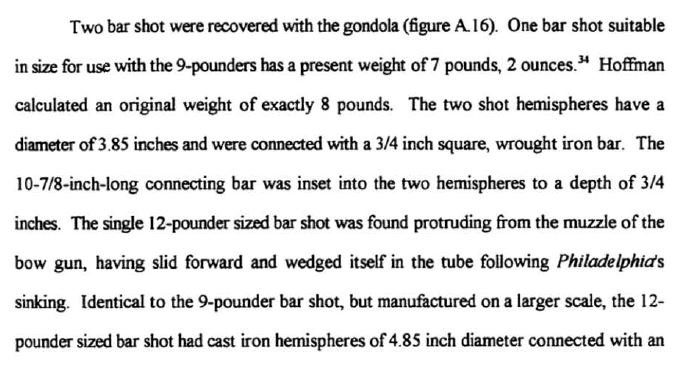
Not true. John Bratten's dissertation on the Philadelphia indicates 2 bar shot were found on the Philly, one was in the 12 pounder at the time of sinking. Bratten's full dissertation can be found here. https://nautarch.tamu.edu/Theses/abstracts/bratten.html

Our Emblem ®