Jump to content
HOLIDAY DONATION DRIVE - SUPPORT MSW - DO YOUR PART TO KEEP THIS GREAT FORUM GOING! (Only 44 donations so far out of 49,000 members - C'mon guys!) ×

Cathead

NRG Member
  • Posts

    3,494
  • Joined

  • Last visited

Everything posted by Cathead

  1. Ras, happy to provide inspiration! I used a similar method on my other steamboats and it's become a comfortable approach for me. This time, as you'll see below, I only used one pattern and built successive wheels on the first one. Another approach would be to computer-design a pattern and print out a whole series so that each wheel can be assembled on its own pattern, I think I did it that way before too. Here's some more weekend progress. I built the other two wheels directly over the first one, to ensure that they all matched. I'd rather have them all consistently eccentric than near-perfect but not matching. So I laid small strips of double-sided tape on the first wheel, then started hand-cutting and shaping each spoke to fit: When they were all shaped, I glued the assembly together and used clamps to ensure it stayed parallel to the first pattern wheel while the glue dried. One thing to be careful of here is not to let glue squeeze out below such that the two wheels get glued together right at the hub where it's hard to get to. I tried to avoid this but it happened slightly; I was able to separate them with a thin knife. It would probably have made sense to put a thin piece of tape or other masking at the hub area to avoid this. But it worked out fine. I then marked the locations for the spacers and slowly assembled those, too. The end result was three wheels that match pretty nicely for hand-made assemblages. At this point I also trimmed all the ends to be reasonably consistent in length. I wanted some "hubs" to help bind these together, so cut a stack of thin discs from a dowel, painted them black, stacked them together with strips of double-sided tape, and drilled down the middle to create a consistent axle hole: Then I painted the wheels and assembled each one with a hub on each side. Here they are threaded on an axle for show, but not in any final orientation: Next up will be working on the "buckets", the proper name for the horizontal slats that actually grab the water. It's nice to feel like I'm making some regular progress again. Thanks for reading!
  2. Well, I quietly missed the one-year anniversary of this build, but I have made some progress by starting on the final "big" project, the paddle wheel. First I cut a whole stack of cherry lumber (same as that used for the main deck) on my Byrnes saw. This is more of the material I harvested here on-farm. Then I laid out a pattern by estimating the size I wanted the wheel to be, from the one decent photo I have, and fiddling with different round objects until I found two diameters that were close enough. Once this was drawn, I set down tiny patches of double-sided tape on each leg's location and began laying out the wheel: Each leg is hand-tapered to fit its neighbors using a sharp knife and sandpaper. I didn't worry about the exact outer length as I'll trim them all down later. I was most concerned with a consistent inner pattern and leaving a clean hole for an axle at the center. When I had them all dry-fit to my satisfaction, I removed each one, put a dab of wood glue on its inner surfaces, then re-assembled the wheel and let it dry. Once this was solid I began hand-cutting the outer circle, formed from a series of small wedges custom-fit between each leg. This is all slow, fiddly work that goes well with a baseball game on the radio. Here's the final result: And here it is test-fit on the vessel: As previously discussed I'll be cutting off a small portion at the waterline but intend to do that once I have all three rings made and can be certain I do them all consistently in the right place. I think it's easier to build the whole wheel and cut it down than try to guess ahead of time exactly where I want the cutoff to be. Overall I think it looks pretty good! Thanks, as always, for the kind comments and support.
  3. Hey Keith, I have a hard time hitting "like" on your last post as I know it's sharing a deeply emotional situation for you, but just wanted you to know I hear your pain. We, too, have had our life path altered by the responsibility of caretaking, though not in the same way as you, and it just is what it is. Hope you can keep your head up and recognize the love involved in the choices you're making. Take care of yourself.
  4. Ras, I finally got around to checking out your build, after seeing you following my own. What a fantastic project! I'd never seen a steamer like this before and it really is a unique vessel, perfect for a memorable scratch build. I'm especially impressed by your metal work, as that seems like magic to me who has never done it. Keep up the good work and I'll be following attentively from now on.
  5. Here's a rough shot of my large display cabinet. Holds three very large models on top, with an assortment of smaller ones on the lower shelves, along with shells, rocks, bones, antlers, and so on. All on the footprint of a single-model case and with a sliding door that seals reasonably well against dust. The mirror in back is a nice touch that lets you see the far side of models. Had this made by a local Mennonite shop for a reasonable price given its quality and usefulness.
  6. As someone who inexplicably enjoys painting figures, those look wonderful! And you're sharing so many neat learning experiences with us that make this a joy to follow. Thanks for brightening all our days even when yours have been darker.
  7. Keith, I came to the same conclusion, that I had made the signs too high. That still doesn't fix the text spacing problem, because it still relates to how those eight letters fit within different lengths. But it was definitely part of the problem, so thanks for the extra nudge to go that direction. So I went back and cut down all three signs I had made, and redid their borders. I then took a gamble and made a fourth, very small, sign that would fit along the port side of the pilot house, and was juuuuust wide enough to fit in the eight letters with the smallest font provided on my sheet of dry transfers. These actually came out quite well, so I decided to not use the biggest sign, shift the two medium signs to front and starboard, and use the little sign on the port side. Here's what they all look like together (the former front sign just propped in front for reference): This doesn't quite match the photos because the port sign is shorter than the front sign, but I'm ok with that because I think the tight spacing between text and top/bottom border looks better than text floating in a larger margin. I just think the tight signs look better, as Keith suggested. And here are two more shots of the new approach from both sides. You'd better like them because I glued them on! I feel like these really add some flair and personality to the model. So here's one more broader view against a backdrop of original photos. Close eyes might notice that the tow knees are missing. I'm leaving them off while I work on the paddle wheel because I'm afraid of knocking the bow against something while I'm focused on the other end of the model. They're easy enough to attach as a final detail. Thanks as always for the likes, comments, and nudges to keep improving on my initial instincts. It's now clear there's no way I'm completing this in one year, but whatever. She'll be done when she's done.
  8. Brian, that's a really creative idea, but I think when you look at the zoomed-in image I posted above, to me it looks like the door is clearly white all the way down. The hog chain post partly blocks the view, but the dark sign is clearly there left of the post but to its right there's nothing but a white door. Ras, thanks, but I do want to keep thinking it through because it just bugs me to have no nameplate sign on the port side of the pilot house. Especially because that's the intended "display" side.
  9. Ian, if you go back to the photo of all three together, you can see that I did use smaller font on my side boards but it still takes up too much horizontal space. The hints of lettering I can see implies that the side board lettering is just a little smaller vertically than the front board lettering, but must be painted on with a narrow font to squeeze the word in there. That's what I can't find a clear photo of; what that word looks like fit into that space. I had an idea overnight and will see if I can find time today to play with it. Thanks to all for helping me think this through; even rejected ideas help nudge cognition along.
  10. Here's a couple ideas on cases. One, there seem to be relatively affordable acrylic case makers out there. I bookmarked this one from a different MSW discussion and can't vouch for it directly: https://www.acrylicjob.com/product/custom-display-case/ Also, depending on how many models you intend to build, a larger cabinet could end up more cost-effective. Often called "curio cabinets", a lot of furniture makers offer these for people who collect dishes, dolls, what have you, and they can be adapted to ship models. They're not cheap up front, but mine holds at least 6 models, which on a unit-by-unit basis is quite cost-effective compared to 6 separate cases. It also takes up a LOT less space in a house than 6 separate cases since they're all "stacked" in one small footprint. Plus, you can share these with another family member; several shelves in ours also display natural items like shells, bones, etc. that we've collected.
  11. Mark, the photo I posted at the beginning of this update shows the port-side board, which is the same height as the others. You just can't read the lettering. Here's another image that I zoomed in and cropped, to clearly show the full-size lettering I based on my signs on, and that again you can't see just what's going on with that port side board. Maybe they used a more squished-together font there, but I can't easily duplicate that with dry transfers. I could print out signs to fit, but I don't like the look of that as well.
  12. John, if I used the small font (necessary for the port side) on the other two signs, it'd be dwarfed by the size of the signs overall, and they're very clearly that size in the historic photos. In another photo you can clearly see large PEERLESS lettering on the front, for example, filling that signboard. Plus, I'm thinking I'm not real comfortable laying out dry transfer text any smaller!
  13. Making a little progress on a rare quiet/unscheduled afternoon. Got a baseball game on the radio and taking care of a fiddly detail: the name boards on the pilothouse. You can see these here: I built these from flat scrap wood with borders of cherry that I carefully carved down with a hobby knife. The central panels are painted red while the borders are cherry darkened with pastel. I then used dry-transfer lettering to lay out the name. I really like the visual effect of dry transfers but have always struggled to lay out series of letters evenly. In this case I like the unevenness, as it yet again looks like some small riverside yard's best shot with a handmade stencil. And it's another one of those details that will blend into the overall rough-around-the-edges effect of the model's style. I made one larger one for the front of the pilot house and two smaller ones for the sides. Here's the front and starboard ones installed: But then I discovered something I hadn't thought through: the port side wall is shorter because of the pilot house door. The original photo shows a board there but I hadn't thought about how it actually fit into the smaller space available. It's the same size board as the other side, but has less length, so how did the lettering work? None of the original photos are clear enough for me to tell. So I clearly can't install this there. Two other possibilities: I could hang it off the stern or off the port wall, where it fits perfectly just aft of the pilot house: Or I could start over and make a new board of the correct length, but with much smaller lettering. That option feels wrong because I think the tiny lettering needed to fit in that space would just look weird. Thoughts?
  14. Yeah, it's hard to imagine these things snaking around winding river bends with a barge lashed to the front and just a sternwheel and a few little rudders. But it happened! Z-drives were not yet even a twinkle in a dreamer's eye. And since we have no idea what Peerless' rudders or lower stern actually looked like, it's all conjecture. I just don't have any evidence for any setup other than the typical one for the era leading up to her construction. One of the great benefits of a waterline model, I can mostly ignore the issue!
  15. Keith, to the best of my knowledge, that's a pretty common layout for a sternwheeler stern & rudders. Best I can say is it seemed to work well enough!
  16. In the absence of any plans or other evidence, I based her hull design on Bertrand, for which I did have very detailed plans: These show a flat stern with just a bit of overhang; you can also see the full rudder setup. Remember that I'm building Peerless as a waterline model, so the rudders really can't be seen, except for a hint of the (skegs? is that the right word?). I toned down the rise of the stern and wheel supports a bit, but it's the same basic setup. So all you see on the model is just a hint of the stern curving inward and down, and the otherwise flat plane from port to starboard. One of the last details I'll add it a hint of rudder tops poking out; I haven't done it yet for fear of knocking them off because they'll be very small without the extra support from the part "underwater" and not modeled. So to forestall the next obvious question, I plan to cut off (or not build in the first place) the bottom part of the wheel so that it sits on the display surface as if it's entering the water.
  17. Phil, that's a great story! I, too, think it would be fascinating to cross on a railroad ferry and have never done so. Mrs. Cathead grew up in northern Arkansas and we were just down in the Atkins area a couple years ago. To the best of my knowledge, the first railroad bridge across the Mississippi was built at Rock Island, Illinois in 1856. That bridge is also famous for the lawsuit brought against it by steamboat interests, in which a young Abraham Lincoln represented the bridge interests; it went all the way to a landmark Supreme Court decision that firmly established the right to bridge waterways. This is a good article on the subject.
  18. Thanks, Gary! I rebuilt a new version of the tow knees. These are just set in place right now. I decided to focus on the style seen in this photo: Thoughts? I also started laying out a draft of the paddlewheel. Here's the loose size I'm thinking of using; compare with the photo below that is my best view of the stern area. Thoughts on all of this?
  19. We recently spent a few days along the Upper Mississippi River (the stretch bordered by Minnesota, Wisconsin, and northern Iowa) and I thought a few photos and stories might be of interest to the general audience here. This part of the river is quite different from that below St. Louis; it's controlled by a series of locks and dams that create relatively stable pools for navigation, whereas below St. Louis the river is free-flowing. This also means that the whole valley is often filled with water, creating a maze of channels and islands that's actually more natural in appearance than the highly channelized lower river. Views like this also resemble what rivers like the Missouri used to look like before they were locked into permanent navigation channels and their complex forested floodplains transformed into dry farmland. The bluffs along this stretch can rise over 400 feet above the river, giving dramatic views from various public lands, like this shot looking down on a toy-like towboat far below. We were also fortunate to catch a large tow going through Lock & Dam 13 (just north of Fulton, Illinois), and set up a tripod so we could take time-lapse imagery of the whole process. I can't upload video here, but extracted a sequence of frames to show the process, which is pretty neat if you've never seen it done before. This tow consisted of three columns of barges, two of which are four barges long and one just three, for a total of 11. The lock can only accommodate three barge-lengths without a towboat, so there's no way this whole massive tow can get through in one piece. So how is this impasse handled? Here the lock is opening and you can see the tow approaching from downriver. After some careful maneuvering, the towboat shoves its tow into the lock, with only a foot or so to spare on either side. The tow is "broken" between the first and second rows of barges, and the towboat begins to back out of the lock with the first row, leaving rows 2-4 alone in the lock so the gates can close. Once rows 2-4 have been raised to the upriver level, they're hooked to a little engine/winch that runs along an extended rail beyond the lock. This pulls the tow upriver out of the lock, beyond the upper gates, where it's tied off to await the rest. Now the water is lowered again and the towboat enters with row 1. A closeup of the towboat, a 6140 horsepower vessel built in 1976. It bears some resemblance to the Caroline N, subject of @mbp521's beautiful ongoing build, though they're not sister ships (second image from Towboat Gallery). Once the towboat has been raised, it reunites its tow and proceeds upstream. I didn't record this part. Anyone interested in watching how locking works should check out the live webcam streaming from Lock 19 at Keokuk, Iowa, which also monitors an active rail line running along the river next to the lock. This is mounted on a historic double-decker road/rail bridge, the upper portion of which has been converted into a pedestrian overlook of the lock and river and is a great place to hang out on a pleasant day and watch river/rail traffic. But you have to watch what you say, as the camera picks up voices from below (I have mixed feelings about that). This lock is longer than the one shown above and can accommodate a full 12-barge tow and towboat all at once. And just to show that I'm an equal-opportunity transportation buff, here's a nice shot of a CPKC freight running downriver on a very active line.
  20. Keith, fair question. We'll see what it looks like when I pop them off but my instinct is that there'll be two long thin glue scars where the base timbers were glued down that won't look quite natural.
  21. @mbp521 Tow knees, thank you! Driving me crazy to not have a proper name. Yes, they're definitely there to provide maximum stable contact with a tow. @steamschooner The first time, I decided to ignore the roller chocks since I thought they'd be barely visible between the narrowly spaced tow knees; they're not always visible even in photos (for example, look at the second vertical one I showed above where they're covered by the tow knee bracing). @LJP I tried something like that and got the wire as straight as I could before installing. I also mounted it on the model in such a way that I could put a fair amount of tension on each section as I glued it in. Doing this actually demonstrated the engineering integrity of the hog chain system because those angled posts took all the strain without flinching! The result is the best I could do with that I had on hand and I'm fine with it. And to everyone else, I'm convinced of the need to pop the tow knees off and start over, but it'll be a few weeks due to schedule overload. I can easily hide any slight scarring from the removal with ropes or something. I'd say this will teach me a lesson not to get ahead of myself, but if this build shows anything, it's that I don't learn that lesson easily. This time I'll demonstrate the new assembly before gluing it to the model. Also, to hold your interest during the next interlude, here are a couple recent views of the Missouri River just downstream of Rocheport, the upriver home port for Peerless. You're looking upriver in both shots, with Rocheport tucked into the bend at right. First one is from a bluff a couple hundred feet above the river, second one is nearby but riverside. Peerless would have traveled this stretch regularly. When these were taken the river was as high it's been in several years and you can see that the surface looks turbulent with woody debris in the water.
  22. Huh...I'd never noticed that despite staring at those photos over and over as I designed my version. You're right, that second photo looks like they extend quite a bit out. Which would give me leave to do the same and help with my problem. Did the whole forward deck change shape at some point? Both versions look to me to have a similar spacing between them, but one version looks like it's snug against the deck curve and the other extends outward by a noticeable amount. Shouldn't have gotten ahead of myself and glued them on before asking for ideas. Not the first time eagerness has bitten me! Shouldn't be a big deal to pop them off. Thanks for that observant insight!
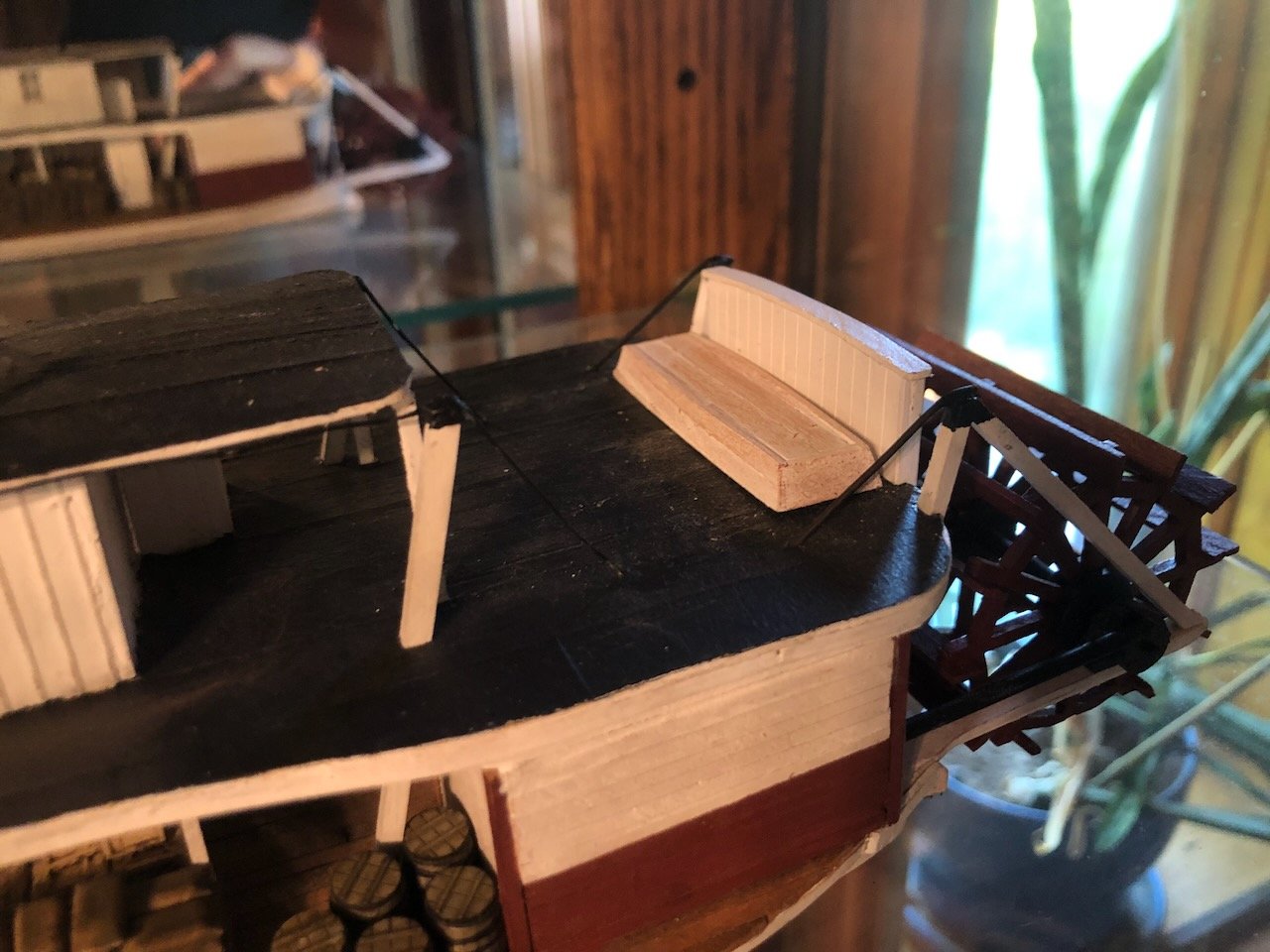
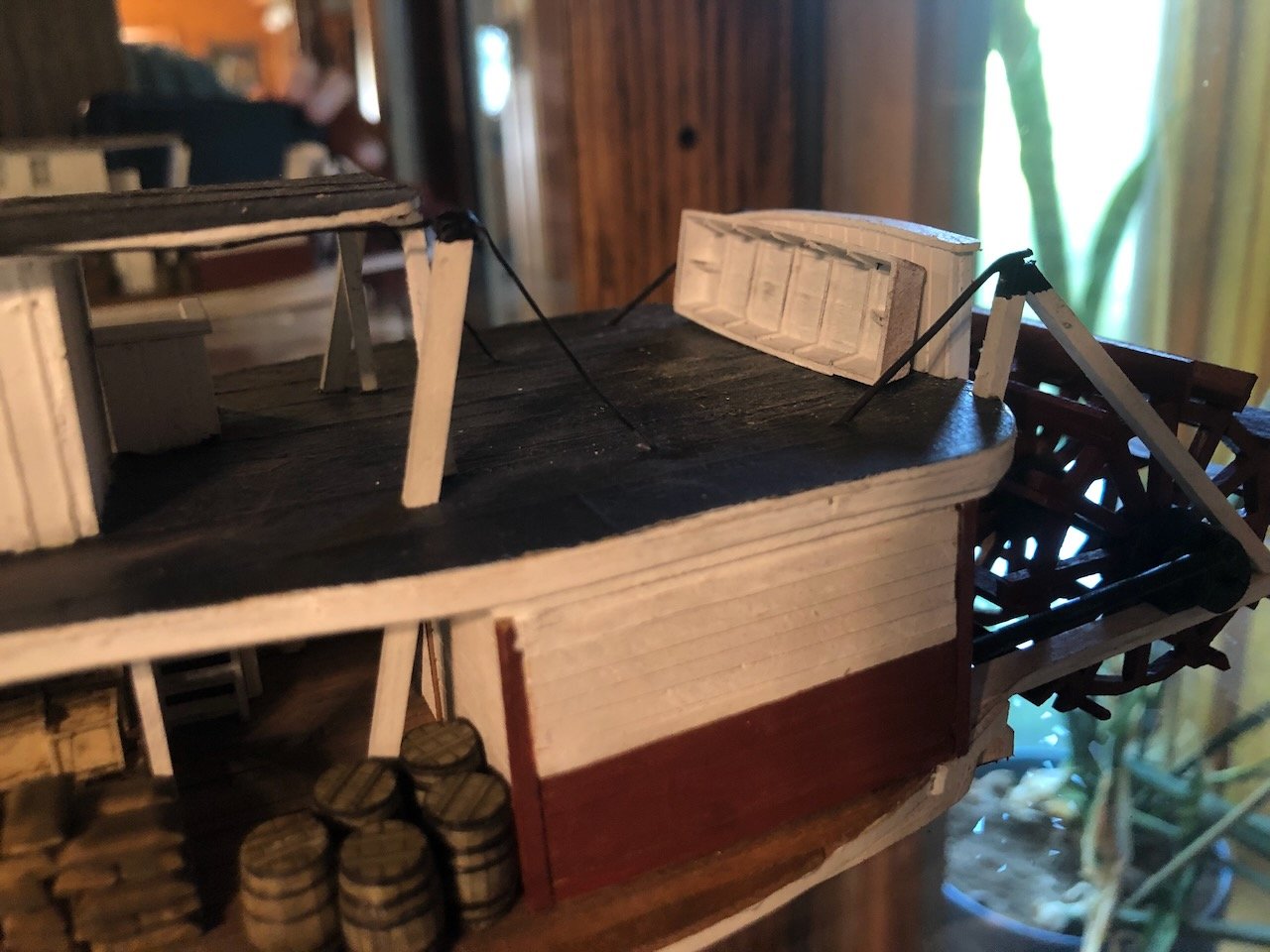
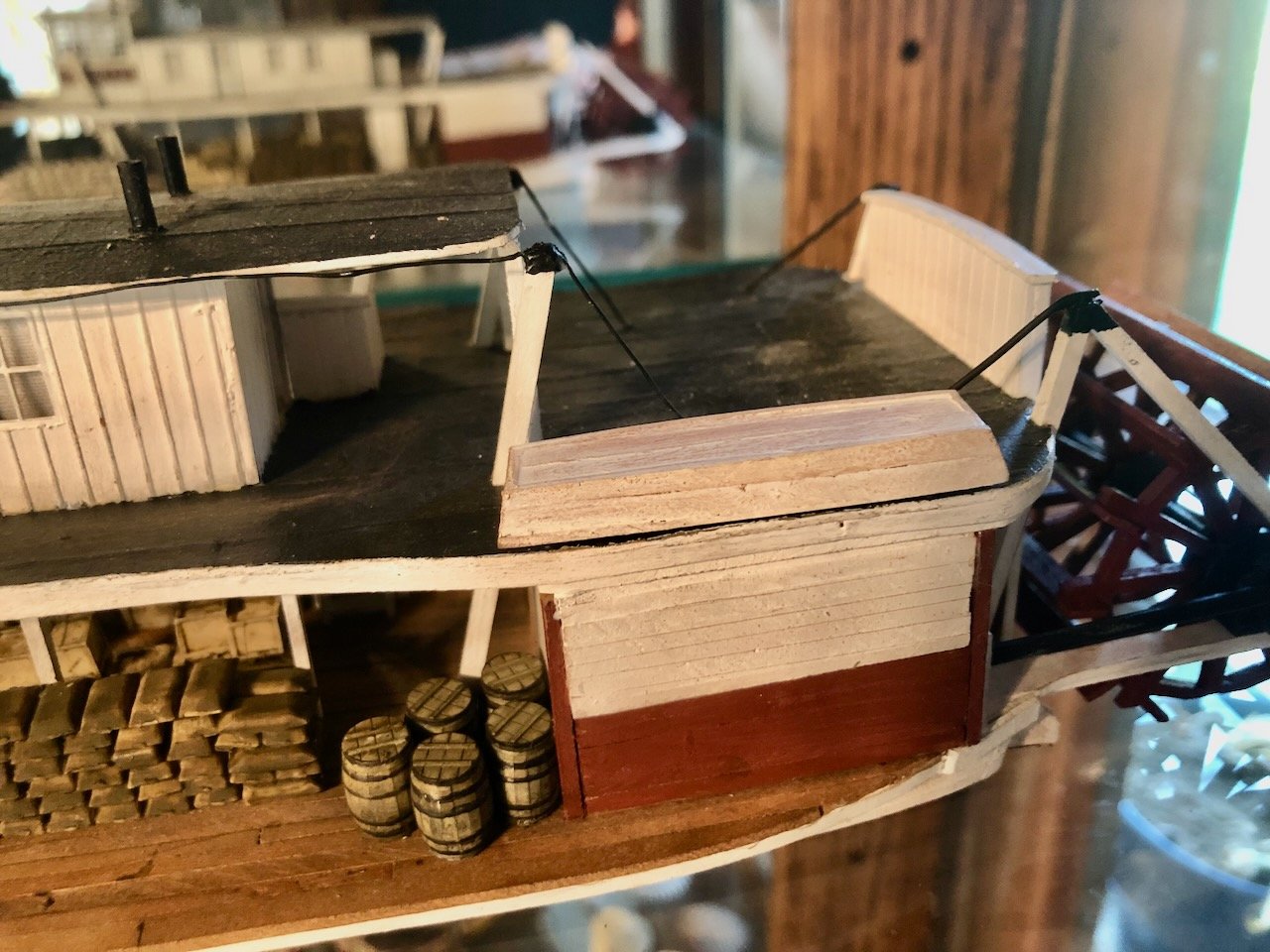
  23. Just a small amount of progress to report. May is not cooperating in terms of free time to work on models. I added the longitudinal hog chains based on some blurry historical image details and logical assumptions about their natural location. I used thin wire, which I couldn't get perfectly straight, but it's another quirk that the camera captures but the eye doesn't really see. Then I got to work on the...not quite sure what to call them, but the timber frames on the bow used to push tows. You can see them pretty clearly here: This is where I found I hadn't thought ahead enough. Those are pretty widely spaced across the bow, which means the bow has very little curvature. When I went to install mine after making them, I found that my bow curves away more sharply than I thought when I first laid it out, so now if I placed them that far apart their fronts fell well behind the bow and wouldn't be able to push anything. So I had the choice of either placing them accurately far apart, but too far back from the point of the bow, or too close together, but accurately forward enough to extend just beyond the bow. For better or worse, I chose the latter, though now I'm wondering if it was the wrong decision because they're more noticeably "wrong" compared to the original photos than if they were properly spaced but a bit too far back. Anyway, see what you think (compare to same photo angle in background): Another view, with comparable angle in background and separate photo below: Changing them would mean popping them off the deck and hopefully not leaving too much glue stain; I could always cover those with a few random timbers or something. Thoughts? In the above photos, you'll also notice I built a version of the capstan that sits just behind those whatever-they're-called braces. Finally, I added the two thick diagonal braces that lead aft from the chimneys to the pilot house: I think I'm getting close to done with the basic details. There are some more thin guy wires supporting the chimneys, though they're very hard to see in the historical photos. I need to figure out where I'm going to get that big locomotive headlight that's so prominent on the front edge of the boiler deck. The biggest single project remaining is the paddlewheel, which I'm going to need some quiet focused time to concentrate on designing. Not going to happen in the next week, that's for sure. But I started this log on June 17, 2023, and there's an outside chance I'll have her done one year later. Thanks for sticking with me!
×
×
  • Create New...