


Mark P
-
Posts
1,774 -
Joined
-
Last visited
Content Type
Profiles
Forums
Gallery
Events
Everything posted by Mark P
-
Sail design for 18th-century longboat?
Mark P replied to Cathead's topic in Masting, rigging and sails
Hi Everyone; Just a few thoughts to throw into this bubbling mixture! I am not a sailor, and I cannot be sure if what I am about to suggest is realistic or not, so other people's opinions will be needed here. However, one point which is being not mentioned here is that the tiller on all such boats was removable. with the boat on either tack, or with a following wind, the sail would be out over one or other quarter, or broad over the beam. In all cases here, the sheet block would be at one end of the horse, closest to the sail, and away from the central point where the tiller pivots. It is only when going about that the sheet block needs to traverse the horse, thereby crossing the centre zone. I believe that the prime mover in going about is the headsails, once the rudder has started the initial turn. What is the likelihood that while the ship was turning through the eye of the wind the rudder is, for a very short period, in a dead zone, and the tiller can be un-shipped, allowing the sheet block to run past, before the tiller is re-shipped. Would this be a true possibility? Over to those more nautical than me. All the best, Mark -
Evening everyone; It's not the USN I know, but in the Royal Navy for many years Gunners were only issued with two tackles per gun. If they needed a train tackle, they would unhitch one of the two gun tackles, and make do with that. They did eventually get issued with three, though. All the best, Mark P
-
Hi rtwpsom2; All masts and yards were measured parallel to their centreline. They were made on land, and the craftsmen making them needed to know how long to make them. All the best, Mark P
-
Evening gentlemen; Some interesting things posted here. Backer, the archaeology report is very interesting. Please note, though, that what are referred to here as filling pieces are not the same as filling frames. The keel is missing, and would have been somewhere below the bottom of the drawing. Filling pieces were a common practice, and were inserted between the main frames to fill any gaps between the main timbers. This was done in the bottom of the hold to prevent water build-up and rot. The joints at the ends of the floors are interesting. And the construction appears to be repeating single futtocks (navel or naval timbers they are called in early contracts) which are then sandwiched by a sequence of second futtocks whose ends completely fill the spaces between the ends of the first futtocks. This is similar to the construction shown in many Navy Board ship models, which is generally believed to be un-representative of full-size practice. I would be very cautious of accepting the blue shaded areas as part of the third futtock; they do not seem right for this location EDIT: (I have just noticed that they are listed as firring pieces in the index, which would mean they were added to increase the vessel's breadth) This is food for thought indeed; thank you for the post. All the best, Mark P
-
Morning Dave; In the AOTS series, the book on 'Blandford', a 20 gun ship from 1720, has some excellent details of her fire-hearth. All the best, Mark P
-
Evening Dave; My reply is in two parts: The diameter of the head of the bolt would be at least 2x the diameter of the bolt, judging from illustrations I have seen of typical bolts. It needed to be wider to prevent the head pulling through. The largest size bolt I have seen referred to for the period you mention is 1 3/8". The smallest is 3/4" (although I stand to be corrected if necessary) The exact size depends upon the size of vessel concerned, and the bolt's location. Assume a bolt head diameter of around 2" and you are unlikely to be far out. At scale sizes, the difference is unlikely to be noticeable. By the way: before you accept Goodwin's reconstruction as the only one, I would read the beginning of Franklin's 'Navy Board Ship Models, 1650-1750', where he discusses some interesting alternative framing possibilities (in the picture you have posted at the beginning here, there is no means of attaching the second filling frame to the keel, nor is it attached to the floor/futtocks on either side. Effectively, it is floating in air, which cannot be correct) Richard Endsor in his two books on Restoration period vessels shows a lot of detail of framing (his work is greatly superior to Goodwin's in many respects) which I recommend you also get a look at if possible. All the best, Mark P
-
Square or round tuck?
Mark P replied to lmagna's topic in Building, Framing, Planking and plating a ships hull and deck
Hi Lou; Following on from Druxey's comment regarding double rabbets, I have seen old contracts for vessels with round tuck sterns stipulating that the side and stern planking which meets the stern timbers (that is the vertical ones, rising from the ends of the wing transom) should be rebated into the timbers, which can only be for exactly the same reason, to prevent water ingress in the end grain. An alternative, which happened on some vessels, was to cover the end grain with mouldings or carvings. All the best, Mark P -
Hi Vinnie; Your picture doesn't show it, so unless it is shown elsewhere, there was a rounded piece of timber, the bolster, set on top of the trestle-trees. This was to ensure that the shrouds did not sit against a sharp edge, and become weakened by it. Also, on many ships, the shrouds were not the first ropes to go over the masthead. If you are making a warship, take a look at James Lees' 'Masting and rigging of English Ships of War'. If it is a merchant vessel, try Underhill's 'Masting and Rigging the Clipper Ship and Ocean Carrier', which is very well illustrated and informative, written by a man who loved sailing ships, when there were still enough of them around for him to have personal experience of them. All the best, Mark P
-
H.M.S. Atalanta - Drafting my own plans
Mark P replied to Ben752's topic in CAD and 3D Modelling/Drafting Plans with Software
Hi Ben; I am not sure if you are doing this for ease of draughting, to be altered later, but the joints in your keel are what is called a 'half-lap' joint. This is much weaker than the joint which was actually used in a keel, the 'scarph' joint, where the cut was only one third into the timber at the shoulder. I suspect that as you have obviously read the TFFM volumes, you are aware of this, but I thought it best to be sure. All the best, Mark P -
Greetings Sandor; One other point with cannon which were stowed is that the bore was closed by a tompion being placed in the muzzle. This was a solid timber shape like a filled in bucket, often with the visible end carved and painted. They were standard issue as part of the Gunner's stores. In the Royal Navy, 'take out your tompions' was the second command given when preparing the guns for use/drill. I am sure it would be the same in other navies. All the best, Mark P
-
Alan, I am sad to hear that they are charging such silly prices. Presumably they mean that someone has to take it out and photograph it. That kind of money would start a small film studio, though. Especially in this digital age, when no-one has to develop or print it. With regard to girdling, it dates back at least to the mid 1600s, and was commonly resorted to when a ship failed to float as high in the water as expected after launching. All the best, Mark P
-
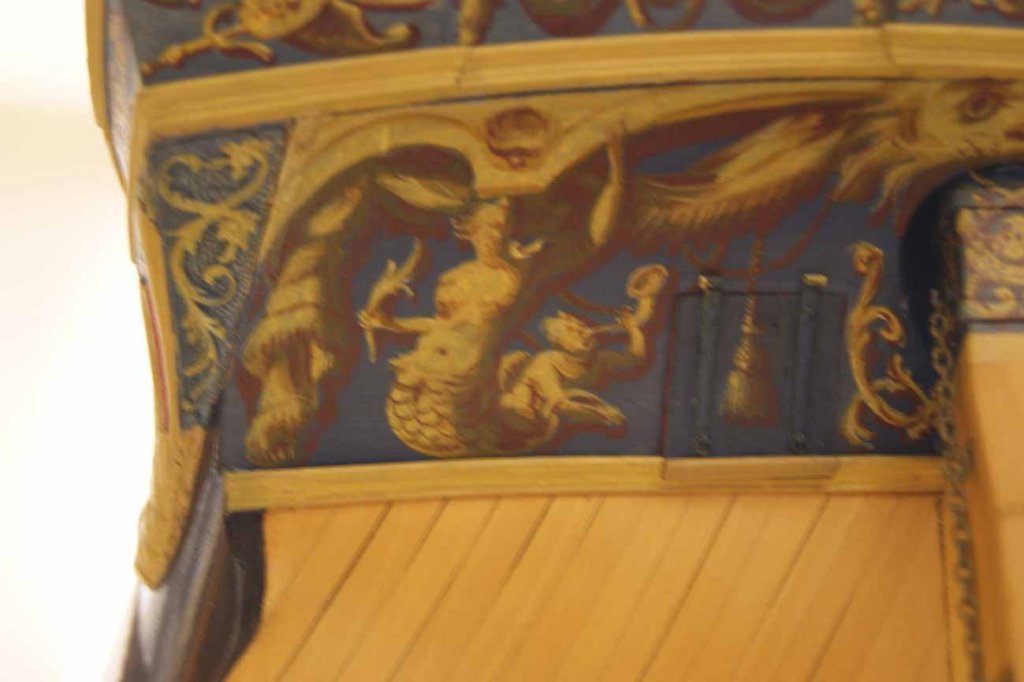
Evening all; See attached a picture of 'Endymion' 44 guns, from the Royal Collection at Kew Palace This shows a triangle of planking. It has to be a separate piece, as the wale would be very thick if it was part of it. All the best, Mark P
-
Evening Druxey; I think that it is actually not part of the planking at all, but the end of one of the model's ribbands, and so only a temporary piece (although it's been there several hundred years!) OOPS! Apologies! Just looked at it again, and it is clearly part of the wale. Is the appearance of a joint close to the end just a trick of the light, though? In the CAD picture it is certainly a separate piece, which would seem the most logical. It is, of course, not necessarily contemporary practice. I will look at some of my photos of contemporary models, and post anything which seems to shed light on this point. All the best, Mark P
-
Good Evening everyone; If you look at the stern planking picture in the post of a 'Swan' Class ship in the CAD forum, drawn by someone who is surely a computer imaging genius, you will see exactly the same planking layout as appears on the Bellona model above. Short sections of triangular planking to fill the space between the bottom end of the wale, and the underside of the counter (tuck) moulding. All the best, Mark P
-
Greetings everyone; For those with any interest in the fighting for American independence in the later 18th century, I highly recommend the book by Sam Willis, titled 'The Struggle for Sea-Power'. I am only half way through it (it's not small!) but it is written in a way which makes the reader aware of how many obstacles there were to overcome before any of the participants could actually fire a cannon. It is filled with examples of patriotic devotion to duty, and to the contrary, lays out many opportunities missed because of a lack of this. The writing is clear and very well informed, and I feel sure brings to light many small aspects of the war and the logistics involved which have not been much written about before. All theatres of the war are considered, and its impact on the colonists, the sailors (on all sides) and all those who made a living connected to the sea or the major rivers that run into it. Anyone reading this will, by its end, know far more about the struggle for independence, and the good and bad luck, the wise judgements and mistakes, which combined to bring about the British defeat. I am very glad that I purchased this book, and consider it to be excellent value, well worth the time that will be taken to read it. Happy reading! Mark P
-
Greetings everyone; I have seen references to this last piece of wale planking being sawn to fit, not bent, so I am sure you are all on the right track. I would do it exactly as Druxey suggests, get the inside to fit first. All the best, Mark P
-
Good evening everyone; To throw some light on references to caulking port lids shut, this was certainly done with some of a certain type of Royal Navy vessel. I refer to the 80 gun three-decker, bane of many captains' lives during the first half of the 18th century. These ships became notorious for their inability to open a lower-deck gunport in any kind of sea. One admiral complained that his ships were useless, and unless on a mill-pond would never be able to haul up a port-lid, and he named at least one ship under his command whose ports had been caulked when she was launched. The 80 gun ships were too short, too high, but most importantly could not displace enough water to provide the lift required to raise them far enough out of the water to be usable. The shipwrights, however, stuck doggedly to their guns, and refused to admit that there was anything wrong with the type even in the face of the most determined criticism from the sea officers. The situation was resolved by Lord Anson, First Lord of the Admiralty, who upon the death of Jacob Acworth, the long-serving Surveyor of the Navy, installed Thomas Slade and William Bateley as joint Surveyors. They had urgent plans to construct a 74 gun ship, but to try and divert criticism, for a long time they had to claim that the first 74 was actually a new 70 gun ship. All the best, Mark P
-
Hi Shipman; The first one to spring to mind is the Royal William, which never actually sailed as a three-decker, and was eventually cut down to a two-decker (I think with 80 guns) Look her up. All the best, Mark P
-
Greetings everyone; I have to agree with the comments about the view: I wish it was what I saw from the workshop! Anyway, to end the digression: see below an extract from a contract for the building of the 74 gun ship Fortitude, dated 6th February 1778. A bit later than the Bellona, but I doubt that much had changed in the way of timber scantlings. The third paragraph details what you need, but I have left the rest in for comparison also (your model is progressing admirably, and looks so beautiful!) Note that the black strake is exactly twice its thickness in height, and thinner than the wale by 1 3/4 ins. The plank on top is thinner by 1", with the planks diminishing up to the under side of the channel wale. MAIN WALES: The Main Wales to be in breadth from upper edge to lower edge 4ft 4ins, and in thickness 8 ½ ins. To have one fair Seam in the Middle & the two lower & two upper Strakes to be lock’d into each other with Hook & Butt wrought of such lengths and the butts properly disposed so as to give the strongest Shift to the Ports & to each other. THICK STUFF UNDER THE WALES: To have six Strakes of Thick stuff under the Main Wales, the upper edge of the upper Strake to be 6 ¾ ins in thickness, the lower edge of the 3rd to be 5 5/8 ins, & the lower edge of the sixth strake to be 4ins in thickness. THICK STUFF UPON THE MAIN WALES: To have one Strake upon the Main Wales of 6 ¾ ins in thickness and 1ft 1 ½ ins broad. The lower edge of the Strake upon that to be 5 ¾ ins thick and to wear off to 4 ins thick at the Channel Wales. CHANNEL WALES: The Channel Wales to be in 3 Strakes of 2ft 9ins broad on the perpendicular and of an equal thickness of 5 ½ ins. Properly shifted & to work down to make a proper Stop and afford Wood for the Port Hook SHEER STRAKE: To have a Sheer Strake wrought that its upper edge may be agreeable to the upper edge of the Waste Rail in the Waste, and only one Inch higher from thence forward, and from the Waste Aft. To be in breadth 12ins and 4ins thick, & of English Plank in Wake of the Channels. STUFF BETWEEN THE CHAN. WALE & SHEER STRAKE: The first Strake upon the Channel Wale to be in thickness 4ins, & the next under the Sheer Strake to be in thickness 3ins, & the intermediate Strakes to be diminished agreeable to the lower and upper edges of these two. SHEER STRAKE: From the first drift forward & Aft to work one Strake of 3ins thick on the Sheer Strake, and the upper edge of the Strake under the Planshire (sic) from the Drift Aft to be diminished to the thickness of 2 ½ ins, which is to be dry English Plank. Interesting stuff! All the best, Mark P
-
Hi Sailor; One factor which is generally agreed upon in contemporary assessments of British v French ships is that the French ones were built with smaller section timbers and less fastenings, such as bolts and knees. This was presumably because the French ships were not intended to remain constantly at sea, unlike their British counterparts. When captured, it was normal for the dockyards to survey foreign vessels, and the report normally mentioned that she was in need of strengthening, which was frequently done. It was also frequently found that captured French ships were so badly strained and worked by a few years sea-service that they were beyond economical repair, and were hulked or broken up. All the best, Mark P
-
Hi everyone; One point that some may not be aware of: the picture posted by Jud shows what is known as a 'Compass Rose'. This was the name of the (fictional?) corvette in Nicholas Monserrat's WW11 sea novel, and it wasn't until many years after I first read it that I realised what the name meant. All the best, Mark P
-
Hi Archnav; Thank you for the info in extracting the pictures. I will give this a try and see what I achieve. Don't worry too much about your English; the meaning is generally very clear. All those A+ weren't given for nothing! One possibility for this big dead-eye is that it was used to repair a stay. As for being found at the aft end of the ship, this is not a reliable indication of where it started out. The ship was gradually broken up, and falling masts could have gone in a curve that took them and any dead-eyes far from their original positions. The action of waves would do the same thing; or even some of the previous attempts to salvage cannon or other useful items from the wreck. All the best, Mark P
-
Good Evening Wayne; I have to disagree with you on that last bit. Scuppers were actually cut through the waterway in all the illustrations I remember, with the inner lead flange nailed to the waterway. The waterway did not cover the scuppers. Although I find it hard to believe that the report could miss something so seemingly obvious, given its level of detail, there is most definitely a strip of timber running along the junction of the deck and spirketting. This timber is not in the same plane as either of the adjacent areas of planking, and occupies the spot where a waterway would be. Not to fit one flies in the face of everything ever written about this area of ship construction at this time. Look again at the picture no 30, with the corner of the standard cut away, and a length of timber running through it (remember the spirketting is at the bottom of the picture) Look at the picture no 25, which again shows a length of moulded timber at the junction of the spirketting and the deck planking (arrowed by Archnav) This timber is quite clearly not shown on the coloured drawing of the excavation. All the best, Mark P
-
Hi again Archnav; Firstly, you are of course quite right: mess tables were set up between the gunports, not at them. There was a thumping great 32pdr cannon in the way! Silly me. Secondly, I believe that the dimension given in Steel refers, as you say, to the distance by which the outer planking of the port lid overlaps the exposed frame timbers, which are left uncovered around the gunport when the ship's planking is stopped short. Thirdly, you are correct in your thoughts: it is indeed the method you use to extract part of the pdf and then write all over the extracted part which I am unable to master. A brief pointer would be very welcome. Thank you for posting the further pictures. In case anyone was wondering, the one showing the standard has the deck planking vertically to the right, and the side planking along the bottom. All the best, Mark P


Our Emblem ®
