HOLIDAY DONATION DRIVE - SUPPORT MSW - DO YOUR PART TO KEEP THIS GREAT FORUM GOING! (Only 36 donations so far out of 49,000 members - C'mon guys!)
×


Dr PR
-
Posts
2,414 -
Joined
-
Last visited
Content Type
Profiles
Forums
Gallery
Events
Everything posted by Dr PR
-
 Ian, I sympathize! Back in the early '80s another fellow and I were writing a C compiler for a new computer we were making. When I was testing the code I found something that just wasn't working right. It included some of the code the other fellow (a very experienced programmer) had written and I came to a single line with many statements concatenated using just about every operator in the language. Every time I read it I came to a different conclusion about what it was doing. So I took it to the other fellow and asked how it worked. He looked at it a while and said he had no idea what it did! After that I broke everything down into simple statements on separate lines. It made the printouts longer but was easy to understand and significantly reduced debugging time.
- 536 replies
-
- 2
-

-

-
- Quadrireme
- radio
- (and 1 more)
-
I have always just painted with flat black paint. This has the advantage that you can work on a few brass pieces at a time and put them in place on the wood before painting. You can't do this with blackening chemicals because they stain the wood. Paint also works equally well on bare metals of all types and on solder joints. It has the disadvantage that the paint chips off on areas that get wear (like when you are attaching rigging). I do have brass blackening chemicals and want to give it a try. I think it produces a better (and thinner) black coat and is resistant to chipping. However, if you use solder on brass parts the blackening chemicals will not blacken the solder, leaving a shiny joint that will need painting. Another disadvantage is that you need different chemicals to blacken different metals. If you produce a large number of metal parts all at the same time blackening them before installing in place is overall faster than painting the individual parts one at a time. Your title is addressed to "speedy builders" and I am not one of them. I can find time for only small modeling jobs, and I do not have everything planned in advance and all the materials prepared for mass production. So I end up making a few pieces each time, and blackening is not handy for this because of the chemical mixing, metal cleaning, etching and blackening process times. Paint is faster and easier. But if you have everything planned, all the materials on hand, and the time for mass producing all of the metal parts in advance I would recommend blackening.
-
Allan, In some cases instead of sending crew aloft to furl a sail high on the mast the yard is lowered to the deck to take down the sail. This can be done faster and with fewer crew, and it reduces topside weight. This was common with topgallants (or upper topsails) on topsail schooners and royals on larger square rigged ships. As I understand it the sail was bent to the spar and furled to it with ropes (gaskets) while on deck. The spar was hoisted aloft (on the lee side) by one end (vertically) and then the lower end of the spar was raised so the spar was horizontal. All the lines (lifts, braces and clues) were handled on deck. Then the gaskets were removed and the sail unfurled. This could be done by one person aloft. Also the gaff topsails on schooners were often raised and lowered on yards instead of trying to furl them aloft. Again, it required a smaller crew. The ability to lower topsails quickly was especially important on vessels with extreme sail area aloft when the wind suddenly changed. I have read several accounts of vessels capsizing when sudden squalls caught them abeam with a lot of canvas high on the masts.
-
There is also the question of how much rigging do you want to do, and how accurate it will be. Sailing vessels have two types of rigging, standing and running. The standing rigging is fixed in place, and rarely adjusted. It takes the forces on the masts and transfers them to the hull. It is usually dark brown or black because it is tarred to protect the ropes from the weather. Running rigging is used primarily to adjust the sails. It is light brown or tan, and runs through blocks and sheaves. Much of the running rigging is attached to the sails, so if you have no sails much/most of this rigging is not in place. Consequently the rigging can look pretty sparse. So if you intend to fully rig the model you pretty much need the sails. However some of the running rigging can be installed and belayed as if in preparation for hoisting the sails. Whether the sails are furled or not is your decision. Sailing ships rarely set every inch of canvas. Often they ran with only a few sails set. It depended upon the wind and weather. Topsails were set with light wind, but hauled in if the winds were really strong to avoid capsizing in sudden gusts. And in battle the courses (lowest and largest sails) were furled or brailed (hoisted to the yards but not tied to the yards) to clear for action. So what do you want to do?
-
Bill, I have read many places that you should heat the parts to be soldered and not the solder. I have always ignored this. You need to transfer heat from the soldering iron to the work, and just placing the soldering iron tip against metal will result in a relatively slow heat transfer. With brass and copper the heat will flow away from the point of contact, heating the solder area slowly and allowing the heat to spread through the metal to more distant places. This may result in unsoldering other existing solder joints. You can use heat sinks (metal clips, forecepts, wet paper towel, etc.) to protect existing joints. You want to transfer the heat rapidly. For this the tip of the soldering iron should be wet with a small drop of molten solder. This will transfer heat quickly. I usually put a small amount of solder on the tip and solder flux on the joint to be soldered (I prefer the liquid citric acid flux). Then I touch the joint with the tip and the solder flows into the joint. The liquid flux draws the solder into the joint as it evaporates. The flux dissolves metal oxides that would prevent a good solder joint. Depending upon the area to be soldered you may need to feed more solder as you move the tip along the joint. Practice will teach you how to do this. Once the solder has flowed you can pull it along the seam just by dragging the soldering iron tip along the seam. One other thing to remember - the tin in solder dissolves into brass and copper. It doesn't just flow onto the surface. Some metal flows from the brass into the solder. As a consequence, you cannot remove excess solder without leaving a solder "stain" on the metal. So plan your work carefully and apply the soldering iron to the inside of the work when possible, so any excess solder will not be visible. Use as little solder as necessary to secure the joint. If you are going to paint the part the stain doesn't matter. But it will prevent blackening the stained area with metal blackening agents.
-
Size Issues When Converting Blocks/Deadeyes from Inches to MM
Dr PR replied to GGibson's topic in Masting, rigging and sails
For what it is worth, block sizes were determined by the size of the lines running through them. So if you know what size lines you are using you can figure the proper block size. When looking at historic information on line sizes remember that the dimension given is the circumference of the rope. However some more modern books, especially ship modelling books, refer to the diameter of the line. Zu Mondfeld's "Historic Ship Models" has a table of block sizes based upon line diameter on page 242. You can probably find the same information somewhere on line. -
Adding Bulkheads
Dr PR replied to acaron41120's topic in Building, Framing, Planking and plating a ships hull and deck
I have made additional bulkheads by tracing the two bulkheads on either side of the gap, one on top of the other, and then just sketching in lines for a new bulkhead between the to trace lines. This is just an approximation so I allow a little extra width that will be sanded away during fairing. Or you could just copy the wider bulkhead and remove the excess material during fairing. Use the technique of holding (I use rubber bands) a wood strip (like a hull plank) along the length of the hull and noting places that it is "proud" (sticks up too high). Sand these high places until the wood strip curves over the new bulkhead without a high spot - a smooth curve along the hull. -
Seats of Ease
Dr PR replied to stuglo's topic in Discussion for a Ship's Deck Furniture, Guns, boats and other Fittings
I am modelling a small schooner and I was wondering what "necessaries" they might have had. Most deck plans leave off the heads and other deck furniture, so the lack of heads doesn't mean the ship didn't have them. I think in most cases we will never know for sure unless we find an accurate model that shows the features. I did start a thread about schooner heads that has a bit more discussion if you are interested: https://modelshipworld.com/topic/29060-schooner-heads-1700s-through-1800s/?do=findComment&comment=829120 -
ZB, Thanks for the information about tacking the gaff topsails. I was wondering how it was done. There as been some discussion and different ideas on other threads, but the videos you posted show the process nicely.
-
Bob, Thanks for the comments about shellac's shelf life. I have wondered if this was just rumor. I have seen other posts from folks who have used containers of shellac that have been around for many years. Like you said, I suspect that solvent evaporation is the most serious problem, and that is easily solved by adding more ethanol. And cheap ethanol is easy to find. It is sold as 95% denatured alcohol fuel for stoves, with 5% methanol to discourage it from being ingested.
-
Looking great, as always! That Jackyard topsail is huge! I read in John Leather's Gaff Rig Handbook that the jackyard evolved as a means of getting around some type rules for racing. It allowed the area of the spar gaff topsail to be expanded greatly without violating the rules as written. He said some jackyard topsails had greater area than the main sail! You would have to be quick handling those things if a sudden squall blew up. It is a beautiful model!
-
Seats of Ease
Dr PR replied to stuglo's topic in Discussion for a Ship's Deck Furniture, Guns, boats and other Fittings
There are other threads on the forum discussion seats of ease. Someone posted a link to the attached thesis on the subject. Seats of Ease Simmons-MA1985.pdf -
I have started experimenting with shellac and I like working with it. I have both a spray can (wasteful) and flakes, both clear and dewaxed. It seals the wood nicely with a mat or satin finish that I like, and it doesn't stink. I have also painted over it with acrylics with good success. One caution about shellac. After it is mixed it has a limited shelf life of only a few months. That is why many modellers get the flakes and mix them in alcohol (95% ethanol, available cheap as a fuel) when needed. Allow a day or two for the flakes to dissolve completely. There are extensive discussions about shellac and how to mix and use it on the Forum.
-
I have used lead bearing solders for at least 60 years, with no "toxic" effects. Lead is toxic if you eat it - as with the early lead soldered metal food containers. And it is toxic if you drink it - as with water delivered in lead pipes or copper pipes with lead solder joints. But you have to eat or drink a lot of it. Just momentarily handling lead solders is not hazardous. Soldering does not produce hazardous lead vapors. Maybe if you handled lead or soldered for hours daily for years you might suffer toxic effects. But occasional hobby work is not going to cause problems. I do like to have adequate ventilation to remove the smoke and fumes from the fluxes used with soldering. They are probably more "dangerous" than the lead. And it is a good idea to wash your hands with soap after handling soldered pieces because brass, copper, tin and lead are all metals with possible toxic side effects. The problem with lead solders is that objects carrying lead soldered parts (electronics circuit boards, etc.) are/were being disposed of in city dumps where the lead can leach out into the water table. This is why lead bearing solders have been banned, not because they pose a direct hazard to people using them to solder things.
-
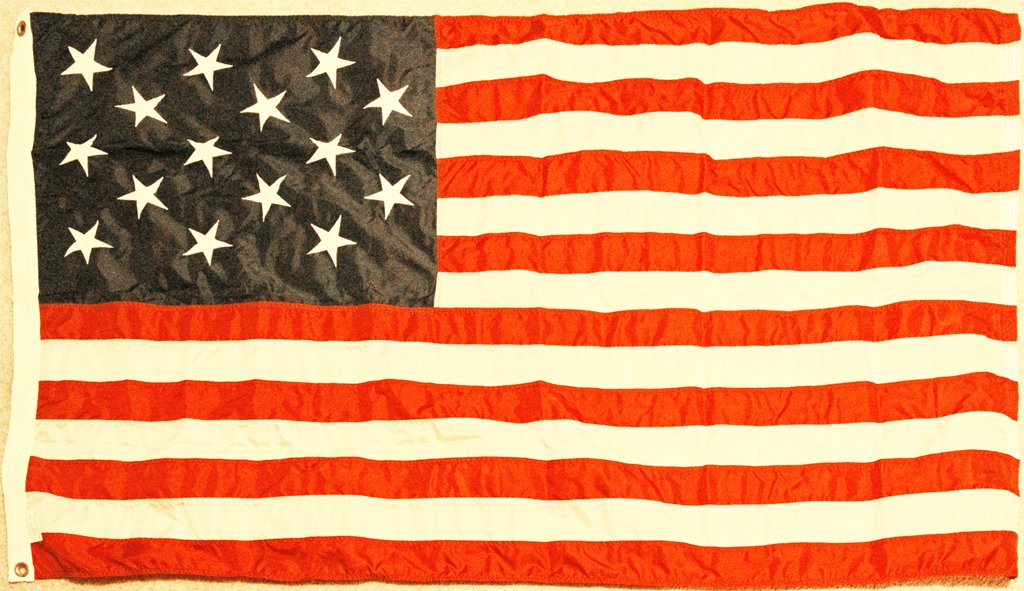
I have a 15 star/15 stripe flag (replica) that I was presented as part of a War of 1812 celebration at the Buffalo and Erie County Naval and Military Park in Buffalo, NY. A note that came with it said the flag was used May 1, 1795, through July 3, 1818. This would have been on Lake Erie and that area. The flag was 3x5 (actually 60 x 34 inches).
-
Capella, The motor control (fan control) you listed should work, but note that it is for brush type motors only and not brushless motors. But all the drills I have seen have brushes, especially the cheaper drills. Also, it is rated at 15 Amps and that is good enough for any motorized device that has a cord to plug into a wall socket on an ordinary household 3 prong 15 Amp 120 Volt AC circuit.
-
Electric motors are inductive loads - like electromagnets. These do some peculiar things (a non-engineering explanation) to the driving AC current. Light dimmers usually use a solid state switch called triac or silicon controlled rectifier (SCR). Operation of these devices is very dependent upon the characteristics of the AC current - as delivered by the AC power line - and are designed to drive resistive loads like light bulbs that don't mess with the characteristics of the current. If you try to drive a motor with a dimmer the results may be unpredictable and/or the dimmer may go up in a puff of smoke. The motor may overheat, and the dimmer may emit a lot of RF noise that interferes with television, radio and cell phones. There are some fairly inexpensive variable speed AC motor controllers that you can just plug the drill into without cutting the cord. Then you can plug these motor controllers into an off the shelf AC foot switch to interrupt power to the controller to stop the drill. And these things are wired correctly and UL/CSA approved so they won't burn your house down. I have an old (1980s) Dremel motor controller and foot switch I use to control AC motors.
-
Bob brings up an interesting point about "collector items." Some collectors prefer the dirt and grime be intact as an indication of the item's age. They say you ruin the value if you clean an old object. Other people prefer a shiny clean piece. You should just do what you like and not try to follow other people's rules. Personally, as a microbiologist, I find the idea of using saliva to "clean" things disgusting. To me something that has been spit on is just filthy! If you do try using a solvent (water, soap and water, alcohol, etc.) be careful. Those old paints might dissolve in the wash. So try it on an unexposed place first if you can find one.
-
You can find small multi-strand wire in jewelry supplies in hobby stores. I have some Beadalon brand 7 strand at 0.012", (0.30 mm) 0.015" (0.38 mm) and 0.018" (0.46 mm) diameter. I also have some nylon coated Cable Strand Corp. Acculon brand 3 strand at 0.012" (0.30 mm) diameter.
-
The Prince was a pretty ship. I'll be interested in seeing how you do on this. I understand the "ordinary" part. I am slowly completing a model that sat unfinished for at least 30 years.
-
sail plan for Ballahoo (Fish class) topsail schooner
Dr PR replied to georgeband's topic in Masting, rigging and sails
George, Very nice. I am following this with interest. I have worked out a preliminary belaying plan for my topsail schooner build, but I am not happy with the belaying point plan I have for the fore mast. Too many lines are crowded onto fife rails around the base of the fore mast. I have been considering a belaying pin ring or cleats around the mast to take the running ends of some of the tackles. Also I could use cleats on the shrouds for lines that do not have much strain on them when sails are set (clew lines bunt lines).- 22 replies
-
- 2
-
-
- caldercraft
- jotika
- (and 4 more)
-
Carriage Gun Rigging
Dr PR replied to Dr PR's topic in Discussion for a Ship's Deck Furniture, Guns, boats and other Fittings
Thanks to everyone for contributing to this discussion! There is a lot of good information here! -
Valeriy, Thanks. I did notice that you plated some parts with copper before nickle plating, and wondered if that was to get a more uniform nickle plating. But the real solution is to just be careful with the soldering. Using a minimum amount of solder helps, and a good liquid flux (I like citrus based fluxes) helps promote solder flow between pieces. I also have a resistance soldering machine and have experimented some with it. It has the advantage that heat is generated at the contact/solder point, reducing heating of adjacent parts and previous solder joints.
-
Valeriy, Thanks. I have used some rouges for polishing but I was interested in how you do it. Your results are beautiful! I have also puzzled over what to do when a bit of solder flows over visible areas on brass parts. The tin in the solder dissolves into the brass leaving a tin colored stain. Careful positioning of the solder areas to inside or non-visible places helps, but sometimes a visible solder fillet is necessary. Blackening and other coloring agents don't work evenly over these exposed high tin areas. But it seems you solve this problem by nickle plating the parts. The plating covers the brass and solder areas evenly. Looks like I will have to set up plating equipment. I already have power supplies and I was an undergraduate chemistry major so that part will be simple.
Our Emblem ®