

ccoyle
-
Posts
10,604 -
Joined
-
Last visited
Content Type
Profiles
Forums
Gallery
Events
Everything posted by ccoyle
-
 In Action with the Destroyers 1939-1945: The Wartime Memoirs of Commander J A J Dennis DSC RN Edited by Anthony Cumming Barnsley, UK: Pen & Sword Maritime, 2017 16 x 24 cm format, hardback, 208 pages 30 B&W photos, end notes, bibliography, sources. MSRP £19.99 ISBN: 978 1 52671 849 5 Summary: An enjoyable memoir. One could scarcely find a better man than Alec Dennis to write up an overview of life at sea in the Royal Navy during World War II. Dennis‘s memoir In Action with the Destroyers is a refreshingly brisk telling of his time served in destroyers, written in an engaging style and sprinkled with bits of characteristic British humor in the face of adversity. Interwoven with his terse accounts of his ships in action, Dennis gives wonderful insights into the tedium of wartime routines, the hazards of sailing in hazardous weather while under constant threat of danger, and snapshots of time ashore in virtually every far-flung corner of the British Empire. Dennis served in destroyers for the duration of the war, and he experienced a lot of action at sea: Arctic convoys, the evacuations of Greece and Crete, and numerous battles including Cape Matapan, North Cape, the taking of Diego Suarez, and Operation Overlord, just to name a few. He was aboard the G-class destroyer HMS Griffin when war broke out in 1939, and he stayed with her until 1943 – nearly four years. During those four years, Dennis observed first-hand some of the darkest days of the RN, when the service was stretched to its limits against threats from the combined might of the surface and aerial units of Germany and Italy. He was also around, happily, to observe the changing of the tide as Britain improved its tactics, weapons, and ships, gradually wearing down her adversaries. The gradual changeover from continuous defense to unrelenting offense can be seen, for instance, in Dennis’s starkly contrasting descriptions of the harrowing actions around Crete in May 1941 with the anticlimactic response of the Germans to Overlord three years later. In 1943, Dennis transferred to the S-class destroyer HMS Savage. Highlights from this period include the ship’s encounter with DKM Scharnhorst at North Cape, screening the invasion fleet for Overlord, and accepting the surrender of German forces at Kristiansand in Norway, where Dennis had the opportunity to examine some of the newest Type XXI and XXIII U-boats. In June of 1945, Dennis was given command of the Hunt-class destroyer HMS Tetcott. Scheduled to deploy to the Far East, Tetcott was still refitting at Gibraltar when the war ended, bringing Dennis’s naval career to a close as well. As readers, we can be thankful that he both survived the war, when so many did not, and that he subsequently proved to be a gifted writer. His book, coupled with editor Anthony Cumming’s included historical notes, also serves as a good overview of the RN’s actions throughout the conflict. In Action with the Destroyers is highly recommended for anyone with an interest in the history of the RN during WWII. CDC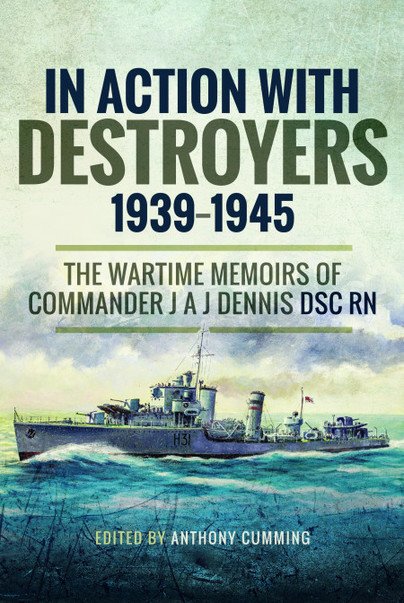
-
- 3
-

-
Same here. There are not a lot of >2-masted schooner kits on the kit market, and I think that BJ offers the majority of them. When Wyoming comes out, it will probably be a super-majority. Now they need to turn their attention to a 3- or 4-masted barkentine (hint hint, Nic).
- 166 replies
-
- 2
-
-
- fannie a gorham
- finished
- (and 1 more)
-
Yes, Roger, there is. I haven't seen it, but I'm sure that it is likewise outstanding.
-
Great story!
-
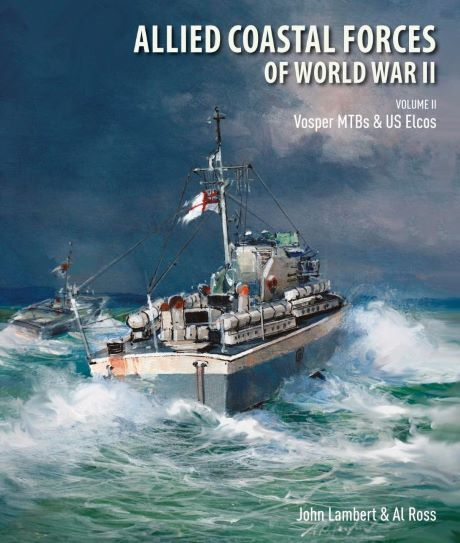
Allied Coastal Forces of World War II, Vol. II: Vosper MTBs and US Elcos By John Lambert and Al Ross Barnsley, UK: Seaforth Publishing, 2019 11.25 x 9.5 inch format, hardback, 256 pages B&W photos, line drawings, bibliography. MSRP £40.00 ISBN: 978 1 5267 4755 6 Summary: Great book! First of all, this book has a really long title, so henceforth we will refer to it as ACF2. Second, the authors of this fine volume should not be strangers to anyone who has been building ship models for any length of time. The late John Lambert was a world-class technical illustrator, and his drawings and plans have been serving as the basis for scratch builds and super-detailing for decades. Al Ross is of course one of the in-house designers for BlueJacket Shipcrafters, and his designs have a well-deserved reputation for historical accuracy. This edition of ACF2 is a reprint of the 1990 original, itself a companion volume to ACF1, which covered Fairmiles and US subchasers. The printing, binding, and dust jacket art are top-notch and what we have come to expect from Seaforth. It is safe to say that if you are a builder of either of the types covered by ACF2, then you will want to have this book as a reference. The keyed drawings are crisp, extremely detailed, and plentiful throughout the book, covering every possible aspect of construction from hull framing to armaments and equipment. The relevant drawings are usually accompanied by photos of the item depicted. Both are interwoven with a rich text that details how the boats were specifically designed with their intended use in mind, including, for example, a discussion of the particular challenges of designing a boat meant to operate at high speeds. Beyond the technical aspects of the boats taken as a whole, additional sections are devoted to camouflage (color line drawings of color schemes are included, labeled with Admiralty and USN official colors), weapons and mounts, machinery, lists of every Vosper and Elco boat built along with its final disposition, and a list of surviving boats. In this 256-page volume, there are literally only 15 pages that don’t have at least one (usually more) drawing, photo, list, or some combination of the three on them. It’s definitely worthy of its coffee-table size footprint and is as interesting to casually flip through as much as it is a veritable trove of information on these sometime overlooked contributors to the allied war effort. If you are a serious modeler or just a fan of naval small craft, you will doubtlessly be pleased to add this work to your collection. CDC
-
Many folks advise against tea staining because of the acidic nature of tea; others will tell you that they have used the technique for years with no obvious ill effect. But you can avoid the question entirely by using fabric dyes, e.g. Rit, or by purchasing fabric of the desired color. One thing to take note of, which you can see in photos of tallships, is that life under the glaring sun at sea tends to bleach sails lighter than some modelers might expect.
-
Matthew, the best option is to find whether any modeling clubs exist in your local area and see if any members are willing to do the job. You can also state your location here to see if any of our members live nearby. Be advised, though, that finishing a model as complex as Victory can take a great deal of time, as much as several years for a hobbyist, depending on what stage of construction your father-in-law left off at.
-
Wow! Can't get much more "hot off the presses" than this!
-
Model #2 - Mamoli Constitution vs. The Field
ccoyle replied to CarolinaCommodore's topic in New member Introductions
I'm not a South Carolina native, being originally from California, so I have no irons in either the SEC or ACC fires. I was rather surprised though by the number of "USC" fans I encountered when I arrived here. Took me a while to figure it out. -
Welcome aboard! I look forward to seeing your work.
-
Thanks for sharing your work! I look forward to seeing further progress.
-
Congratulations!
-
Congratulations -- looks sharp!
-
Model #2 - Mamoli Constitution vs. The Field
ccoyle replied to CarolinaCommodore's topic in New member Introductions
Welcome aboard! Are you an NC commodore or an SC one? -
I think that some of the newer kits coming from lesser-known European manufacturers are setting the bar pretty high, e.g. MarisStella, Vanguard Models, and Master Korabel. Of course, as has been pointed out, any kit involves some element of compromise -- the makers do have to make at least some profit. Still, there are any number of kits that will build into decent replicas, going even as far back as Chris Watton's early Caldercraft designs, although I'm sure that even he would admit that his current methods yield superior results compared to those early kits. It's worth a mention that even though Model Shipways kits are well-regarded, they don't have a stable of in-house designers, and apart from the relatively small number of MS kits that are rebranded Syren designs, most of the MS lineup is getting somewhat long in the tooth when compared to the newest stuff coming into the market. They still make very nice models, but they're no longer cutting edge designs.
-
Welcome aboard, Taylor! I agree that Atlantic is a great model subject and look forward to watching your progress. I wouldn't mind seeing a few images of your catspaw dinghy, too.
-
Welcome aboard, Mark!
-
Oops! I missed that detail in her description. Either way, she will require a large display area!
-
Excellent! I was hoping that we'd have a chance to see her on the water. She really was making quite the headway in a breeze that barely rippled the water!
-
E6000 is a family of industrial strength craft glues based on a tetrachloroethene solvent, i.e. not water-based. We usually have a tube of it somewhere around the house. Should be available at your local hardware or crafting store.
-
Welcome, Mike! I hope you will enjoy your time here. Cheers!
-
Catching up on your log, G.L. What an outstanding model! It is a testament to the fact that the model builder's art can be as much in evidence in a "small"craft as in any 1st-rate man-of-war. Cheers!
-
At 1/96, Wyoming's hull alone would be 56" long. 😮
-
Moin, moin! Welcome to our group!
-
Wyoming was a 6-masted schooner. https://en.wikipedia.org/wiki/Wyoming_(schooner) That will certainly make an impressive model!
Our Emblem ®