
HOLIDAY DONATION DRIVE - SUPPORT MSW - DO YOUR PART TO KEEP THIS GREAT FORUM GOING! (Only 36 donations so far out of 49,000 members - C'mon guys!)
×

BANYAN
-
Posts
5,938 -
Joined
-
Last visited
Content Type
Profiles
Forums
Gallery
Events
Everything posted by BANYAN
-
 Hi folks, anything pleeeeaaassse... What I think I really need is a diagram or description of the keel, limber, floor, futtocks and framing pattern of a contemporary vessel (such as one of the Cruiser class (1850 ish), Arrow Class (1854) etc - anything will be a great start for me. Begging complete cheers Pat
 -
That is a great idea Pete; very useful in several application. Thanks for sharing. cheers Pat
- 1,051 replies
-
- 4
-

-
- cheerful
- Syren Ship Model Company
- (and 1 more)
-
Coming along very nicely Vossie. All this attention to the bones of the model will pay dividends in the long run. WRT entry spaces etc, I have toyed with the idea of painting them a very pale grey/blue so that they reflect light a little better? cheers Pat
- 714 replies
-
- 2
-
-
- lady nelson
- victory models
- (and 1 more)
-
Thanks Druxey, That diagram is from the construction of a Tea Clipper and not built on the Lang Plan principle (ironwork); it was was shown only to illustrate the planking (I will edit the text accordingly). I am basing most of my assumptions on White's discussion paper where by he describes the use of temporary vertical timbers which would have been removed later? Thanks for the imput and I very much appreciate that you are looking at this discussion. cheers Pat
-
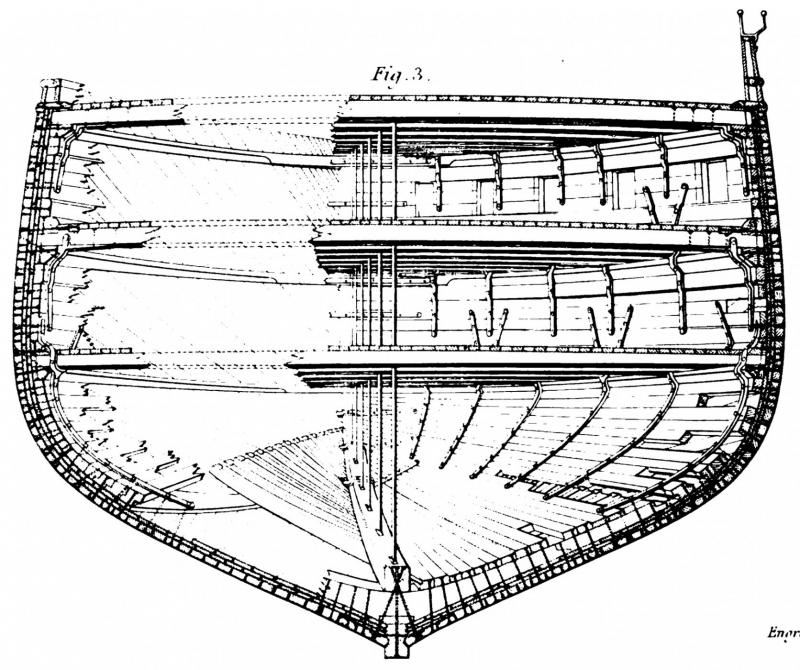
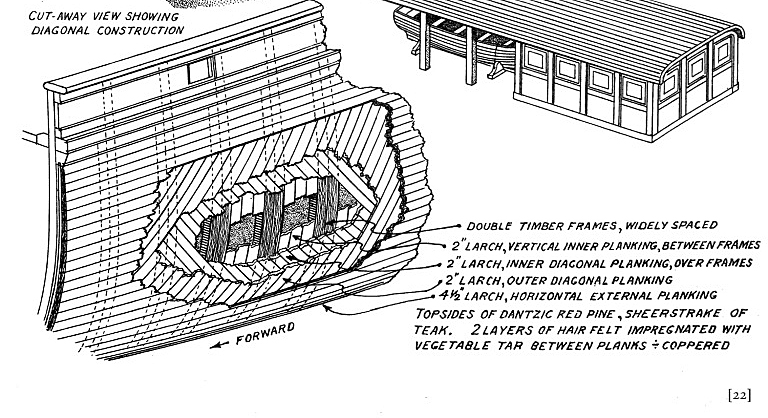
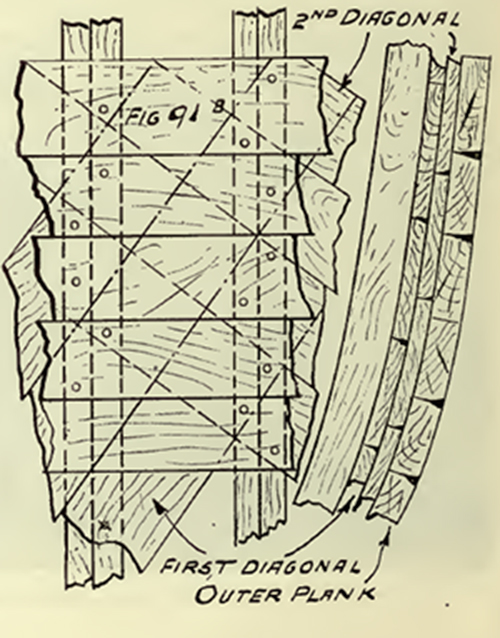
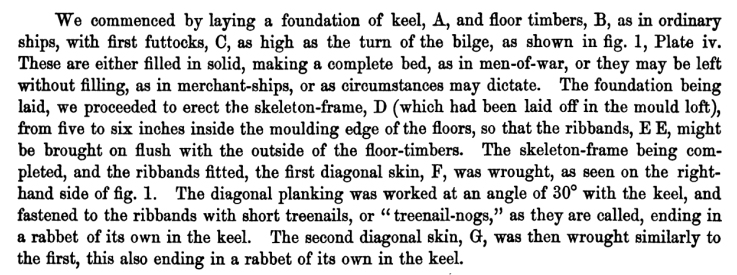
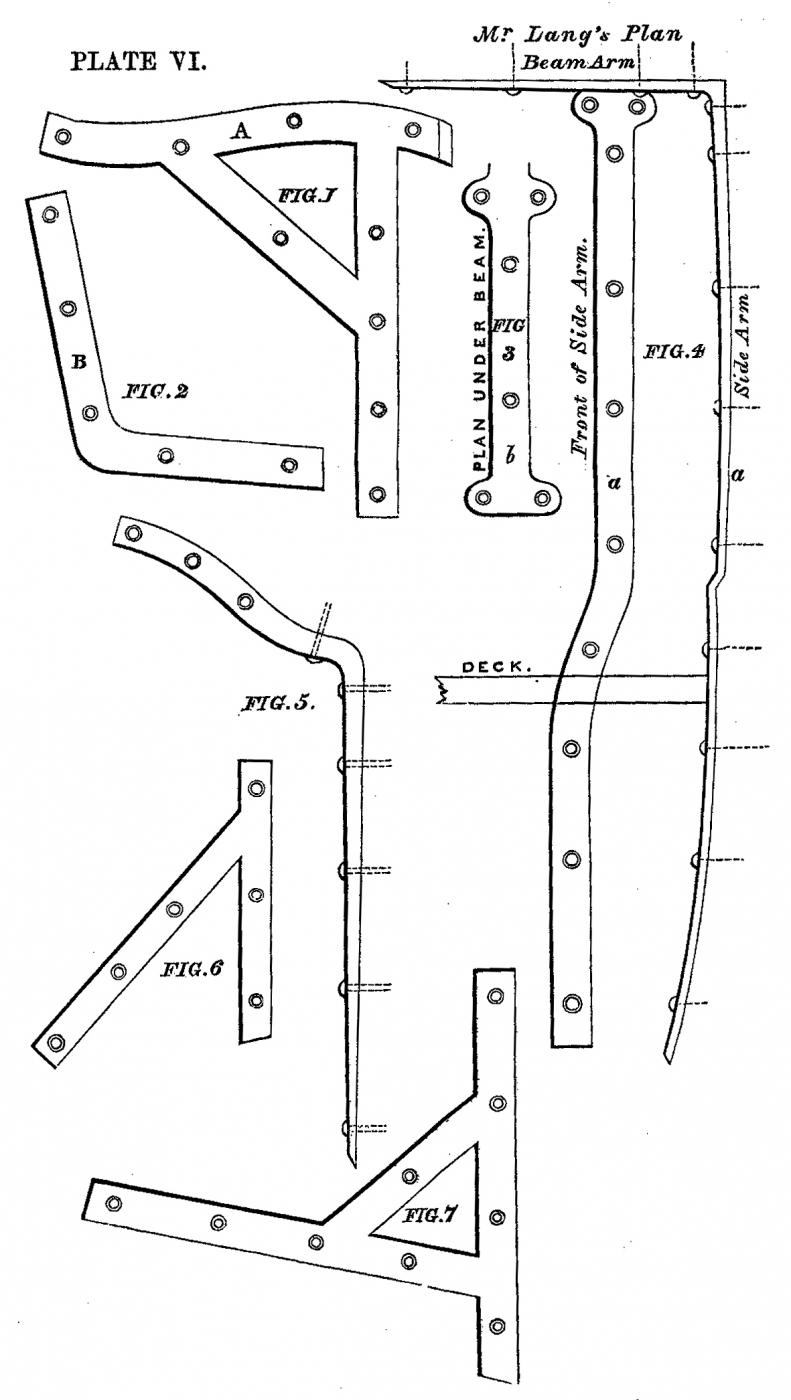
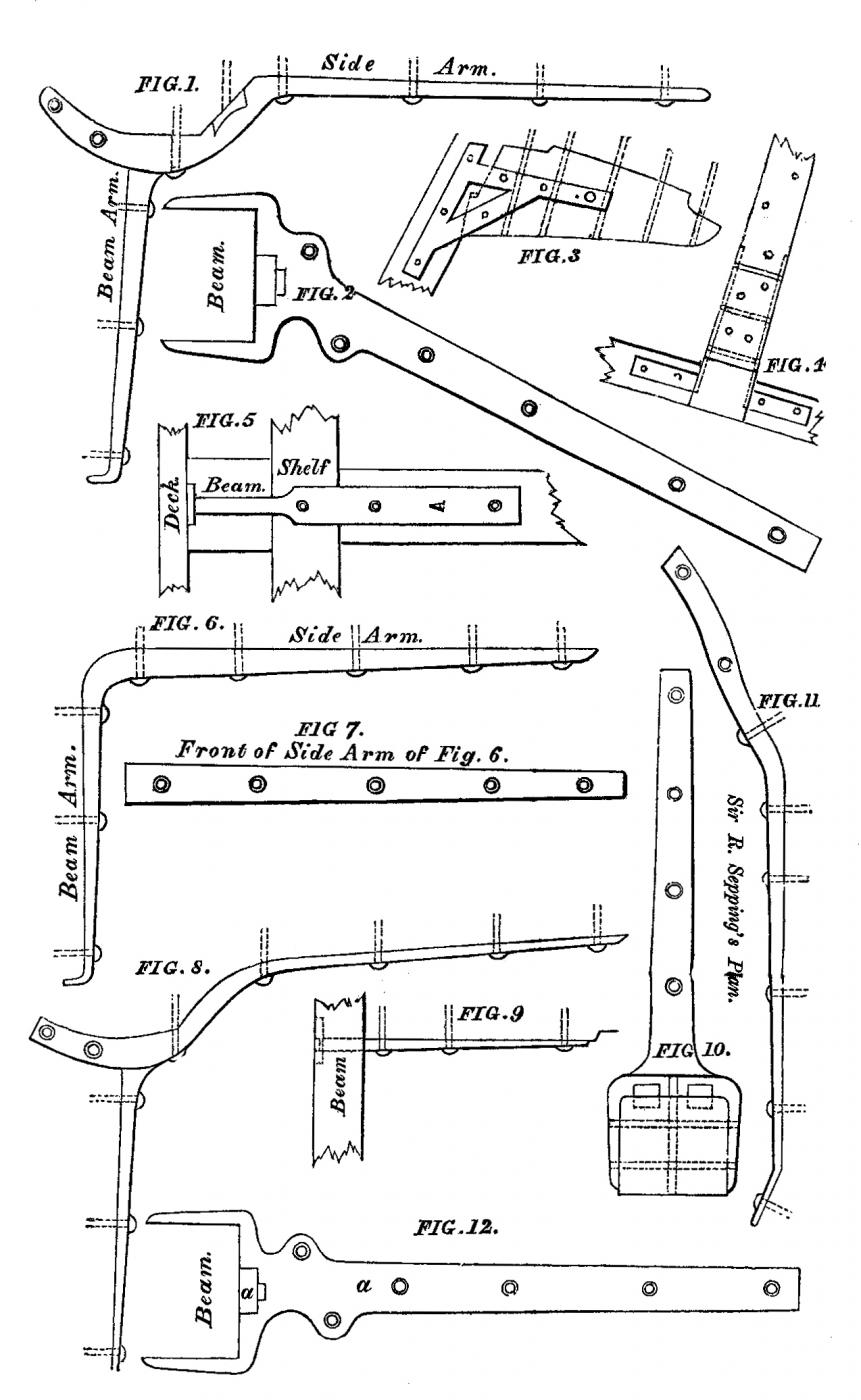
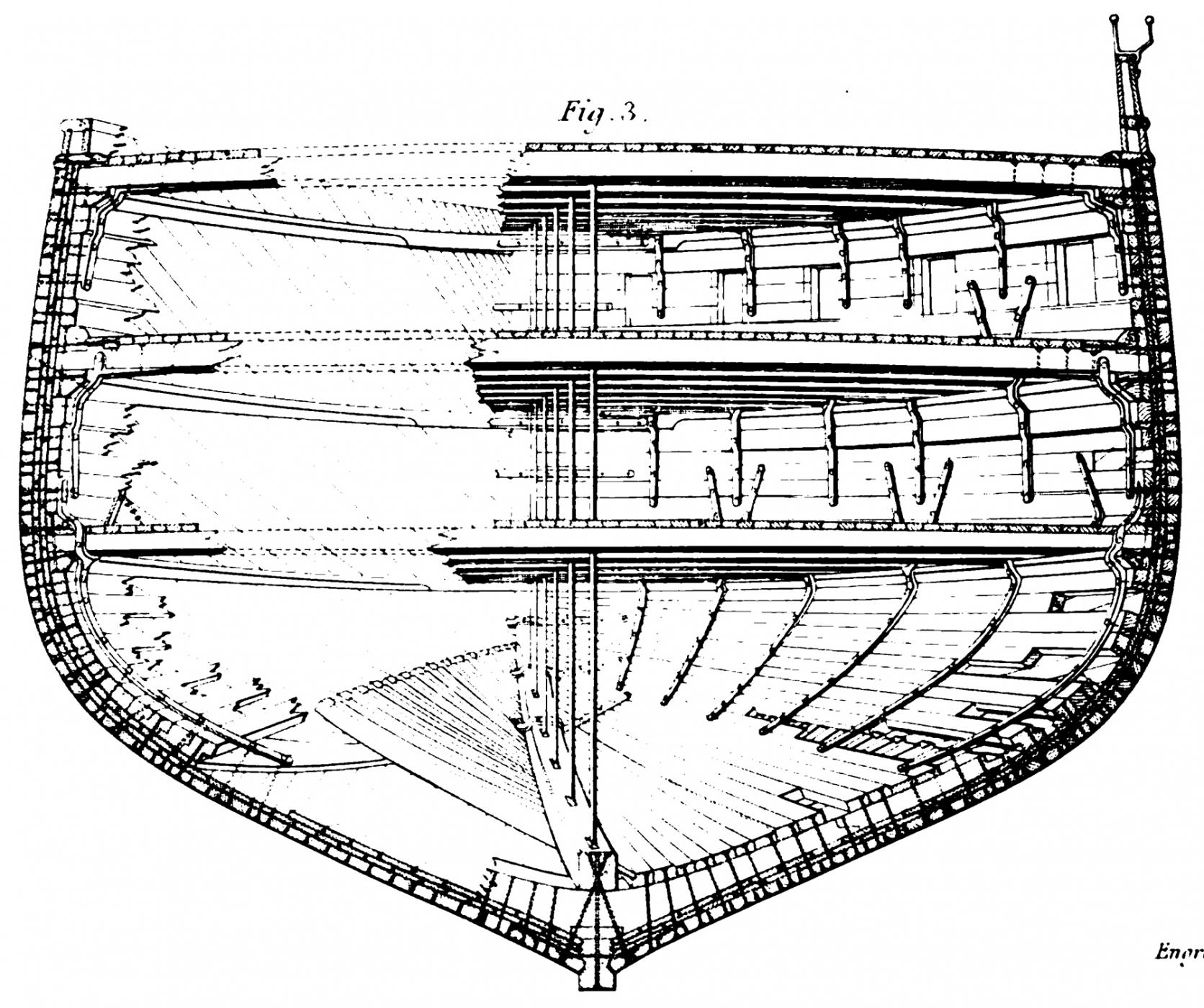
Hi folks. Some help please (see end of post). My investigations and research on the HMCSS Victoria (1855) continue. While designed along the lines of a Gun Despatch Vessel (see Cruiser, Arrow and Vigilant Classes), Oliver Lang used some leading-edge construction techniques when designing her. As such she differed substantially in construction to RN warships of the era (although she looked similar externally). Lang designed her to be constructed using the diagonal planking technique; as espoused by a fellow member of the Institute of the newly formed Naval Architects, Mr John White. White presented a paper (2 March 1860) on this subject in the first edition of the Journal "Transactions of the Institution of Naval Architects" titled "on an Improved Method of Building Diagonal Ships". The publication is available online (Google Books) and the article is on page 112 of the document (page 137 of the pdf). [Edit: Different to the designs shown below, White suggest a 30 degree angle superior in strength to that of 45 degree diagonal planking. As White and Lang were contemporaries and both members of the Naval Architects Institute, I am assuming this would have swayed the construction to White's method. Further support for my assumption is that the ship builder (Young), and the designer of the feathering screw (Maudsley) were also contemporaries and members, all of whom would have influenced his design (noting that one of the provisions for Lang designing the ship [free of charge] was that he was given "free reign" with no limitations/restrictions other than to meet the broad requirements.] I am sure she had diagonal planking as it was specified in the Contract (Scantlings) as shown below: This technique involved stopping the frames at the 'turn of the bilge' then using the strength of the diagonal planking supported with iron plates for lateral and vertical strength, with additional iron work to support beams etc. This is shown in a plate that accompanied the paper: As Lang designed the ship, I am also assuming he would have used his own iron work designs as shown In James Peake "Rudiments of Naval Architecture" : An example of what the diagonal planking looked like can be seen in Charles desmond "Wooden Ship Building (1919) - Fig 91 (page 102) and in George Campbell's "China tea Clippers" in his illustrations (Fig 22) of the Clipper "Vision" of Liverpool (page 67)- please note, these illustrations are included only to show the planking technique (as pointed out by Druxey, the China Tea Clippers, well the VISION at least,, had vertical timbers. I am assuming that Victoria used Lang's Plan of iron supports as espoused by White) Questions: I am trying to get a feel of what the actual framing and construction would have looked like? Would the base framing (to the turn of the bilge) have been exactly the same as for a contemporary fully framed ship (say HMS Harrier or HMS Arrow) - see discussion in the presented paper (extract follows) and I am assuming Victoria would have used the warship option for the floor timbers etc. I know Lang would have used his own keel design (Lang's Safety Keel); but as a novice in this area, I am trying to determine the framing/timber layout/spacing etc used . As there was no rise I am also assuming there was no need for chocks in the futtocks etc. Can anyone point me to a good drawing or reference , or provide some clarifications on this please? cheers Pat
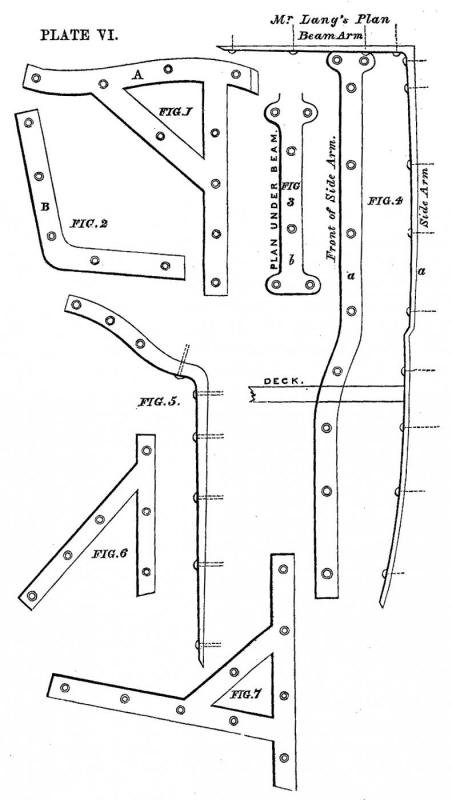
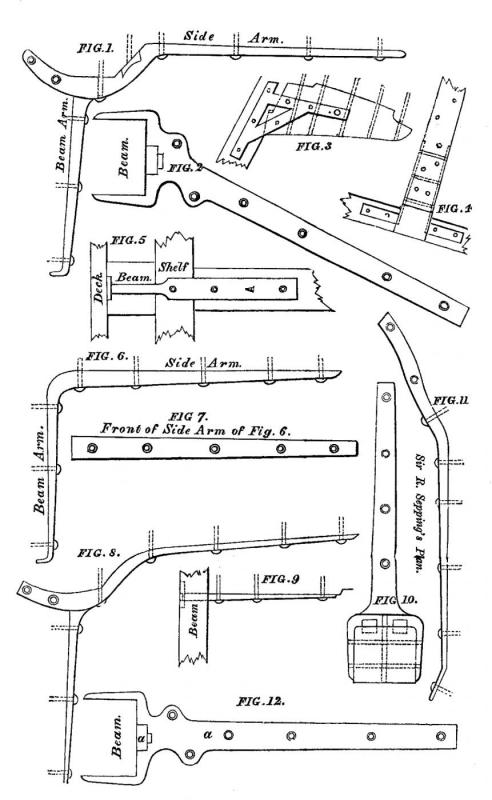

-
I'm following along Joss and enjoying your discussion. I am currently doing a simple 2D plan and side elevation drawing of the Victoria, but one day hope to draw up full plans - so I am following along to see what you do cheers Pat
-
Hi Kiran and welcome to MSW. This is a great place to learn and you will find people willing to help you when needed. What sort of models do you make/interested in; static or RC, period or steel navy etc? cheers Pat
-
That's unusual REXY, mine was the AL kit (as a starting point) and it had the walnut wheels; i don't recall there being any brass ones. Could be a later version of the kit? cheers Pat
-
ancre Chebece 1750 by Jeronimo - FINISHED
BANYAN replied to Jeronimo's topic in - Build logs for subjects built 1501 - 1750
I look forward to this build Karl, your last was inspiring and this looks as it will be another! cheers Pat -
Hi Carl, There are a few discussions about the use of Talc and baking soda/powder with thin, and with "old' CA as a filler and/or strengthener, but also as a backing in crevices to support small pieces etc. See http://cs.finescale.com/fsm/tools_techniques_and_reference_materials/f/13/t/90424.aspx or http://www.tested.com/art/makers/573280-shop-tips-mixing-superglue-and-baby-powder/ or http://www.whatifmodellers.com/index.php?topic=33125.0 Note in the latter discussion it states that once sprinkling the powder over the CA, let it set but to sand it sooner rather than later as it sets very very hard. This is an example of the commercial product (no associations nor have I used it yet - just aware of it). i do not know if it works better or not than baking soda https://www.deluxematerials.co.uk/en/rc-modelling/30-roket-powder-5060243900159.html cheers Pat
-
Hi rexy, great to see you making some progress with the planking. Could I recommend though that you do not leave the metal pins in as these will cause hard spots when sanding to fair the first planking. You will find that the sandpaper will take away the softer wood leaving the metal with a small surround of wood forming a bump if you have to sand that area. I found it best to use the pins as temp fasteners and not drive them home so that i could remove them once the glue has set. cheers Pat
-
Greg, Carl would 'powder' and thin CA along the joint for reinforcing also work? I know Rocket make this stuff but I have heard that using talc would also work? The card modellers use this technique a lot I believe? cheers Pat
-
Nice work; if that is what you do when crook, I really look forward to the quality of your work when you are feeling well cheers Pat
- 714 replies
-
- 5
-
-
- lady nelson
- victory models
- (and 1 more)
-
HMB Endeavour by mikec - Eaglemoss
BANYAN replied to mikec's topic in - Kit build logs for subjects built from 1751 - 1800
Nice to have you back in the dockyard Mike; must have been a great holiday? cheers Pat -
Great to see you back Steve; the gaff looks good. cheers Pat
-
Nice work Sjors; slowly but surely will get you there cheers Pat
- 1,616 replies
-
- 5
-
-
- caldercraft
- agamemnon
- (and 1 more)
-
Coming along very nicely Gaetan, and thanks for sharing your techniques. cheers Pat
- 728 replies
-
- 3
-
-
- le fleuron
- 64 gun
- (and 1 more)
-
Glad to hear your Admiral is much better and you are now both enjoying life. A good update too Mark; she really looks good without those extensions. So what is the verdict; to hahn or not to Hahn again? cheers Pat
-
Thanks Wayne and team; another fine addition to the growing archive of useful materials and research documentation. A great effort by all. cheers Pat
- 19 replies
-
- 4
-
-
- Early Navy
- frigates
- (and 2 more)
-
THE 74-GUN SHIP by Jeronimo
BANYAN replied to Jeronimo's topic in - Build logs for subjects built 1751 - 1800
Very nice Karl, another fine example of craftsmanship. cheers Pat -
I think you can say you have sated her needs of some TLC Denis, she is looking amazing with all that detail in place. With the extras you have planned she will look very much the part of a hard working trawler. cheers Pat
-
Sorry mate, I was not too clear - I don't think you/user can change it. There is a setting the Admin makes which limits the overall size and number of images per post, for the whole site; there is discussion in one of the stickies on this. This is governed by a limit of 2MB per image and there are certain file types not supported. That is why I always reduce the resolution ad limit the pixel size to around the 2040 on the longest side; the initial rules were 1600 x xxxx but I have had 2040 go through as long as under the 2MB limit. There is also this how to. As to interlacing, if you use the More reply options, once you have uploaded your images, there is an option to the right (may be governed by which theme you are using) which allows you to add the image to your post (rather than leave it as an attachment). you can use this to place the image anywhere and interlace it with the text should you wish to. Hope that helps? cheers pat
- 714 replies
-
- 4
-
-
- lady nelson
- victory models
- (and 1 more)
-
Come on Denis; I can here the poor ol Syborn shouting our for some tender lovin even from here cheers Pat
-
Hi Vossie, just found your log. You have made a great start here and I look forward to seeing the model develop. WRT photos, there is a setting I think WRT how thumbnails are handled. i simply take my photos and resize to 72dpi and about 2040 x ???? depending on orientation and any cropping. When I add to the post, the site software simply creates the thumbnail and wwhen I click on them they are then open to full size. I am not sure if you are adding the attachment to the post (in the 'more reply options) after downloading the photo? WRT colour, not sure but I have a series of (poor quality) photos of a model of the ship which is at Mount Gambier here in Australia which shows a brown with black livery - not sure if this was the actual scheme? i can send you copies if you think they would help just PM me. The model is not the best I have seen cheers Pat
- 714 replies
-
- 4
-
-
- lady nelson
- victory models
- (and 1 more)
Our Emblem ®
