


Cathead
-
Posts
3,529 -
Joined
-
Last visited
Content Type
Profiles
Forums
Gallery
Events
Everything posted by Cathead
-
Welcome! I'm also a model railroader who diverted into shipbuilding. You might enjoy this photo of my steamboat Bertrand at a mid-1800s railhead of the Hannibal & St. Joseph Railroad, on the Missouri River in northwest Missouri. If you're going to built Chaperon, I strongly recommend this additional guide written by Kurt Van Dahm, a director of the Nautical Research Guild and resident steamboat expert. It's got a ton of good details and suggestions that complement the kit instructions. The price is well worth it compared to the cost of the kit and the time you'll spend on it (especially the time you'll save avoiding mistakes!). There are also some very good build logs for the kit here on MSW that would be well worth reading through for insights and inspiration. I weather my steamboat models to the same extent I do railroad models: to look reasonably well-used but not decrepit. Many ship modelers don't weather because there's something particularly attractive about a pristine stand-alone model, but I think riverboats just don't look right if too crisp. Certainly if it's going on a model railroad layout, weathering makes sense. I primarily use pastels for light shadings of dirt, grime, rust, and so on. For example, here's my lightly weathered Arabia (another Missouri River steamer); not grimy, but not shiny either: I'd certainly encourage you to start a build log for your Chaperon here, as it'll be the best way to get advice and support as you dive in. It's a great choice of kit, really the only accurate riverboat kit available, and turns into a beautiful model. Good luck and I'll be there in your build log if you start it.
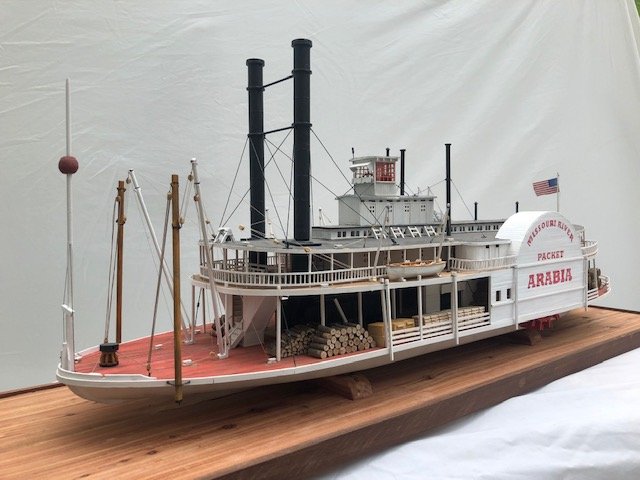
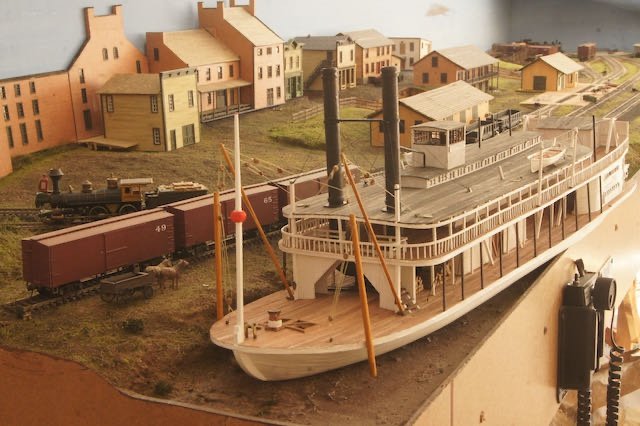
- 20 replies
-
- 10
-

-
 I honestly don't know what to say re. the boiler deck. You have good arguments supporting either arrangement. The model looks lovely so far.
 -
This is a devastating story and loss, and I'm so appreciative that you were willing to share it. You certainly have the right to take a break from the model. My last project, a Viking ship, was in part dedicated to my father-in-law, an Old English scholar to whom I was very close. He, too, died (this past winter) before I could finish it, and never really got to appreciate even the build properly as his health and mind failed too rapidly once the project had begun. But I'm so glad I did finish it eventually, and now I think of him whenever I see it displayed in my home. It helps him be a part of my everyday life to see that ship there. So I hope you'll at least consider the suggestion of coming back to the model when you're ready, whenever that may be. In the meantime, I feel your loss as deeply as a stranger can, and hope you'll take care of yourself as you mourn. All I can ask is that you set the model aside, rather than enabling any possible urge to dispose of it. That way, it's there if you decide to return later.
- 89 replies
-
- 3
-
-

-
- Enterprise
- first build
- (and 2 more)
-
Good start! That's a neat way to simulate the original carved stem, I was scratching my head about how one would do that on my recent Viking build.
-
Great improvement! More accurate, saves space, and looks better all around.
- 89 replies
-
- 1
-
-
- Enterprise
- first build
- (and 2 more)
-
That's a good method for simulating the real effect at a small scale. One note, especially if you're going to redo this anyway: model blocks should be oriented so that the hole is on the opposite end of the loop made by the string as it goes through the hole. In other words, you'll want to flip the blocks shown in your photo end-to-end. This is because, on real blocks, the line is going around a pulley in the center of the block, so it needs to pass over most of the block before going through the "hole". In even other words, the line should pass over most of the block before looping through the hole, not looping through the hole at the very tip of the block. Look really closely at the drawing you posted above and compare where the line passes through the real block compared to where it passes through on the model block you show above. This is always hard to explain in text, let me know if it makes sense. It's a really common thing to overlook and nothing to be ashamed of. As for manufacturers, certainly BlueJacket and Model Shipways tend to have clearer instructions. I've seen Vanguard and Caldercraft mentioned as well, though have never built a kit from them. There are lots of threads on kit/manufacturer reviews elsewhere on MSW that you can dive into. It's complex enough that any one person's opinion only counts for so much. Some manufacturers provide the instructions as a free digital file, which is especially good for evaluating a kit ahead of time.
-
This is an especially common problem with kits produced by manufacturers for whom English is not a native language. Few bother to have their instructions checked for language or clarity. Even native-language instructions can have errors, but it's particularly prominent in "foreign" kits, although in fairness this varies quite a bit by manufacturer.
- 89 replies
-
- 1
-
-
- Enterprise
- first build
- (and 2 more)
-
The instructions are wrong: the cathead is, indeed, the wooden piece you've already installed. The other piece is meant to hold rigging; see this photo from another build log for this kit:
- 89 replies
-
- 2
-
-
-
- Enterprise
- first build
- (and 2 more)
-
Lots of good advice here. Another option is to consider a display cabinet instead of a case. One of these can store and display multiple models far more space-efficiently than several cases, which all need their own surface space, and they're more flexible if models come and go. One approach to the style generally called "curio cabinet" tends to have wide glass panes in front that are great for model display. Here's an example from a customer furniture maker here in Missouri (Ramer Brothers): While these aren't cheap, especially if you get a high-quality hardwood version, the equivalent of 3+ cases isn't cheap either. And while cases have few other uses beyond specific model displays, a curio cabinet can be resold or handed down through family for many different uses, making it a potentially better long-term investment. My wife and I recently agreed to invest in one of these for my growing model collection, rather than build a whole series of cases, because it'll be way more space- and resource-efficient while being a better long-term investment. Just a thought to consider.
-
Is there a chance it'd work better to draw the eye on with something like colored pencil or fine pen? That inherently gives the painted-on look without any decal film, and also lets you work naturally with the planking and its seams, just like on a full-size vessel. Might be worth testing with some scrap wood. For example, on my recent Viking ship project, I found that colored pencils created a really nice coloration effect on the shields, far better than paint.
- 62 replies
-
- 1
-
-
- amati
- greek bireme
- (and 1 more)
-
I, too, use the poor man's lathe as Keith describes and it's great. One additional note, the drill's chuck can easily leave marks or other damage to the dowel, so it's important to leave extra length on whatever you're doing. So if you need a rounded mast 8" long, make sure you cut the piece, say, 8.5" long so that extra half goes in the drill and you can cut it off when you're done. Otherwise one end will be damaged and you'll be upset! (trust me)
- 160 replies
-
- 4
-
-
- Model Shipways
- norwegian sailing pram
- (and 1 more)
-
Though I have to say I'm glad there aren't hundreds of nuclear submarines sunk along US river systems...
-
Fantastic! It’s been a pleasure following along. I think you’ll quite enjoy where this hobby takes you as you keep delving deeper.
- 160 replies
-
- 3
-
-
-
- Model Shipways
- norwegian sailing pram
- (and 1 more)
-
Welcome! You're off to a good start and I hope you'll keep sharing your progress.
-
Looks beautiful. I think it's safe to say the Greeks knew about caulking, there's evidence of Bronze-age caulking even in the backwaters of Britain (using things like moss and wool if I remember correctly). Maybe not the Age of Sail kind, but there're lots of ways to do it, and you pretty much can't build a planked craft without it.
- 62 replies
-
- 3
-
-
- amati
- greek bireme
- (and 1 more)
-
Wish I had advice on the rigging. I've used clamps to help maintain tension, as it looks like you did, too.
-
Since you mentioned it, the word you're seeking for "steering handle" is "tiller". Also, the mechanism for raising and lowering the anchor would be a "windlass". Nice work, the model's very attractive so far.
-
I've been working on laying out planking belts and could use some advice. The instructions call for dividing the hull into three belts between the wale and the garboard strake, and here's my first attempt. Note that the strips make the central belt look narrower than it really is because I'm measuring from their lower edge (so the middle belt includes the strip's width). I've measured them and they're all three equal amidships. Stern: Bow: I've never done this before and am having difficulty envisioning what's correct, especially at the bow. My sense is that the run of the planking should look pretty horizontal when viewed from the side, no curving up or down as the hull changes shape. I'm having trouble comparing this with the images shown in the instructions and log. I'd be grateful for any advice from @tlevine or any other experienced folk. Thanks!
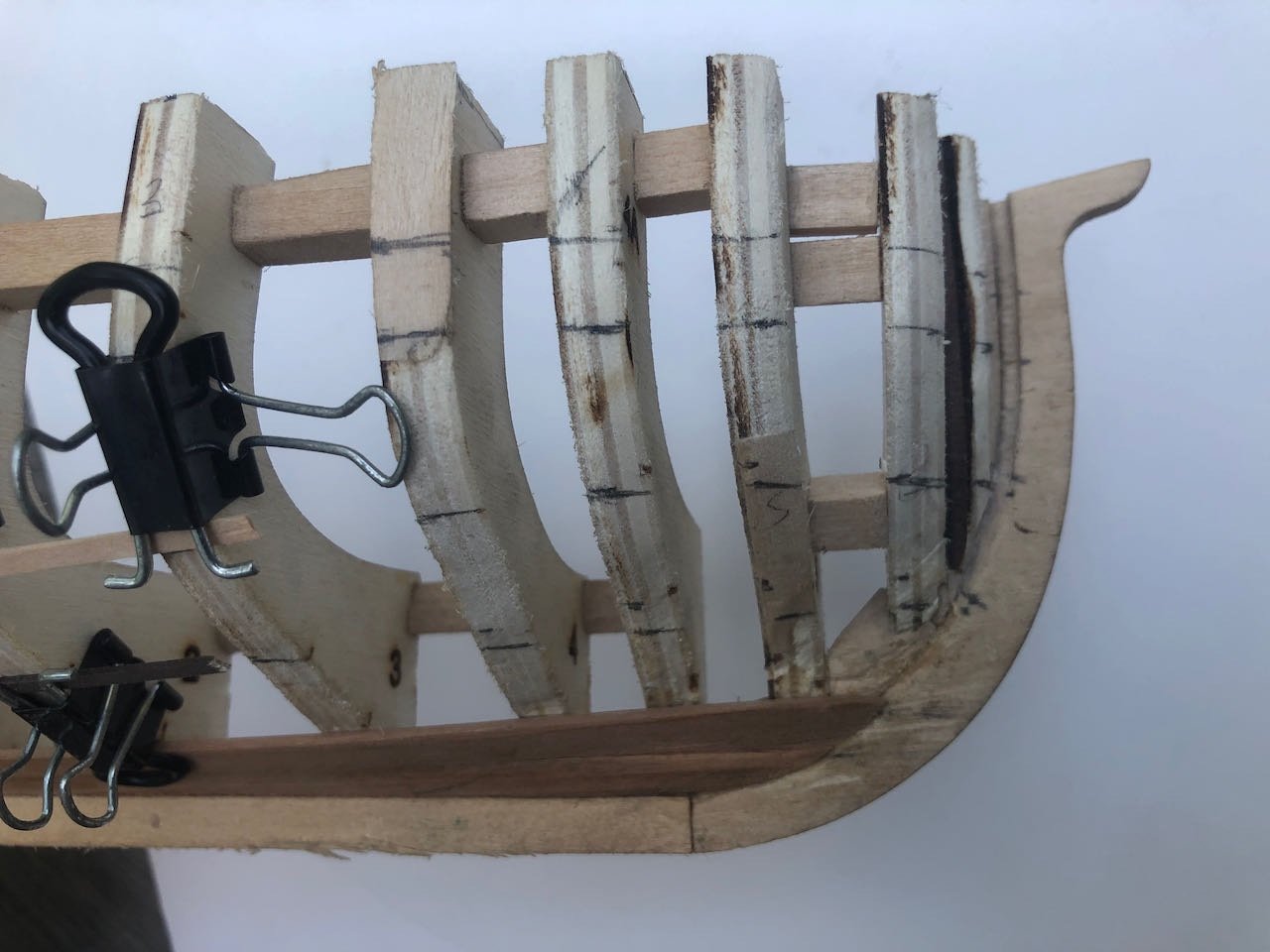
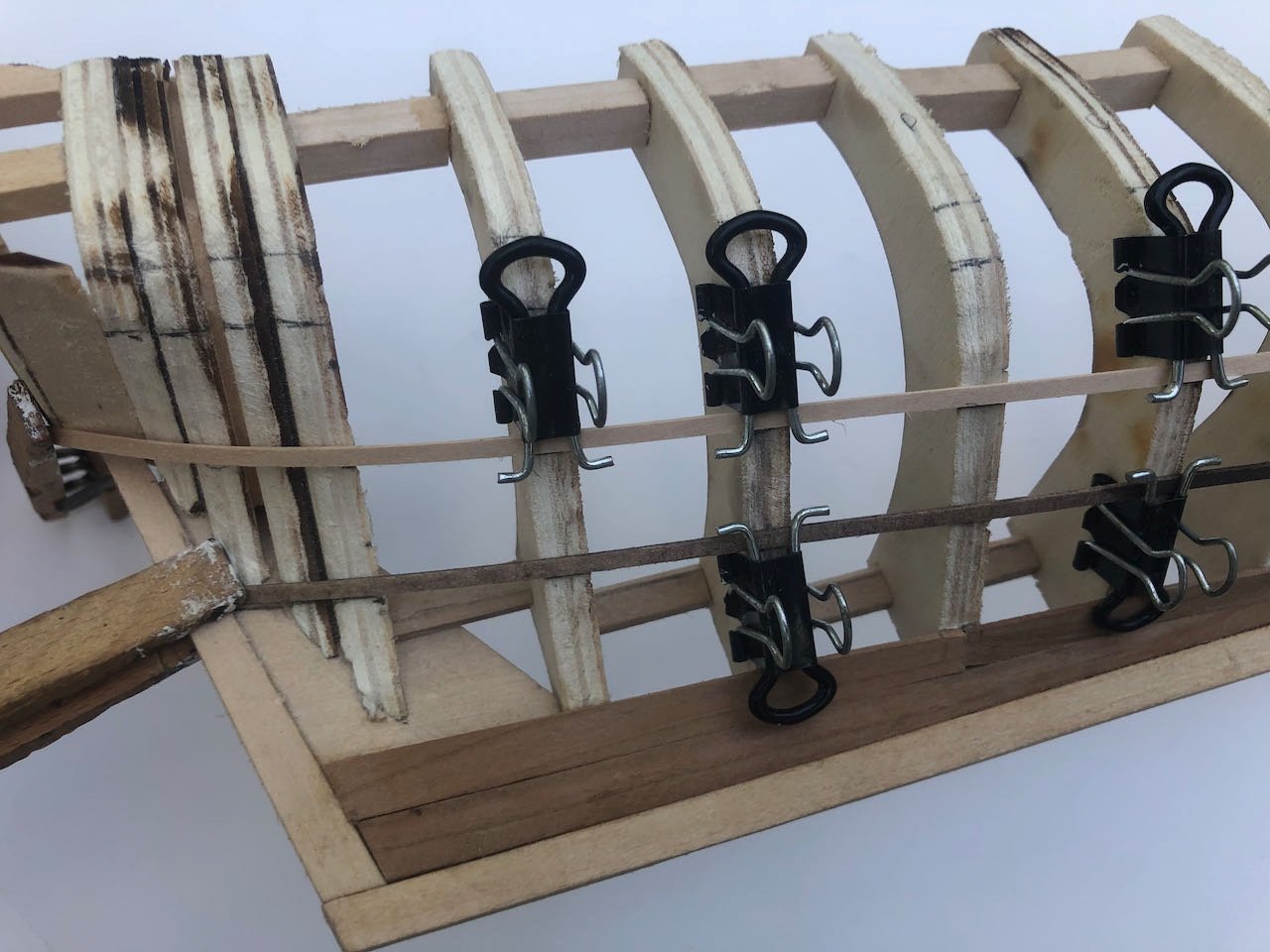
-
The irony is there's both in our medicine cabinet, since my wife makes very effective vodka-based herbal tinctures for sleep. Chamomile and ashwagandha are very effective, only a small dropper's worth needed.
-
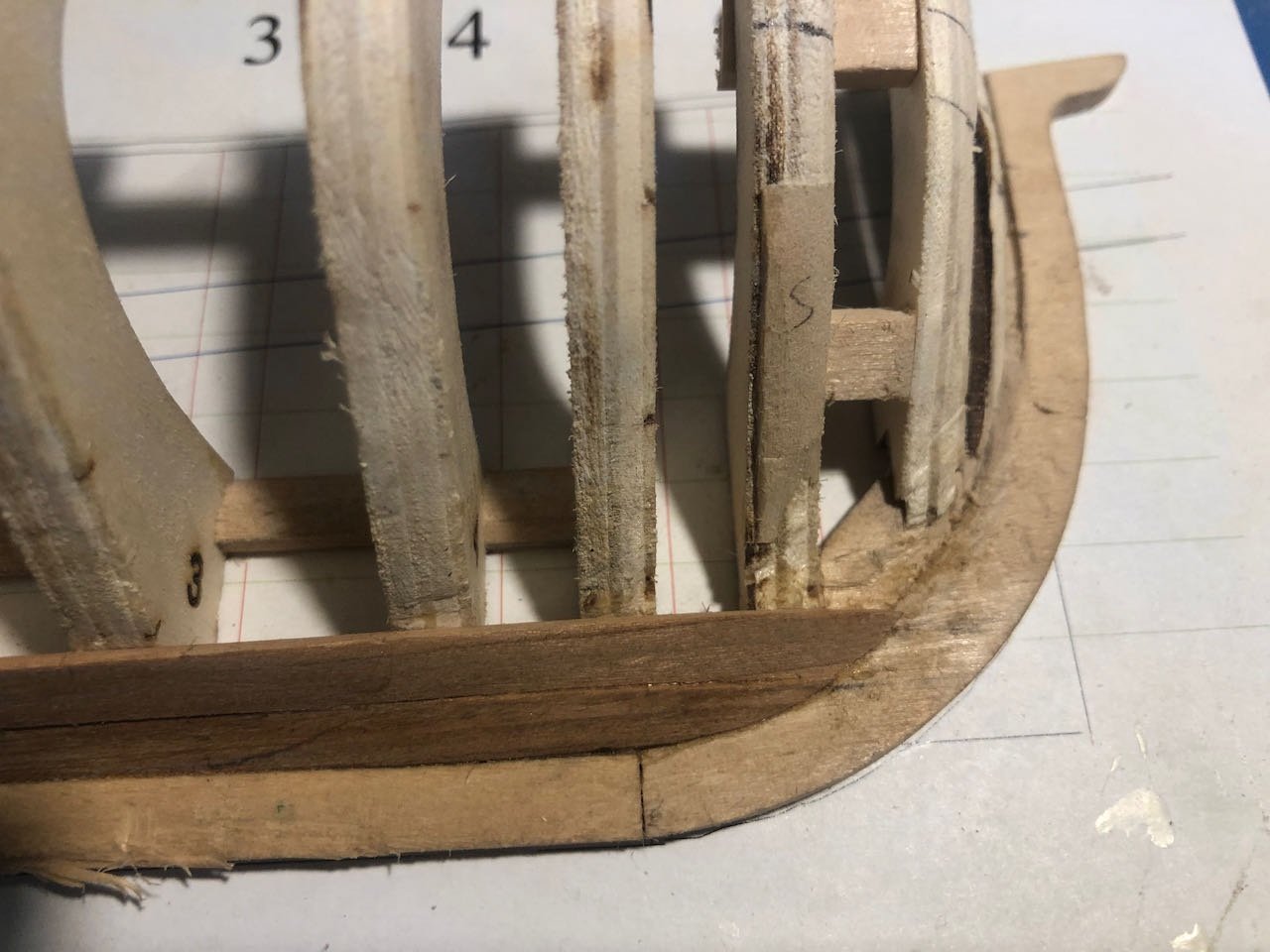
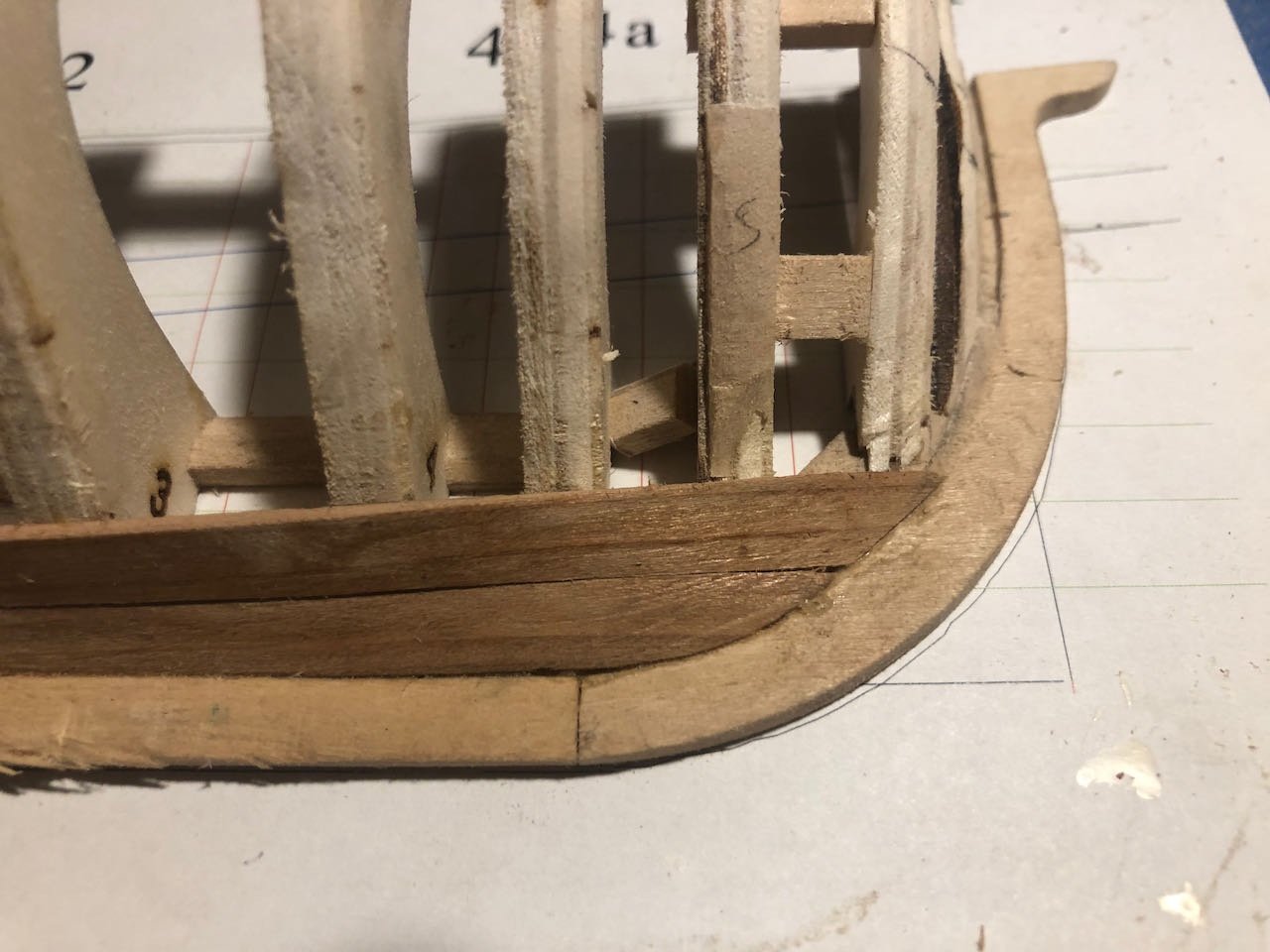
During the week, I had finished installing the broad strake (the next one up from the lower-most garboard). But a little demon in the back of my mind kept telling me it wasn't right. At the bow, both planks ended up curving upward and creating the "smiley-face" effect that the instructions specifically warn against. It wasn't really obvious to me until after I saw both strakes in place, but then I couldn't unsee it, and knew I had to fix it. After watching @tlevine's NRG presentation this morning on improving ones' models, which included the specific exhortation to fix things you know are wrong so you don't regret them forever, I did so. Here are the original planks at the bow: Not only can you see a strong upward curve, look at where each plank ends relative to the horizontal lines extending off to the right on the plans. The top of my garboard meets the first line, while the top of my broad strake meets the second one. Now look at how this is supposed to be, from the demonstration build log: Notice how BOTH strakes fit into the space below the first horizontal line, and the flow of the planking is much more horizontal when viewed from the side. I don't know how I let it get so off, but I did. So out came the alcohol (for the glue, though I considered my own emotional needs) and a sharp chisel blade. I removed the forward broad-strake plank and then carefully carved the top of the garboard strake down to a better alignment: I made a mess of the rabbet in the process, especially carving out all the bits of glue-stuck wood in there, but it doesn't matter in the end. I then reshaped a new plank that looks much better. Ironically, this was easier than expected because I had gone through several attempts at shaping this plank in the first place, and one of my discards ended up being just right for the new plank with some more shaping: It's still a bit higher than it's "supposed" to be but I think it's good enough, and I'll pay more attention from now on. It's interesting working with the cherry, which is stiffer to bend but also more forgiving to carve and sand than the super-soft basswood I'm more used to. Next up, laying out the planking belts.
.jpeg.48528e9559e0f369ec73a7ba9bf571e4.jpeg)
-
Your idea is great, but is there any reason they need to be circles? Squares would be much easier to make and seem like they'd grip just as well since the essential point is the surface, not the shape of the edge.
Our Emblem ®
