

BANYAN
-
Posts
5,951 -
Joined
-
Last visited
Content Type
Profiles
Forums
Gallery
Events
Everything posted by BANYAN
-
 Those parrot guns came up a treat Keith; nicely done. How are you determining the the sweeps for the 'races' (tracks) for these pivoting guns? Do you have a plan? I am still trying to determine these and using pivoting points based on the probable port locations as I have no plans etc. cheers Pat
 -
You are really getting to grips with that laser cutter Eberhard; a very good result with the nameplates and scroll work. cheers Pat
-
Which direction do the tails of shrouds go?
BANYAN replied to Maury S's topic in Masting, rigging and sails
Thanks Justin and Allan, very useful. Maury, I hope you don't mind, bt does anyone know if this was applicable for wire rope shrouds turned on a Thimble also. I believe most wire rope was all RHL? cheers Pat -
OK, I've run out of superlatives Keith Very nice work as usual, and that overall shot of her after deck looks just like the real thing. cheers Pat
-
Fiddly it may be, but it doesn't seem to have slowed you down much - Looking good and nicely detailed. cheers Pat
-
WW2 ship drawings anyone know what this is?
BANYAN replied to Dean77's topic in Nautical/Naval History
Hi Dean, to my eye, those schematics look like a hydraulic or valve plan - i.e, shows the default configuration of valves (open or closed), where the manual and powered valves are. By hydraulic this could be water, fuel or oil. cheers Pat -
I'm not so sure PE will have looked that much better Eberhard, the effect you achieved in the second collection of photos is pretty close to the real thing - only difference being the square rather than rectangular mesh grating. Looks good to the eye (based on the photo) cheers Pat
-
No probs mate Pat
-
Mark, he may be talking about the trunnion caps? Chuck, some extra detail or explanation would greatly assist others to help you - a picture or the part, or picture of the drawing of the part would clarify for us? If you are talking about the caps, I use an old pair of pliers that have no grip in the jaws (flat). I filed a shallow groove of the corresponding diameter as a piece of hardened brass/steel rod the same diameter as the trunnions, and silver soldered that into the groove. You also need to file a groove over that into which the rod + strip will sit once the jaws are closed - sort of like forging. I put the strip of brass of the required width and thickness into the jaws so that it sits square over the rod, squeeze down and it forms the 'saddle'. I then drill holes on either side for the simulated bolt heads (I use small brass pins), then cut the formed length off the strip, and trim to size on either side - Hey Presto. cheers Pat
-
Another welcome from downunder. Friendly mob here so don't hesitate to ask any questions at all. cheers Pat
-
I don't know whether to praise or abuse your efforts Keith Your workmanship is always exceptional with very high quality finishes - so there is the praise; ..... but, it makes my efforts look so poor I could swear Very nice work as usual, I am continuously impressed with the jigs and process you develop to complete these fine details. cheers Pat
-
While you're at it Stephen, better include a water cooler too - where else will they gather to trade yarns and scuttlebut (roumers)? cheers Pat
-
Carl, I thought that was your normal state of being 👅 Greg, that will look great; will you be training the turrets off to one side also? cheers Pat
-
That cutter is coming along very nicely BW, great to see the update. cheers Pat
-
Thank you again Jaager (Dean), Bruce and Derek, much appreciate the feedback. No matter the country, era etc, this has been very interesting and I am learning a lot from the discussion. Bruce is correct in identifying my particular period of interest being the mid-19th century, and by looking at the details within several of the posts I thinks the basics I have gleaned are that the butt shift and stagger pattern should : 1. be a three or four plank shift 2. the beam spacing (and to a lesser extent the length of the planks) govern the length of the overlap 3. adjacent planks should have at least a two beam (apart) stagger/overlap, which determines the stagger pattern 4. the more appropriate pattern for me (based on the Longridge diagram provided by Derek) would be 5-2-4-1-3 (if reading from plank 1 and downward), or 5-3-1-4-2 if reading from plank 6 working upward) This would ensure the greatest separation of the butts along the same beam but also ensure at least 2 beams length of plank between adjacent plank butts; providing the greatest strength in the planking along any beam. This is of course general in nature, as many plank lengths will have been interrupted by deck openings etc. Thanks again all Pat
-
That's looking great Steven, it will look superb with the deck houses added - and yes got the joke cheers Pat
-
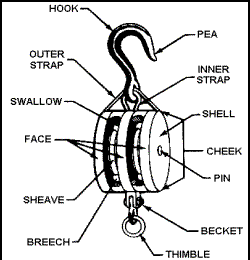
Hi cricket, I am building a 1850's built ship model. The Contract specified iron bound blocks with bronze sheaves. However, in contemporary publications there appears a move towards more iron blocks (all iron) especially snatch blocks and the like, with the advent of steel wire rope rigging. have a look in Harold Underhill's 'Masting and Rigging The Clipper Ship and Ocean Carrier'. The following is an example of the type of wooden iron bound blocks used in the latter half of the 19th centuryy - sorry, cannot remember where I sourced this. cheers Pat
-
Thanks for the great response and continued discussion. I am now more the wiser WRT to the stagger being applicable to the landings on the beams rather than length of plank overlap, and that there was a two beam overlap. I remain confused with the stagger pattern however; and, if I am not missing a basic point, may have differed for the English rules. What I am now trying to understand is whether there was an 'offical' or even 'rule-of-thumb' for the stagger sequence? I posted two stagger sequences ( 5-2-3-4-1 and 1-3-5-2-4) that I have seen in my initial post; can anyone provide better guidance on which was used (or if both). What confuses me most is the second of 5 butts in the sequences - at the moment I am simply assuming that 5 and 1 (in the first sequence) are butts landing on the same beam, which would be a 4 butt shift. However, the second sequence would not hold to this interpretation. The only thing I can put this down to is that perhaps, with time, as the width of the planks dimished as suitable timber became harder to source, that a 5 butt shift was needed to get adequate separation along the same beam? In 'Victoria' The maximum plank width was specified as 7" but measuring the planks visible in the two photographs showing deck planking, the average plank width was 4.75". cheers, and many thanks again for the great discussion. Pat
-
Hi folks, I am trying to determine the correct sequence of the butt shift for deck planking. I have done a search but find several references and cannot find a contemporary (1855) reference that gives the sequence. I am using a four butt shift, so what would be the correct sequence please? I have seen it expressed as 5-2-3-4-1 and 1-3-5-2-4 but what does this actually mean? I think the numbers are applicable to the plank no, rather than the butt number - have I got that right? What I am trying to get to grips with is how this translates into practice - that is, if I start with a central plank, say #1, and then the next plank would be set back (butt shifted) a distance in a particular pattern of stagger. In previous models I know I have got this wrong by just staggering them in a regular sequence rather than the above sequences. By standard or regular stagger I mean that if #1 is the start, and the stagger is 5 feet overlap, the next would be 5 feet back, then the next another 5 feet and the fourth another 5 feet, the the sequence starts again. I have read the former sequence(s) is supposed to provide greater strength/less chance of splitting along a common line, but wouldn't a standard/regular sequence provide the same if they all land on a deck beam? Seeking an education Can anyone please provide the correct terminology for this, and explain (in dummy's language) exactly how the stagger is supposed to be. Also, is it different between Service and Merchant ships? Many thanks Pat
-
White is the way to go then . You should be able to thin the Admiralty white with water if I recall, several thin coats would be preferable so as not to clog up the chain links? cheers Pat
-
What a great model Eric, she turned out a thing of beauty. cheers Pat
- 599 replies
-
- 4
-

-
- sidewheeler
- arabia
- (and 4 more)
-
Keith, great process and another excellent outcome! That whole assembly looks great, and with the 'rope softening' will look very realistic; another idea to store away. cheers Pat
Our Emblem ®
