
HOLIDAY DONATION DRIVE - SUPPORT MSW - DO YOUR PART TO KEEP THIS GREAT FORUM GOING! (Only 36 donations so far out of 49,000 members - C'mon guys!)
×


Snug Harbor Johnny
-
Posts
1,466 -
Joined
-
Last visited
Content Type
Profiles
Forums
Gallery
Events
Everything posted by Snug Harbor Johnny
-
 'Thought about it some, and here's my 'take' on the instructions, which appear to be done by computer translation. Rad admits that he does not know English, so uses a translator. Step 1, Degrease carefully (on both sides) with a 'Q-Tip' (cotton swab) on a PAPER shaft using one of several known liquid degreasers. Don't use the swabs where the cotton ends are on a thin plastic tube, since the tube could be attacked (and/or dissolved) by a solvent. Possible solvents: CRC circuit board cleaner, Automotive 'Gunk' (trade name), acetone, toluene ... one can't get tricholoethylene anymore ... or MEK. Lay the entire sheet on a felt backing and use a light touch. Do with plenty of ventilation, and allow to air dry. Step 2, Paint the outer surface as appropriate with enamel - do not use water base paint. You can use 'micro' brushes. Allow to dry. Step 3, Cut the part with a NEW (sharp) X-Acto blade - or surgical scalpel. The decorative sheet needs to be on something with more substance than an 'ordinary' cutting mat - they make polyethylene mats that have the 'right' firmness, but a piece of vinyl floor tile will do as well. Use a deft touch. Step 4, You can peel the backing off the transfer tape, but then what do you do with the tape in the interim? Rather, just lay the decoration painted side down on a trimmed piece of waxed paper somewhat larger than the piece of decoration. THEN, carefully apply gel CA with a micro brush to the back (unpainted) side of the decoration ... sparingly. If any should get through the decoration to the waxed paper, it won't stick to the wax ... but try to be neat without wasting time in the process. Step 5, Un-peel the transfer taper (if you have not done so already) and lay it on a smooth working surface 'tacky side up' ... that's the side that was protected by what was peeled off. Pick up the piece of waxed paper (slightly 'curling' opposing edges) so the decoration will only slide off the far end. Position the waxed paper where you want over the transfer tape, and let the decoration 'slide' off the waxed paper and onto the transfer tape. It will tend to stick where it lands. The painted side will be against the transfer tape, with the CA gelled side facing up. Step 6, Pick up the transfer tape and move it so the decoration is where it needs to be on the model. In the case of the 'wrap around' stern art, press the center first. If right handed, you will position the artwork centered on the stern (with the right hand) and press the center down with the left thumb - and the left forefinger will reach around to the inside of the bulwark so to help 'pinch' the center point of the decoration in place. Then smooth the right side (as you're looking at it) around with gentler but firm pressure with the right thumb. The sticky side of the transfer tape that overlaps the decoration will stick somewhat to the hull as you go. Once the right side is wrapped around, use the right forefinger to get hold inside the bulwark to help 'pinch' to hold that side of the decoration in place. Then (while holding the right side of the decoration in place), relax the 'pinch' of the left thumb and forefinger so the left thumb can smooth the left side of the decoration around before re-pinching. (This is what is known as using 'finger clamps'.) Then I'd hold on to everything for a while to allow the CA to set. Step 7, When you dare, try letting go and see if the decoration stays in place. IF not, then you let go too soon - and can hold everything down a while longer ... that is, until it stays. 'Don't know how long a good CA cure is, but I'd give it a rest for at least a couple hours. Then the transfer tape can be carefully removed. Don't just pull up on either end, but rather lift one end slowly while tugging out as much as up - and the tape should 'lift off' leaving the decoration in place. For smaller flat (or relatively flat) decorations, they go on much easier that something that has to 'wrap around'. 'Hope this helps someone ... Johnny
- 481 replies
-
- 4
-

-

-
- Cutty Sark
- Revell
- (and 2 more)
-
Rob, I read an account of a builder who had some of the 'as molded' belaying pins on the 1:96 Cutty break off ... 'don't know if age can make them more prone to this - but UV exposure can do it to plastic parts. His advice was to cut them off, then drill holes in the pin rail to accept scale brass belaying pins that are turned long enough to belay lines well. I'm absorbing everything I can from ALL the fine builds of this kit before doing anything on the Thermie (which needs additional work to make it closer to the original than Revell managed). I'm at the beginning off retirement - so am not worried too much at taking plenty of time to mull everything over before starting. 'Course the reaper could come for me at any time (as with those of any age) - but if the object is to satisfy myself with whatever is done, there's no point in fretting over what 'might happen'.
- 481 replies
-
- 1
-
-
- Cutty Sark
- Revell
- (and 2 more)
-
'Thinking about scale, and 1:96 is 'close enough' to 1:100 to make math easier. The builder's specs fro the Cutty note (I believe) 9 1/4" deadeyes (the larger ones), so if one uses 10" (again to make the math easier), that would be about 254mm at full size ... so at 1:100 scale one would use 2 1/2mm deadeyes - and presumably 2mm for the backstays? Did I figure right? So many suppliers use mm, so I'll work many accessories in metric. 'Guess using 3 1/2 mm (large deadeyes) and 2 1/2mm for the back stays is not going too far off strict scale - and easier to work with. Scale gets to be more of a problem going to 1:120 (Woody Joe Susquehanna) or 1:125 (Sergal Thermopylae), as scale deadeyes would be a mere 2mm. A 6" (150mm) block would be only 1.25mm ... kinda hard to strop. So the Sergal kit provides larger stuff to make it manageable to rig - their photo is kind-of cute with the larger blocks and deadeyes, but any other aspects of building in the smaller scale are challenging as Popeye attests.
- 481 replies
-
- 2
-
-
- Cutty Sark
- Revell
- (and 2 more)
-
Let's see ... at 1:100 scale (close enough to 1:96 - a scale I've done in the past and also at present), a .100" square hole (my example) represents 10 inches, where a beam would fit in. Your stated scale is 1:50, so that would represent a hole for a 5" square - still perhaps a bit large, but a .050" square hole (1.3mm) represents about a 2 1/2" square socket. That may be about right for wooden levers (going from square to round - tapering slightly towards the far end) - or wrought iron bars (square to round) used to work the drum. If I needed that size, the .070 (1.8mm) right angle veiner would be carefully reduced (ground) along the back edge (unsharp side) of each leg to .050 - or a little less using a rotary tool (like a Dremel, but I prefer the foot controlled variable speed unit I bought at a Harbor Freight ... don't knock it, as working vintage dental drills are priced out of sight). The mini carving set I found at a one-off (independent) wood working store years ago, but they might have something like that at Woodcraft (a chain) or on line somewhere. After all, there are decoy and bird art carvers who need fine tools, and some of them might go that small. Plan B would be to work a piece of harden-able steel to shape, and torch harden it ... hardly as difficult as forging an Aussie knife on Forged in Fire. Tiny files can also be found as clock makers need them, horological speaking. Snug
-
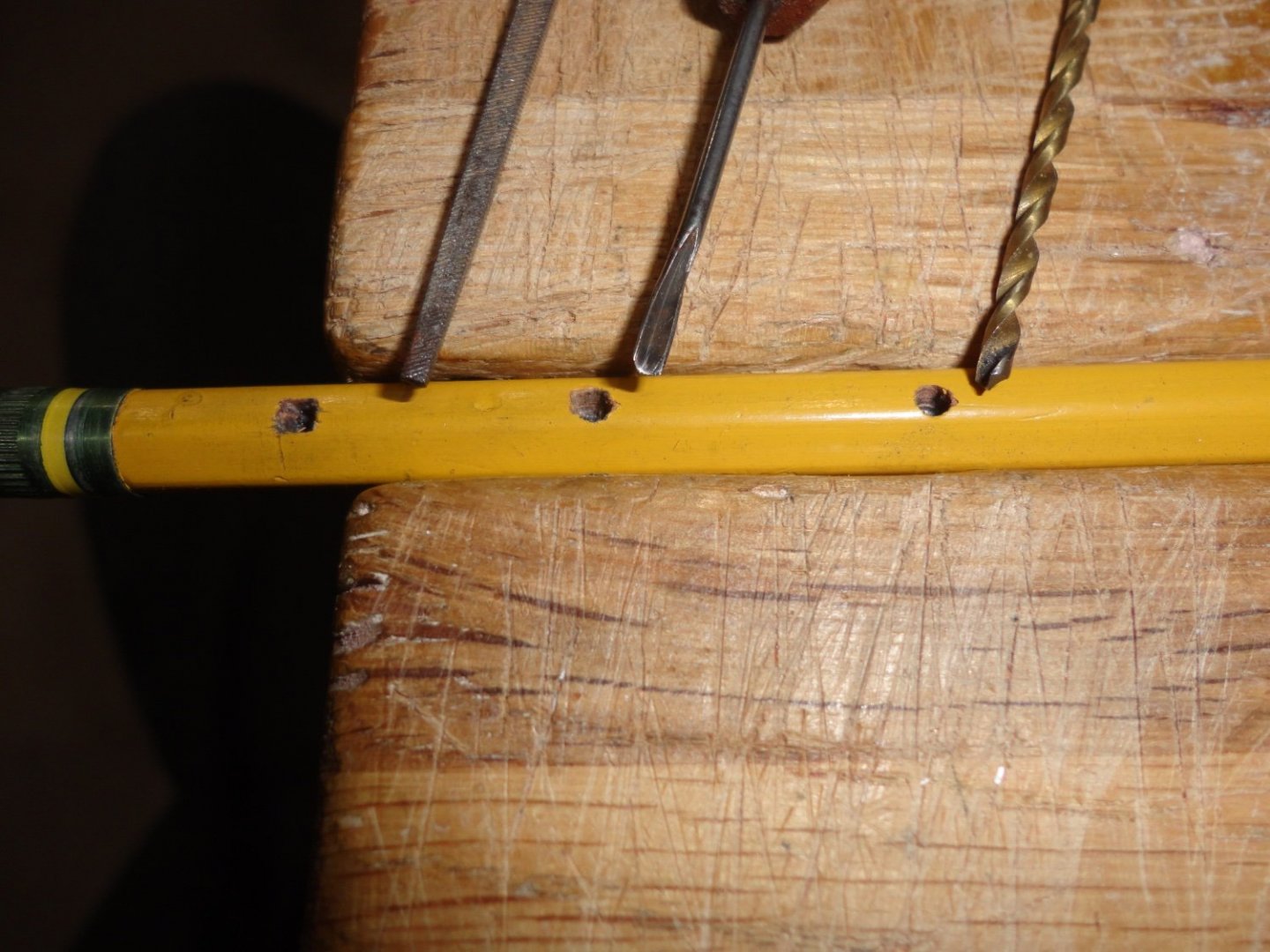
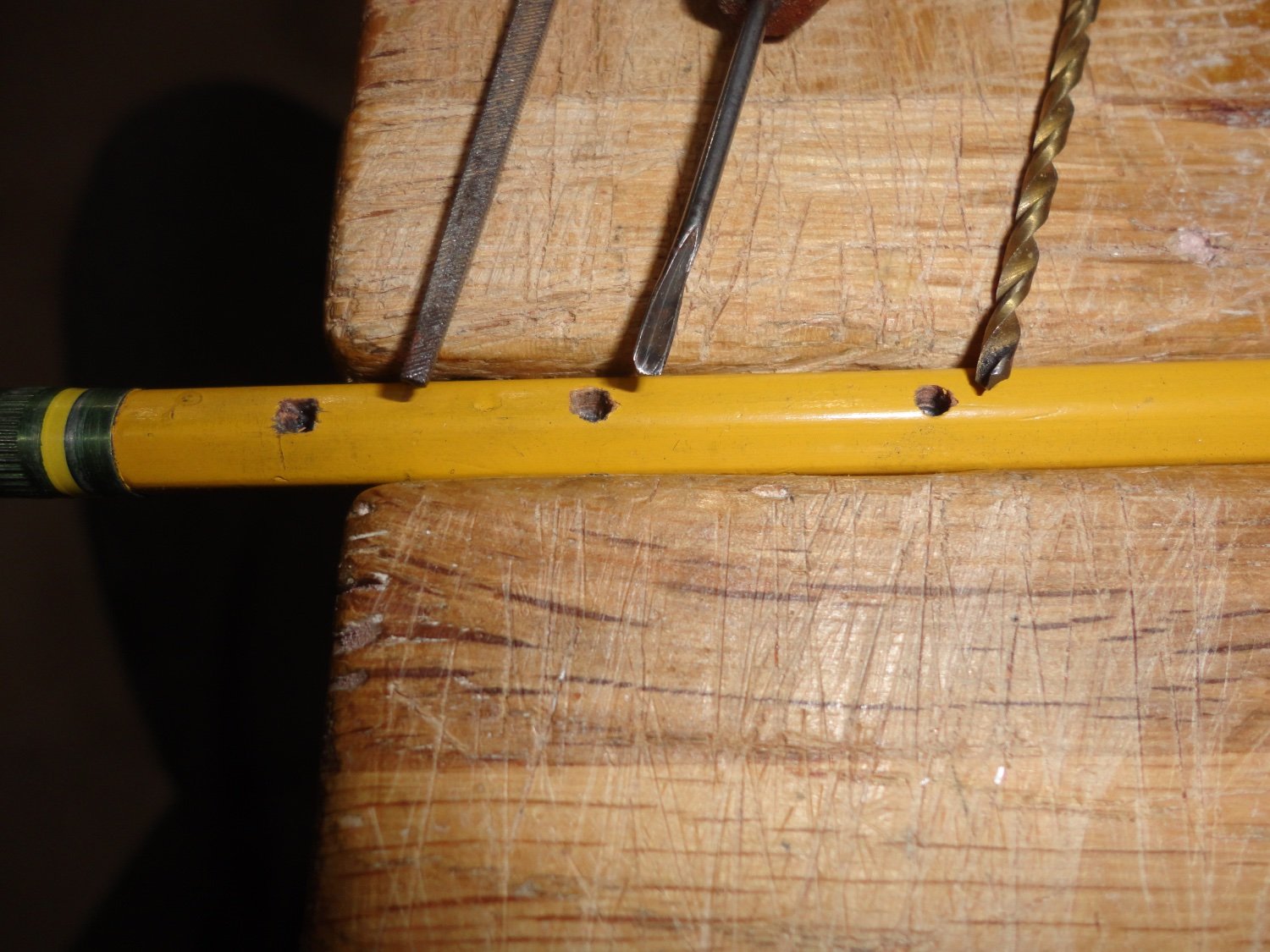
Hi Trond, I'm no photographer but I've attempted to show a test-of-concept. First, don't worry about the mortising tool mentioned - the smallest i think they come is 1/2" square and they are used in furniture making. It was the idea of slicing out a chip from the 'corners' that can make a round hole square. I took a pencil so one can get the idea of relative scale, and drilled three holes with whatever small drill I chanced to come upon (later measured as .085). I did not drill very deep since I soon hit pencil 'lead' (graphite). Obviously, once would not have this problem drilling into a solid wood dowel. The right-hand hole in the pencil was drilled with the drill (shown next to the round hole). The middle hole has just one corner 'nicked' with the mini 'duck carving' tool to square it. The tool does not show the right angle tool as well as I'd like - but the hand-me-down camera is limited in close-ups (as is my skill -or lack of it - in photography). The hole on the left had a chip taken out of all four corners with the 'veiner' (right angle cutter), then I picked at the chips in the hole a little and was able to blow then out with my breath (a blast of 'dust-off' compressed air through the provided extension tube would work just fine for chip removal). There is a tapered square file that I used to 'dress' the corners a little. Now there was a slight enlargement so that verniers showed the square hole to be .100 on each side. Now I've shown proof of concept. If I wanted a smaller square hole, I could always grind down the sides of the veining tool to make it smaller, and there are really TINY files available in sets having a variety of profiles (round, square, triangular) - but one only need used a square file to dress the hole. 'Hope this helps, and as they say 'Once picture is worth a thousand words. Johnny
-
Rob has me sold on furled sails for a couple of reasons, apart from portraying a ship moored for a relatively short while so the crew would not take the sails down. The compactness of furled sails atop the yards requires only a little material folded just-so and dangling 'mouse ears' (aka dog ears). A.) One does not have to worry about all those dangling reefing lines, sail seams and the rope around the perimeter (except for the ears). B.) The furled sails conceal the jackstays, so I won't go to the trouble of making jackstays in scale at 1:96. C.) I can also have them cover-up the buntline blocks (and so omit them, as well as reduce their number .. a sleight of hand to have fewer buntlines to deal with). Any buntlines I use can be glued to the top of the yard before laying the furled sail over with a gammoning line, and rout the buntlines through blocks at the mast then down through fairleads to belaying pins. One can get great ideas from the many fine builds seen on MSW.
- 3,560 replies
-
- 2
-
-
- clipper
- hull model
- (and 2 more)
-
What a treasure to start with! ... and so much tedious work already done for you. With care the repairs can be done and there are several ways to go; stub masts as an 'Admiralty model', first sections of masts with tops and shrouds/ratlines only, fully masted with standing rigging or completely outfitted with sails. A lucky break would be to find an incomplete kit somewhere to use as a trove of masting parts and fittings (and perhaps plans?). You'll find plenty of builds and helpful information on MSW to guide you.
-
I've shore at Burrabogie and I've shore at Toganmain I've shore at Big Willandra and out on the Coleraine But before the shearing was over I longed to get back again Shearing for old Tom Patterson on the One Tree Plain Chorus All among the wool boys all among the wool Keep your wide blades full boys keep your wide blades full I can do a respectable tally myself whenever I like to try And they know me round the backblocks as Flash Jack from Gundagai I've shore at Big Willandra and I've shore at Tilberoo And once I drew my blades boys upon the famed Barcoo At Cowan Downs and Trida as far as Moulamein But I was always glad to get back again to the One Tree Plain I've pinked them with the Wolseleys and I've rushed with B-bows too And shaved them in the grease boys with the grass seeds showing through But I never slummed a pen my lads whatever it might contain When shearing for Old Tom Patterson on the One Tree Plain I've been whaling up the Lachlan and I've dossed on Cooper's Creek And once I rung Cudjingie shed and blued it in a week But when Gabriel blows his trumpet lads I'll catch the morning train And push for Old Tom Patterson's on the One Tree Plain
-
Trond, I think I have an approach to squaring your holes that may work. Mulling over the problem today, I chanced to recall using a mortising drill for furniture making. Yes, it is a way to 'drill' a square hole - in that there is a long square housing with side openings that has a wood auger inside. When used with a drill press on a piece of wood to get a mortice (for a tenon, of course) the auger cuts a round hole and the sharp, square corners of the holder follow and cut square corners. The chips from the round hole come up the flutes of the auger to come out the open sides of the square holder, and the chips sliced out of the corners just come up with everything else. Now there is no such tool small enough for model applications, BUT there are miniature carvers made for bird and duck wood carving. I have such a set I used for old time gun smithing (got them from Woodcraft). One of the is a tiny square 'v' carver. The tools come both straight and with bent ends. The 'v' tool will cut a square corner into the round hole already drilled. One can judge 'by eye' where to make the other three chip cuts to square the other corners, but I suppose they could be marked with a pencil dot for a guide. The tiny chips that come out of the corners can either be blown out or 'winkled' out with a pin (or other implement) - I might try a dental tool.
-
'Love that low-angle plane. Its one of my favorite tools.
-
Some years ago I did see a demo of aluminum-to-aluminim 'solder' at a wood working expo ... a thin rod of aluminum alloy with a melting point a little less than common aluminum for cans or shapes found in hardware stores. It was a no-flux heating of parts to be joined until the solder rod flowed and, to my surprise, the items joined. I bought a small bundle of rods, and they sat around for years. But eventually I had to use one and it worked. I had to heat carefully, because of the danger of MELTING the metal parts. I figure it is actually closer to a 'weld' than a 'solder'.
-
Tools described
Snug Harbor Johnny replied to bruce d's topic in Modeling tools and Workshop Equipment
"I'll do it first." meaning the first chance I get. -
A.) Looking at the images of the work done so far, you only need to modify the planking near the bow. Starting several inches out, draw a pencil line that show the top three planks tapering down to nothing as the line ends up where the top of the third plank from the bottom 'should' be (more or less). Cut carefully along this line with a couple of light cuts using an X-Acto (a flexible steel ruler can be a guide - temporarily taped in place with blue painter's tape as you go). You're only going partway down into the planks, so you can go back and pare the face of the planks with the knife held even with the surface of the planks. This will be a controlled 'whittling' , and you don't have to go down all the way to the first planking either. The lower planks can then be sanded down gradually (surface tapered, actually) until they are thin at the bow. Glue planks with the shape you want over what's left after sanding. Then once the glue is cured, the added material can be sanded until the added wood is 'fair' with what they were glued to. Then you can continue planking with tapered planks up from there. B.) If that seems involved, you can glue strongly tapered planks at the very forward end to produce a triangular 'adjustment' ... a sort of 'fill-in' so you can plank normally up from there. When the model is mounted, the area in question will be very hard to see ... in other words, few people (if any) will notice what is way 'down under'. C.) Ships of this type were likely coppered, so if you take any one of the coppering options (a lot is on the forum about that) the planking underneath can be far from exact due to being subsequently covered.
-
Rubber cement and other 'contact' cements have failed for me over the course of years, so are not recommended for applications meant to last for decades. This is why I take exception to some kits showing the use of contact cements for model building. 'Just saying.
-
I share the same stropping concerns - a reason that 1:96 may be the smallest scale I'd care to work in. Reference Popeye the Sailor's log on the 1:124 Sergal Thermopylae to see how it can be more finicky, and still many components can go 'out of scale'. Louie da Fly is working on an even smaller scale model of Henry Grace a Dieu, which has a build log. Kits at around 1:70 can be more manageable - e.g. many of the OcCre kits. As to our respective 1:96 classic models, Rob has several fine logs of ships based on the Revell Cutty hull. He has used the blocks in the kit - like in the current log of Glory of the Seas, perhaps because many of the blocks were 'internally stropped' by the time of the clippers and had an iron ring on one side. I suppose wood blocks could be stropped with beading wire depending on the configuration needed; e.g. a hook on one end, a hook plus a ring on the other end, double ringed ... I'm no rigging maven, and will have to consult the many sources available. There are posts showing ways of using mini clamps or fly-tying implements to assist in stropping with miniature rope. BTW, I bought a Rope Rocket from Chuck at Syren Ship because I'd like to try spinning my own modeling rope - a vast improvement on most of the rigging thread around. You can also buy scale rope from Syren or Ropes of Scale. Rob is placing furled sails on his Glory, which (per photos of real ships) ... more to follow
- 481 replies
-
- 1
-
-
- Cutty Sark
- Revell
- (and 2 more)
-
The wood deck looks sharp, mate ... really fine. 'Looks like you got the oak option from HisModels - I have a vintage Thermopylae model that I ordered a birch deck for when I get around to building. Hands down, adding a wood deck seems better than trying to paint plastic to look like bare wood. Now some have done well with paints, but ... real wood is real wood. Now, where wood was painted on the original - no problems painting the molded parts. Removing the triangular 'stanchions' was also a good move, as you can replace them with better realism. Wood blocks and deadeyes for full rigging should look great. Fair sailing! Johnny
- 481 replies
-
- 2
-
-
- Cutty Sark
- Revell
- (and 2 more)
-
When picking a kit, one can see if there are builds of that kit already on site. I have an interest in the Oseberg Viking ship, and read two or three builds on the recent Billings kit. I could see every step they builders took, and noted their comments on what they liked or didn't like ... and the solutions they used in each situation. Selected pictures were screen-captured and printed for reference. That gave me a good feel for how I could go about it as a future project - so I ordered the kit to be sure I'll have it when the time comes. And then I'll revisit those builds again, since I'm in the middle of a build myself. I've learned a LOT from other builds (not all complete, but many are far along the way) on my present build, and have made alterations based on the gain of knowledge. Let me tell you, doing something for yourself is a great teacher - and many things can be corrected or otherwise 'done over' as you go. Ultimately, a builder does a project for self-satisfaction regardless of skill level or detail level in the work. It will definitely be a LOT better than any "20 dollar toy" you can find.
-
An answer given me as to deck thickness was 3" ... and I can see that to start with. Now if only 2 thousandths (.002) is abraded with stoning, then 500 applications (500/365 is about 1 1/3 years) would remove about 1" of wood ! That much of a reduction might prompt the need to replace the decking - but they might 'push' it a little further. Let's say that days tied up at harbor might not require deck grinding every single day ... so perhaps the decks were gone over about every other day. Bad weather would preclude the activity in any setting, so let's make that every third day over the long haul. 1 1/3 x 3 is about 4 years by my estimate. So given that some maintenance might be subject to delay, there might have been a 'range' of 3 to 6 years between re-decking ... just an estimate, mind you. Johnny
-
Great drawings, Waldemar. It was obvious to me (in light of your previous comment) that they are of the stern on the 1628 Vasa - as I'm trying to make the 'old' (first edition c. 1970) Billing Wasa (spelling used then for the kit) more like what we know now is the actual ship. The work done in restoration and scholarship in the intervening decades is remarkable. I note the lapstrake exterior planking for the higher portions. A challenge to do at 1:100, I'll cobble what I can for my own satisfaction.
-
I get the need to stone the deck, but didn't know that it was a daily task. The effect would have removed small splinters that might have been forming - to the benefit of barefoot sailors. Yet the process does involve abrasion, and the topmost wood fibers are worn off - reducing the thickness of the plank by a few thousandths. I'm not sure of the starting plank thickness (a good question ... 1 1/2" ? 2"?), but repeated abrasion would inevitably wear them thin enough to compromise their function. So my question is, how often did the decking need to be replaced?
-
Wasn't there more weather deck behind a free-standing forward cabin (apart from the dog runs overhead) and a smaller stern cabin?
-
Ahoy (after time to make all 6 gazebo tops)! Each side has three different sizes per the position they will occupy, and I realize that there has to be a curved roof over the galleries as well. Heavy demand from the hospital I work for as a Pharmacy Tech (due to short staffing) plus an influx of orders for Colonial Re-enactors (from the retailer) force me to sideline modeling for the time being. Yeah, something similar happened last year about this time. Anyway, once the balsa roofs have been carved, fitted and planked with the turrets - I'll take some photos and post. Meanwhile, I just love looking at many of the builds on MSW ... a source of inspiration and helpful tips. All it takes is a bit of searching and patience to find out just about anything about ship modeling. Johnny
-
Hairy/fuzzy rigging thread
Snug Harbor Johnny replied to The Gimps Chimp's topic in Masting, rigging and sails
So what is the RATIO of glue to water that you used? 1:4 1:10 ? This has got to make a big difference as the more concentrated the 'stiffer' it might make the rope. I do like Titebond (or any similar aliphatic resin glue) - especially in Winter (like now) when the relative humidity in our home is VERY dry. Bits of wood I glue with it 'grab' quickly and there is a partial cure in 30 min or so. Letting a blob of glue set on a paint stirrer as I work has some of the water in the glue evaporate to provide a 'thicker' glue even better to use for a 'quick bonding' effect. The same effect can be had if one leaves the top off a glue squeeze bottle for a couple days - then all the glue in that bottle gets more viscous. Putting the top back on stops the process from going buying what is desired. The thinner the glue, the more 'work time' for re-positioning. But if you pieces have been pre fabricated and test fitted already, who needs all that 'open time'? -
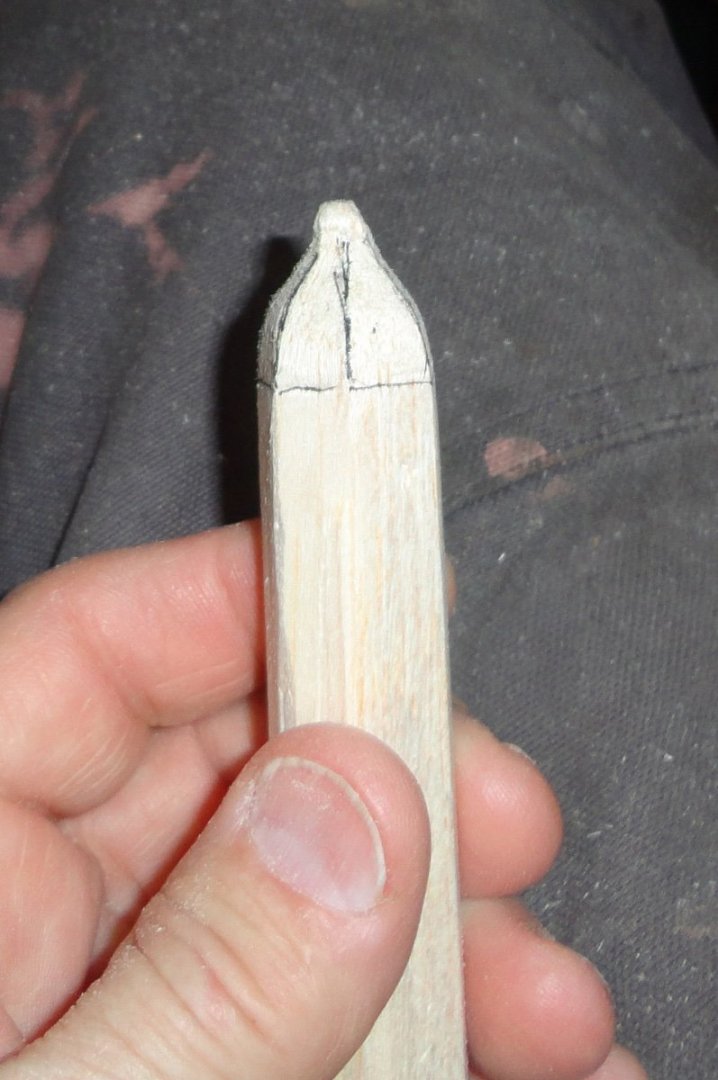
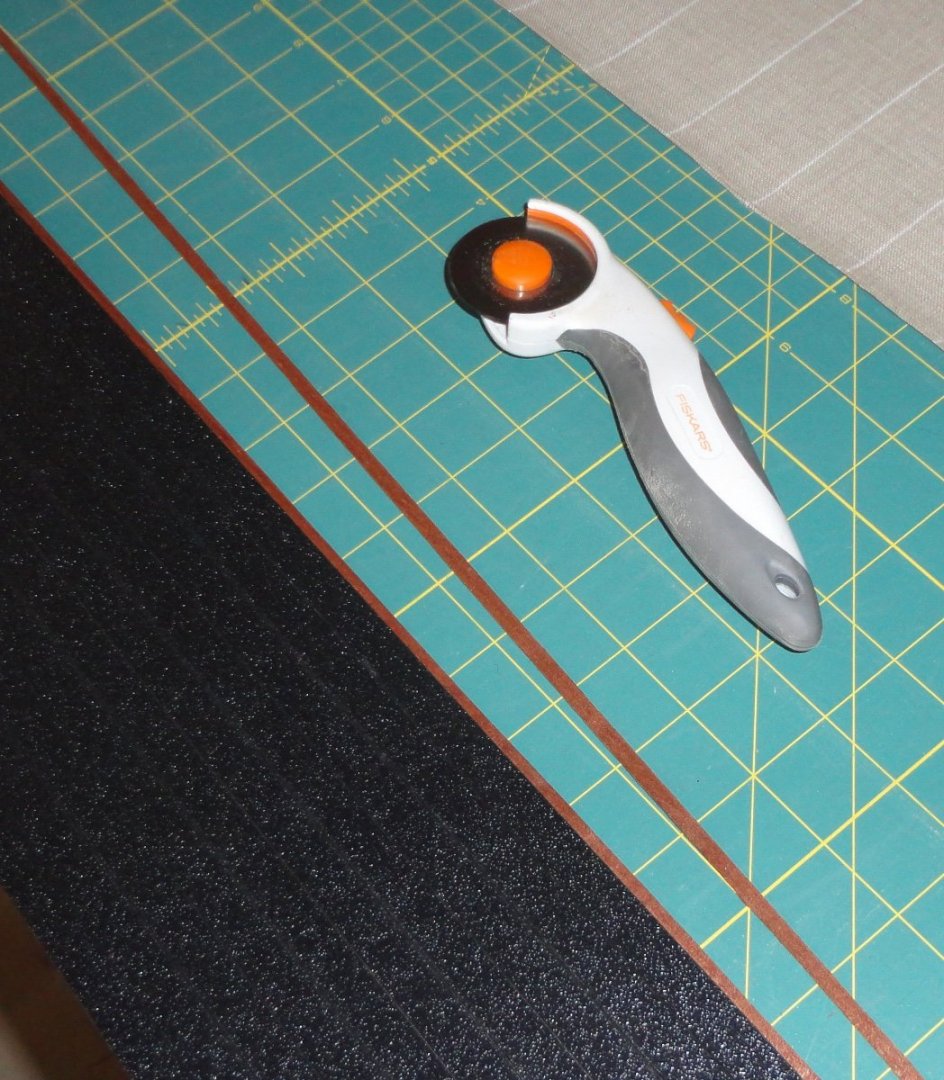
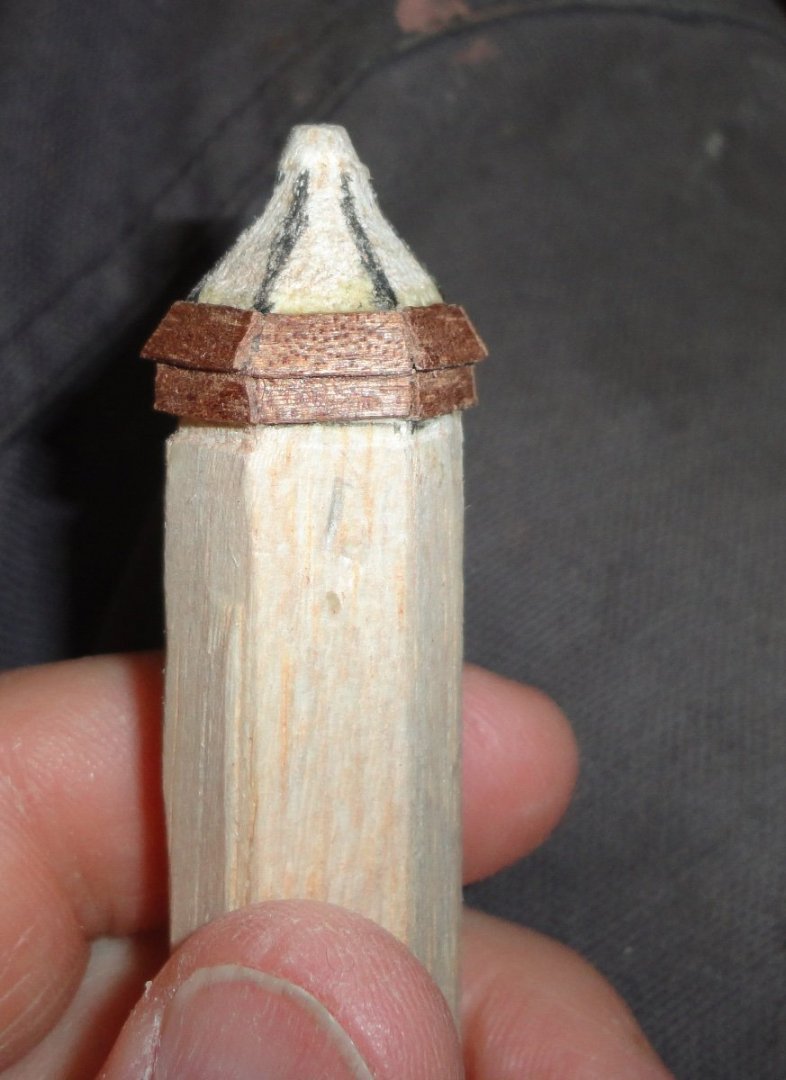
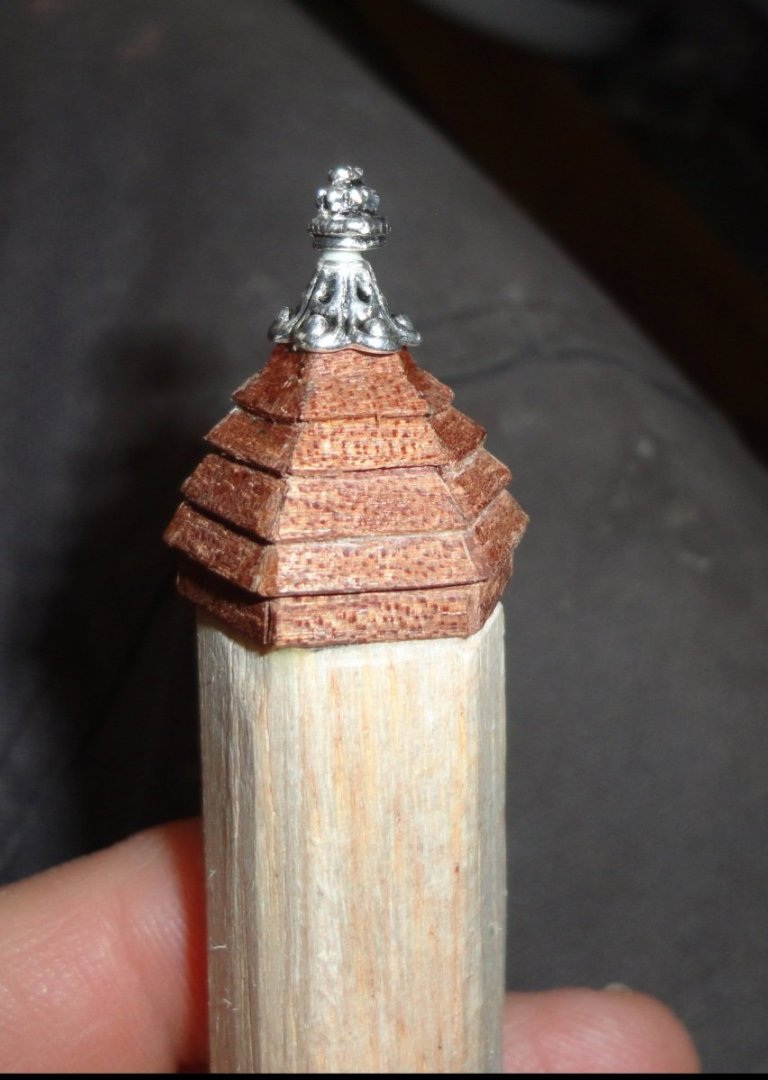
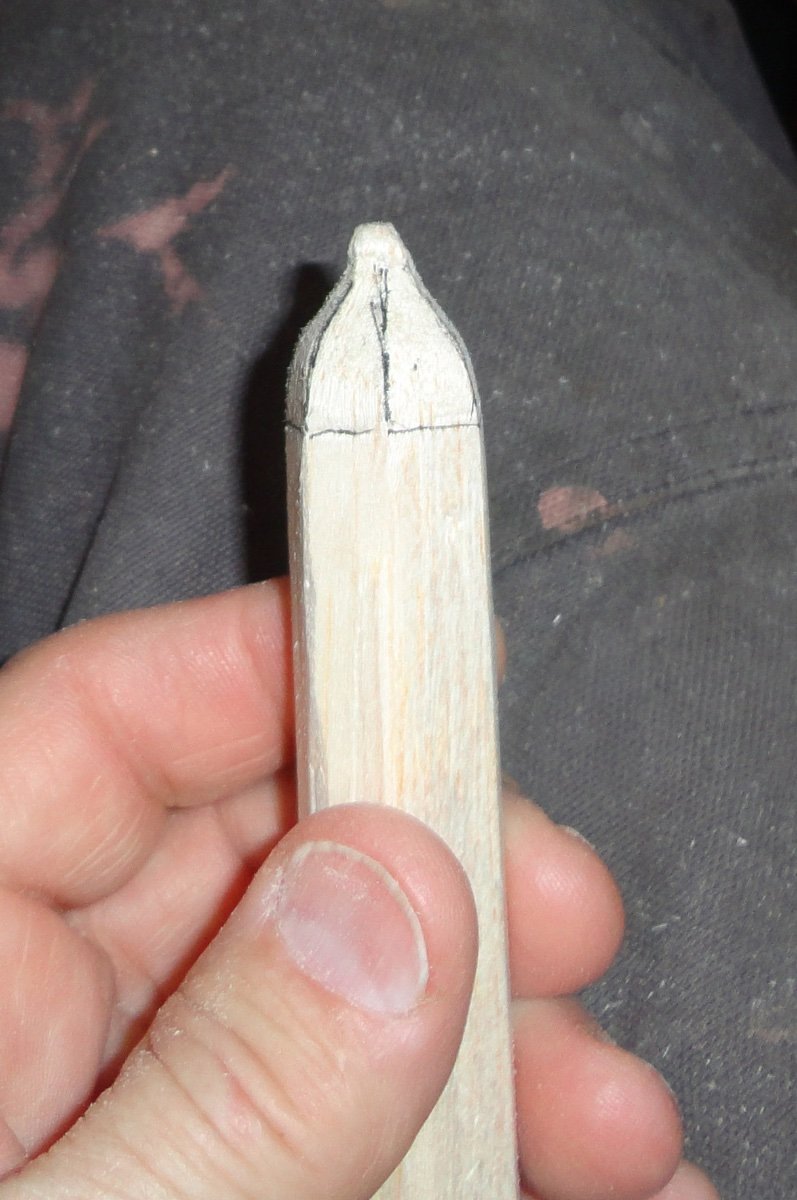
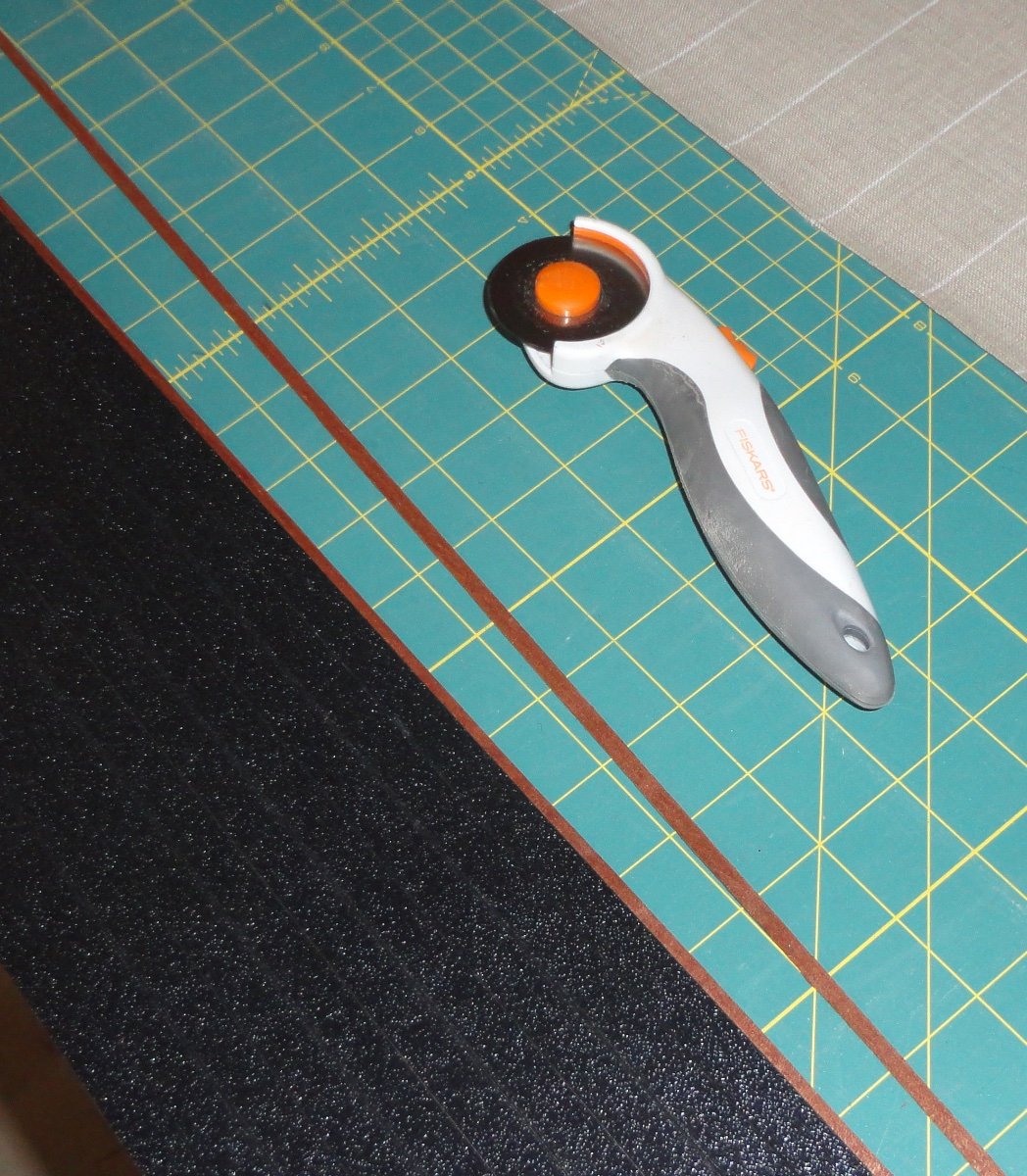
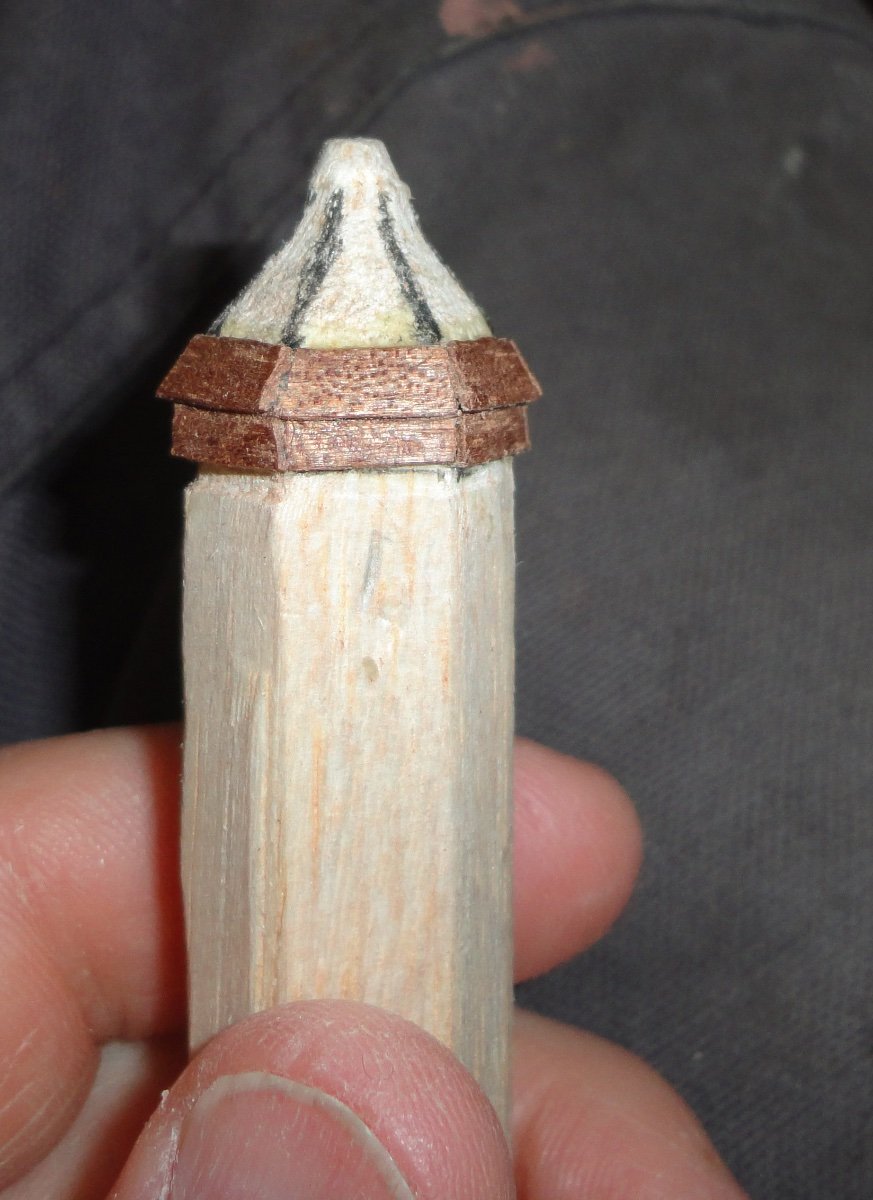
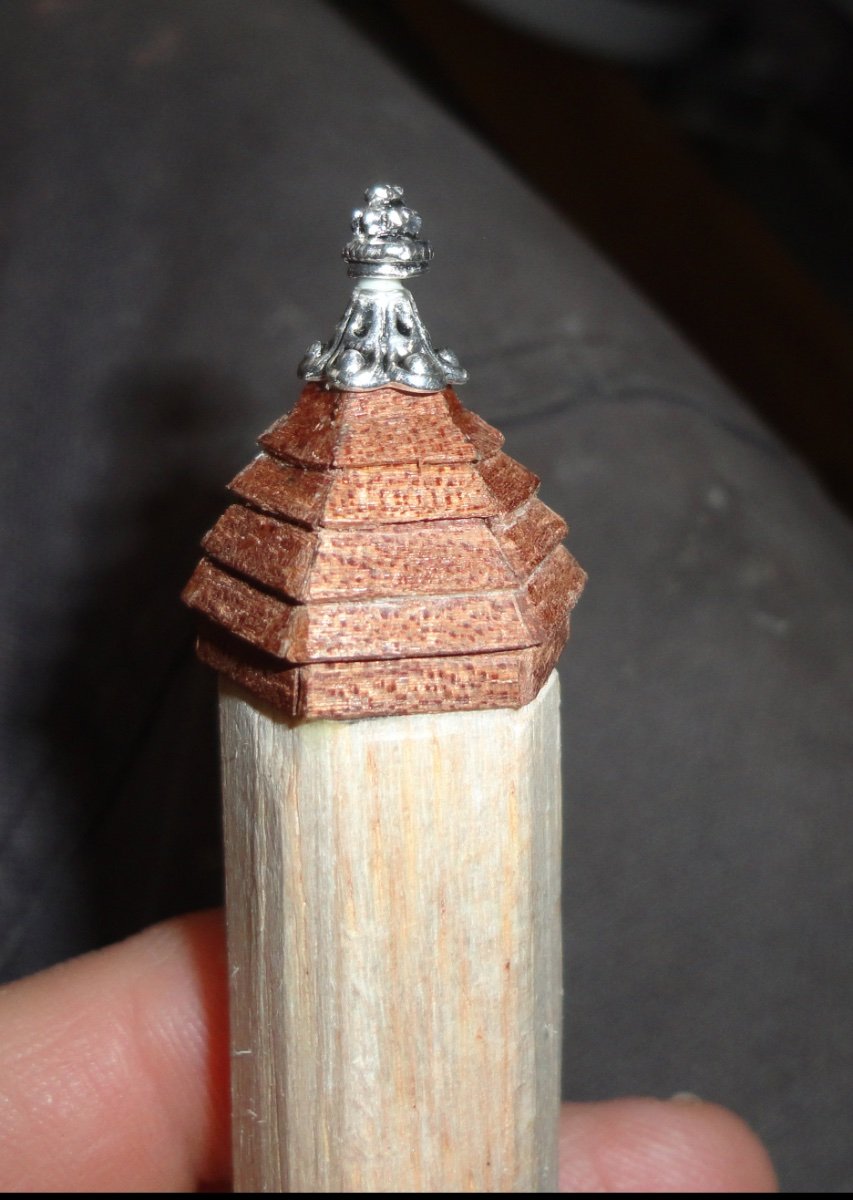
Some thought was given on how to proceed with the cupolas ... Some kits have turned wood to merely glue in place, and some builders have flattened facets on the cylindrical turnings so that shingles can be glued on. I'm trying to 'work smarter - not harder' and took a 3/4 inch piece of balsa stock and used a plane to shape the corners off to make hexagonal stock. Since all the grain is running lengthwise, it was easy to start whittling the end into a hexagon-cupola shape. Of course as one cuts into the stock, the grain becomes more like end-grain - so I used a mini sanding drum on a rotary tool to grind out the 'shoulders'. There first picture shows the stock (easy to hold onto and work on) with the shaped end - I marked the edges to make them easier to see. The illustrations below represent the steps to get from point A to B. No instructions here, so one must plan out each phase as one goes. I cut a thin strip of mahogany veneer to use for shingling the dome on its flat faces. The dry sheet measures 0.027" (nominal 1/32), so can be cut with a rotary cutter on a cutting mat (normally used for fabric. I'll have to change to a new blade before going back to textiles as it had likely been dulled a bit - but it was already overused for the original purpose.) At 1:100 scale it represents 2.7" thick shingles - a bit thick, but that's what I've got to work with. For the 1:75 models, it would correspond to about 1.9" planks - not unreasonable, considering the size of the warship. I did think of a 'colored' wood other than mahogany and walnut that is easy to find in the U.S. - heartwood poplar, which is light brown and oxidizes to medium brown over time. One could cut planking boards off the edge of poplar planks found where lumber is sold - once the light colored sapwood is trimmed. The lighter wood can be used for decking. Photo 2 shows the rotary cutter. Photo three shows the first two layers of shingles glued on with ordinary wood glue. I find that aliphatic resin glue 'holds' fairly quickly, but still has plenty of time to re-position or adjust parts being glued. The shingle stock (strip) is held up to the work piece and marked with a pencil for each piece. The part is cut off with an X-Acto knife and glued. After each time around, I let some time go by (what, 30 minutes) so the hold is firm enough to lightly file or trim. Curing takes longer, but I don't have to wait that long. Once I got the 'hang of it', I started cutting the shingles by angling the blade a little to get sort-of mitered corners. Now for the very tops, I found jewelry fittings at a local craft store - a 'bead cone' to glue on first, and a decorative 'head pin' to simply stick into the top. The pin was not hard to push into the end-grain of the balsa underneath, but a drop of glue was an added precaution. The cupola can be sawed off the stock with a fine saw - then a new cupola can be built. I have to make 5 more, and each will turn out a little different. Each will be tried on various places on the model to see what looks best. There can be further trimming to suit, and I still have to make the planked roof sections that go between the turrets. I'm definitely influenced by my late father, who started with model ships but switched to aircraft. He was really big on flying RC models - which were powered by gas engines years ago (now battery powered motor are the thing due to noise and pollution regulations). I picked a couple of small models from his belongings (my brother got the only remaining ship), and his craftsmanship shows. He had more skill than I, yet persistence and a relatively steady hand can still produce acceptable results in many applications.

-
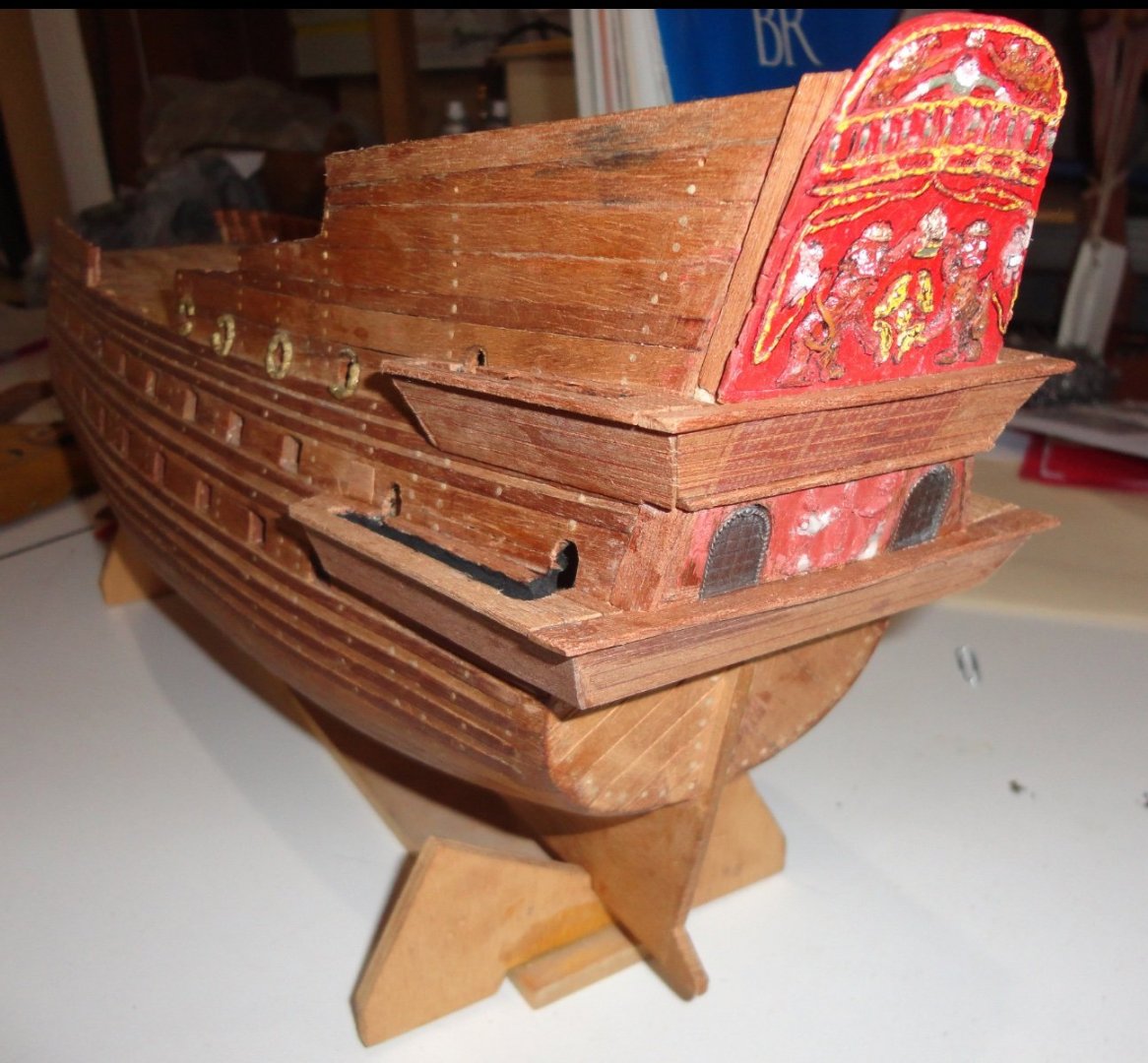
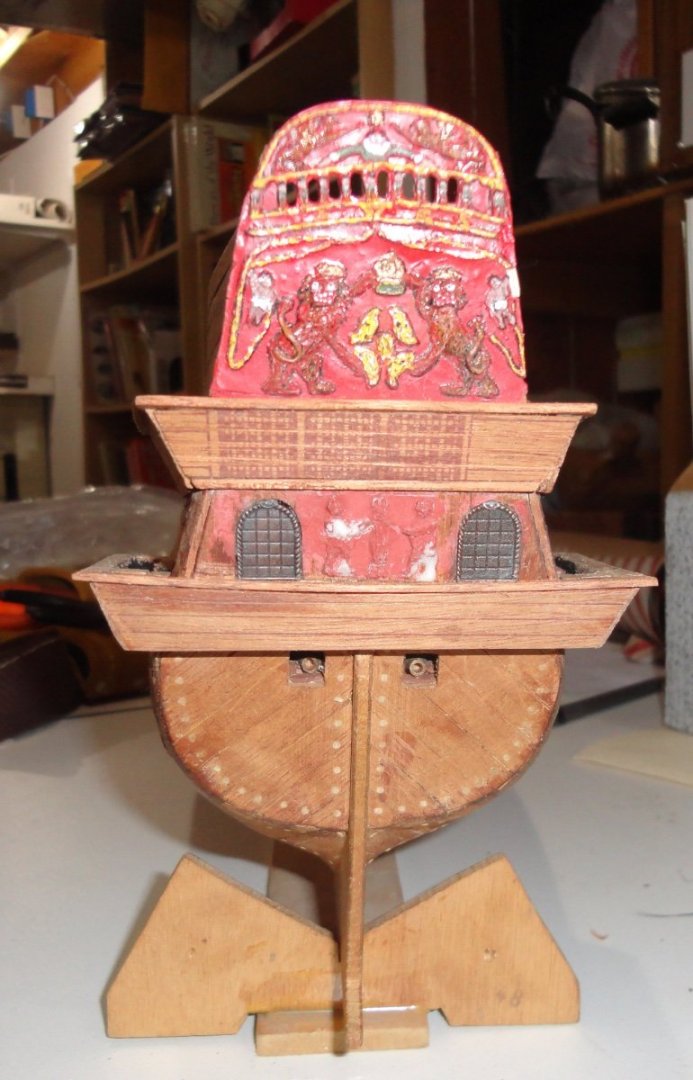
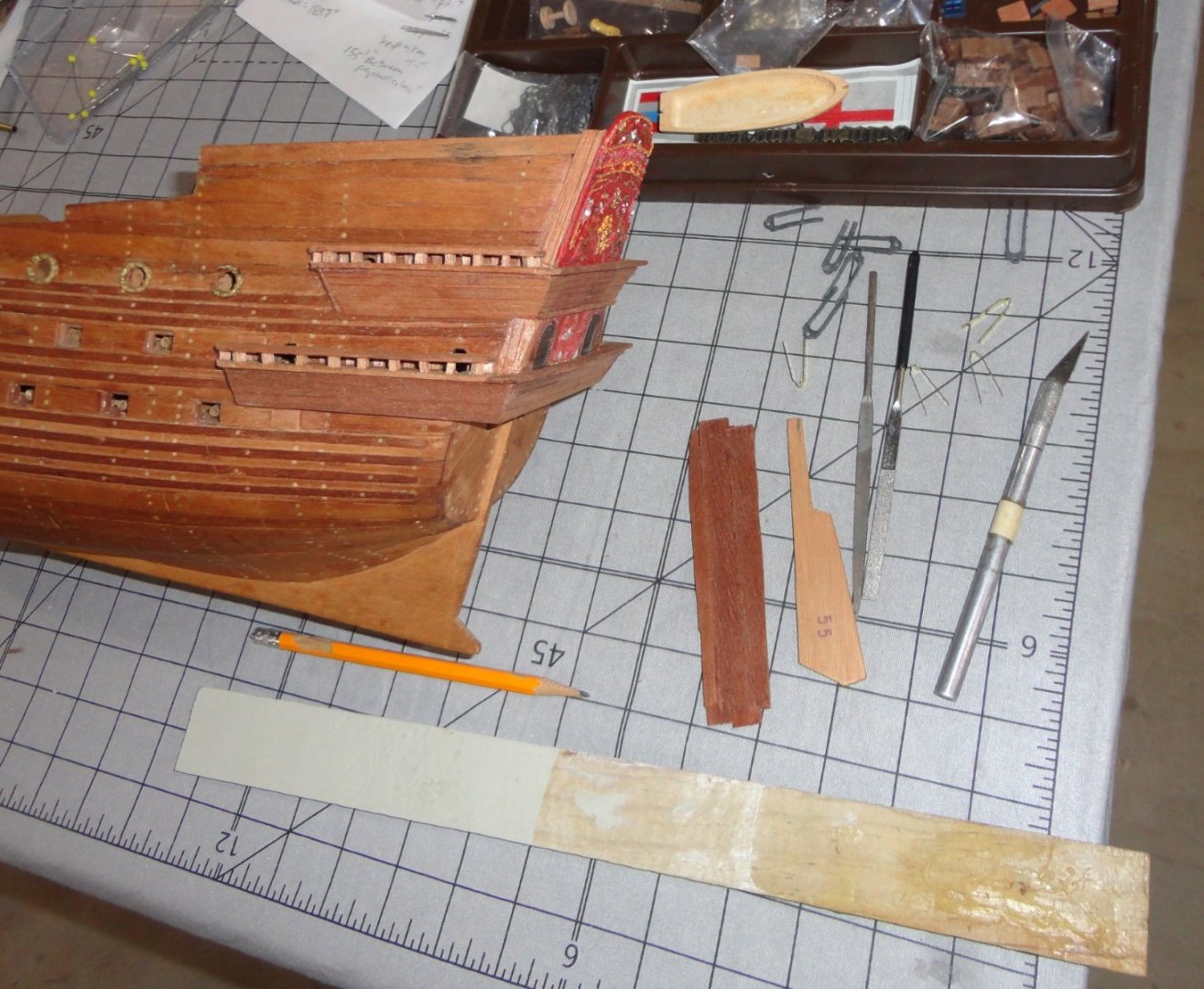
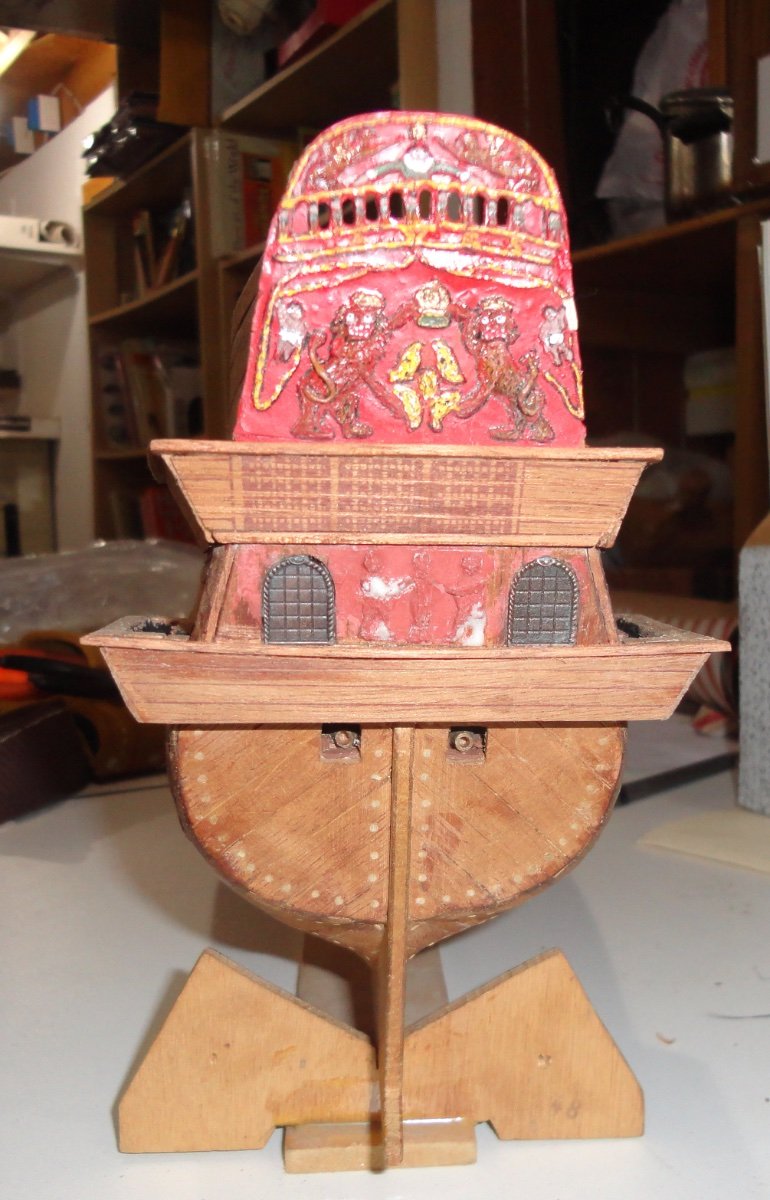
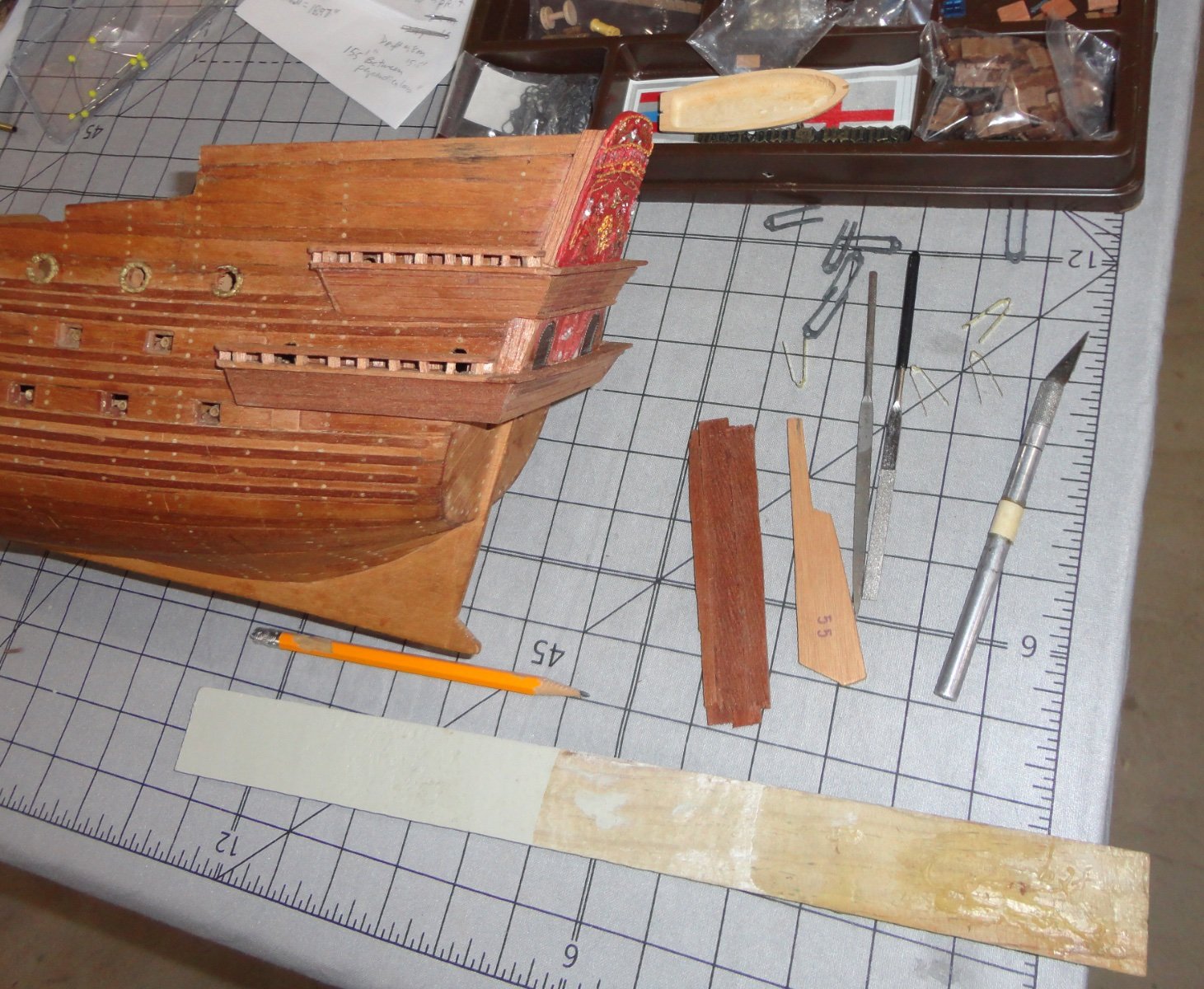
The lower galleries are now planked like the uppers - two access doors were drilled, but are note likely to be seen once the gallery covers and copulas are added. The second photo show that I was able to add some upward curve when seen from astern (didn't think of that on the uppers). As noted before, the job is to come 'closer' to the original, but there will be unavoidable inaccuracies due to the limitations imposed by the circa 1970 kit in 1:100 scale. Yeah, the stern geometry is off - and there will be missing elements, but it should be identifiable as the Vasa. Some pre-painting will be done soon before the gallery covers are fabricated. The third photo shows the installed viewing openings that will serve as a base for the gallery tops. The kit rudder (marked as part #55) is of plywood, so I glued some mahogany strips together and will cut a new rudder. There is a box of fittings from another kit that I've picked some hinges for the rudder. The paint stirrer is used to mix epoxy on (when used), or to hold a blob of titebond glue that is then applied with a small stick. Otherwise, a finger dab of glue can be put on some of the pieces. Fair sailing !




Our Emblem ®
