


amateur
-
Posts
3,534 -
Joined
-
Last visited
Content Type
Profiles
Forums
Gallery
Events
Everything posted by amateur
-
I know it is difficult (and I don't know how much spare you have), but my advice would be: start over. Jan
-
Hi John, to me it is not clear that you removed to much material. To me it looks as if youtend to force your planks into the oosition you want them to be, but where they don't want to go. Forcing your planks results in a kind of 'stepped' appearance of tour bow, as the underside of the planks will tend to bend outward. When you take a strip and lay it at 90 degrees over the planks you did so far, the strip should lay flat over the planks. As soon as you see small triangular openings, you know you are forcing too much. Antother check: pin your next plank on the two midship framse, an let the plank decide where it wants to go. If it does not go nextto the previous, but runs over the previous plank, you have an indication that you are forcing too much. In that case, to have a nice run of you planks, you should either use drop planks (planks that do not reach the bow), or side bend your planks. However, It is hardly ever possible to sidebend your planks, unless you have rather flexible, good quality wood. European kits quite often have rather thick, open grained, not so flexible stuff.... There is a very nice planking tutorial somewhere here on MSW. I lost the link, but you should be able to find it. Jan
-
Definitely not a model to display in your living (unless your living appears to be in something likethe White House) For what purpose was it started (and where will it end up after you are finished? Not a warehouse agin, I hope) Jan
- 11 replies
-
- 2
-

-
- president cleveland
- ocean liner
- (and 1 more)
-
I thought I was theonly one going crazy, but apparently not. The sooner we go back to normal, the better, as far as I'm concerned. The officeis for work, the home for building and messing around. Mixing those up, isnot a good strategy. (Atleast: not for me) Jan
-
Never seen that one before. Looks a nice model. Jan
- 4 replies
-
- 1
-
-
- vasa
- cross-section
- (and 2 more)
-
Hi Dan, thanks for showing your last model. Wish you strength for the time that comes. Jan
- 29 replies
-
- 5
-
-
- hmw
- Hamburg Harbor
- (and 2 more)
-
New Young Model Builder from Minnesota LOOKING FOR ADVICE
amateur replied to Kenna's topic in New member Introductions
Apart from all that has been said above: You may want to take an other course for another reason: the plans from the (at least European) kits are hardly ever based on real drawings (especially the older shiptypes). And as they were made for static display-models, no one ever bothered about proper lines, stability, proper dimensions of the rig compared to the hull. As long as it looks right, it is right So, perhaps you should start with drawings that are based on contemporary drawings of real ships, or on a drawing that has been mede especially for the 'sailing business': I know that for reasons of stability, it vcan be worthwhile to change the underwaterpart of your model, or add a keel of rather oversized dimension, just to prevent 'vasa-like' situatiuons at her maiden trip. That brings me to a question (no experience in this line of business, but just wondering): Ik know a guy in a german forum turning out rather small models (scale around 1:40), which he can sail by RC. Mostly models of schooner-rigged type (as he states those are easier to sail, and therefore more fun). My point is: he needs quite an amount of lead into these models to get them stable sailing. (I rember something like 2 kilo's on a 1.5 ft long model), When you aim for 6 foot, all dimensions go by a factor 4. What does that do to the amount of lead you need on your keel (or how long does your external keel need to be, and how is sailability in not so deep water with such a lenghty keel?). Jan -
Hi Alex, Nice work so far! Do you know the book by Heinrich Winter 'Hollandische Zweidecker 1660/1670'? He gives quite a lot of pictures of a model of a Dutch two-decker. Dik has used the drawings from that book as a starting point for his recreation of the Zeven Provincien, and Mamoli clearly used the book as primary inspiration for the Friesland. The pics in the book may be helpful when it comes to the detailing of the decks. Jan
-
Hi Marc, making masts and spars from wooden dowels can also be done by hand. gives you far more control on the resulting profile than using a machine. There are quite a few threads in the 'wooden' buildlogs showing you the prces to get from square to octagonal to round. I don't know how that was done in French ships, but for dutch ships of that period, the taper of masts and spars was not a 'straight' one: in profile, the masts and spars were kind of rounded, the thickest part not being at the bottom. starting with a square dowel and doing the rounding by hand does give you the possibility to scribe the profile exactly on the wood, and make sure that it fits the regulations. Jan
- 2,699 replies
-
- 5
-
-
- heller
- soleil royal
- (and 9 more)
-
And ofcourse: my last like also includes the paintings between this and my previous like Jan
-
Is running rigging smaller in diameter than standing?
amateur replied to Matt H's topic in Masting, rigging and sails
Ah well, three ships that are certainly not covered by the books you mention..... I don't know anything on greek ships, I know that in Denmark there is a rather large literature on those drakar-like ships. Google on 'skuldelev' and you will find loads of pictures of the reconstructed vikingships. Pics give a rather nice view of the rigging and detailing of the ships. Jan -
Is running rigging smaller in diameter than standing?
amateur replied to Matt H's topic in Masting, rigging and sails
Hi Matt, as a very crude rule of thunb: yes. in practice: depends. I don’t know what model you are working on, but take a 17 century dutch ship: the diameters of all ropes are related to the size of the ship in a rathe complexsystem: the standing rigging relates to the size of the mast: the standing rigging of the mizzen is much thinner than on the main. Also: the standing rigging of the topmast is thinner than the lower mast. The same holds to the running rigging: the larger the sail the thicker the ropes. So: on each part of the mast the standing is thicker than the running, but the running rigging on the lower masts is way thicker than the standing rigging on the topmasts. Besides: the thickness of the running rigging varies: the lifts are relatively thin, the sheets almost as heavy as the standing rigging. following the formal rules, my Prins Willem shoukd have around 20 different ropesizes. Using around 8 sizes did result in a visually acceptable result. Jan -
Did you see Joseph Lavender's models? That is some amazing micro-scale. Gregs models are huge compared to his. No Varyag, however. Jan
-
What a ship! I like those early battleships, especially after the special treatment you give them. (one question: did you use light grey/white thread for the rigging, or is it shiny as a result of the flashlight?). On the pics it looks so clean compared to al the dirt and rust..... Jan
-
The 'real' Batavia has its wales natural. Black can be quite heavy lookin. I prefer natural. Jan
- 136 replies
-
- 2
-
-
- kolderstok
- batavia
- (and 1 more)
-
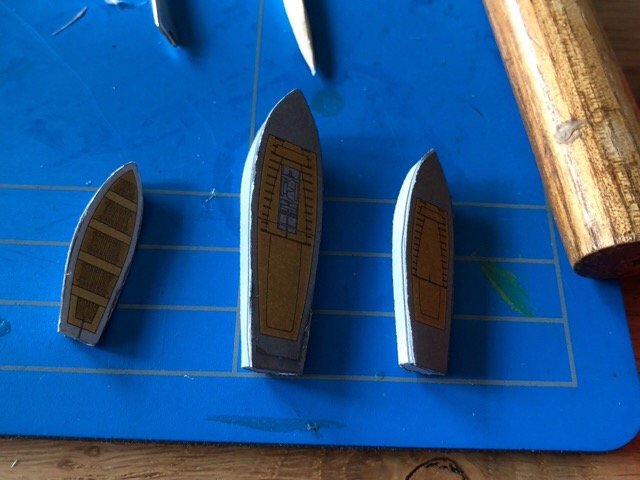
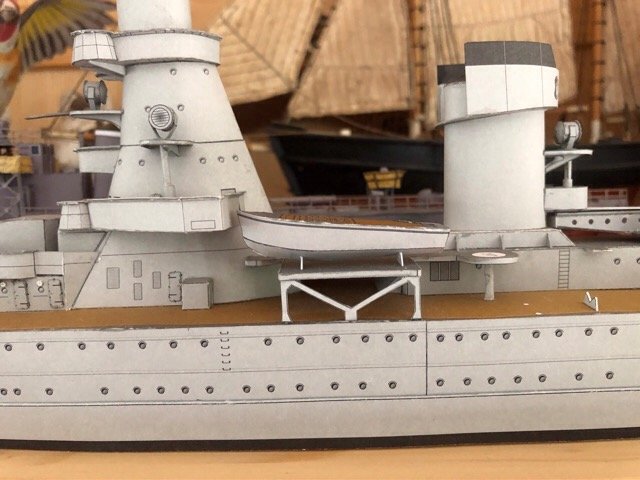
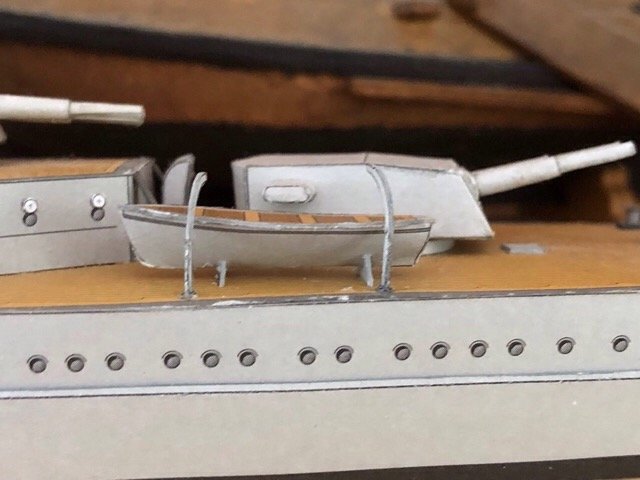
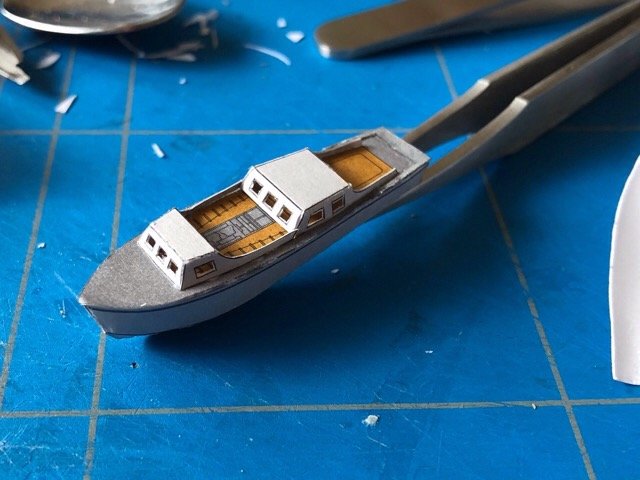
The ships boats were something of a battle. There is no real instruction, so it is totally unclear whether the topside should go inside the hull, or on top of it. Either way: it wouldn't fit nicely. The topside of the large boat was around 2 mm short, and put together, it does not sit properly on its stands.... Here is the result of a couple of hours. Bit frustrating small remark: part of the boats were also in the lasercut-set. However, there the same (and some other) issues arose. the lasercut (although sold to me together with the model itself) does not fit to the DeRuyter in grey. It is specifically designed on the other version: the one in 'dazzle'-paint. In the macro-pics you can see one of the issues with the scaldis-models: when handled, the toplayer comes loose, resulting edges to loose their crispness. you can see it on the edges of the boats: they become a bit 'fuzzy' Jan
-
Hi Kees, Good to see you again, I missed your updates! The ship is coming together nicely. How did you do those navigation lights? They look as if you just made them from real sheet metal. Jan
- 193 replies
-
- 2
-
-
- wilhelmina vii
- fishing
- (and 1 more)
-
Citroen Traction Avant by kpnuts - FINISHED - Heller - 1/8
amateur replied to kpnuts's topic in Non-ship/categorised builds
Now I am at a loss: what colour did the car have when leaving the factory: was it white, or black?? Jan -
Ithough ships and maple syrup were your lines of business, but yourrailroad is also ofhigh quality! Jan
-
Yes, those are clamps to hold the pins. Jan
-
This kit was (loosely) based on a model in the Rotterdam Maritime museum, https://www.maritiemdigitaal.nl/index.cfm?event=search.getdetail&id=100009961 (it is a shame that there are no high-resolution pics in this database) and I guess some basic drawings dating back from the sixties. Lots of knowledge on fluits has build up since then, mainly due to the archeology, and better access to the archives. So, when the kit diverges from the archeology, I would tend to follow archeology. The winch is rubbish: the sides should be smaller, and if there are thoseextensions, they should be forwardfacing: thta is the direction in which they should withstand some force. In some of the smaller wrecks, the whinch is going from side to side. I have also seen drawings (don't know where) with the heavy sides that enclose the winch. As far as I know, the winch should be from one piece: no way to attach two parts in such a way that the thing does not break when force is applied. In more modern fishingboats, (botters) as far as I know there are three types: round, octagonal, or round with some strips attached. The last two, to create aditional friction onto the cable. there should be square holes in it, to get the lever in. Jan
-
West-frisian is a bit confusing terminology: in the Netherlands it refers to the northern part of North-holland, in Germany it ofter refers to anything west of their region Ost-friesland (wich is essentially the dutch provinces Groningen and Friesland). It is not correct to say that the Dutch ended the political independence of west-friesland when you refer to the dutch region west-friesland. The word 'dutch' did not come into existence after the napoleontic era. Before that the netherlands consisted of a political union of various regions, holland being the most important. The political freedom of the kingdom of frisia ended in 1300. The region around Hoorn.Schermer (the waling area) was part of Holland ever since the early middleages (the period were the zuijderzee became increasingly large). So if Frisian was ever the main language around Hoorn, it would have been around 1300, not around 1700. Around 1700 Dutch (which is essentially the dominant dialect spoken in holland) was standard in the western parts of the republic of the netherlands. The Frisian admirality operated from Harlingen (east side of the zuiderzee), and was a small admirality. The Frisian traders operated from Harlingen and Stavoren, and were mainly in the Baltic trade (wood and wheat) Whalers came from Holland, and not from Frisia. Whaling industry was located in Holland, not in Frisia. Jan
-
Could you please post a picture. I have some problem in getting the picture, and am afraid to advise you in the wrong way. Jan
-
In that case I understand why it is on indefinite hold. I didn't realize David sells preprinted kits, I only knew the free pdf-downloads. Jan
- 10 replies
-
- 2
-
-
- paper shipwright
- canada
- (and 1 more)
-
Actually, I didn't check that. Stern is the german translation I learned for the dutch wordt ster..... I never heard noorden ster. Noordster and poolster are quite common. I am not familiar with Frisian ( which is not a dialect, but a different language). Dutch whalers came from the region north-holland (schermer/de rijp). Poolsterre would be the name to use. @robert Lamba: where do you come from that you are familiar various dutch dialects, as well as flemish? Jan
Our Emblem ®
